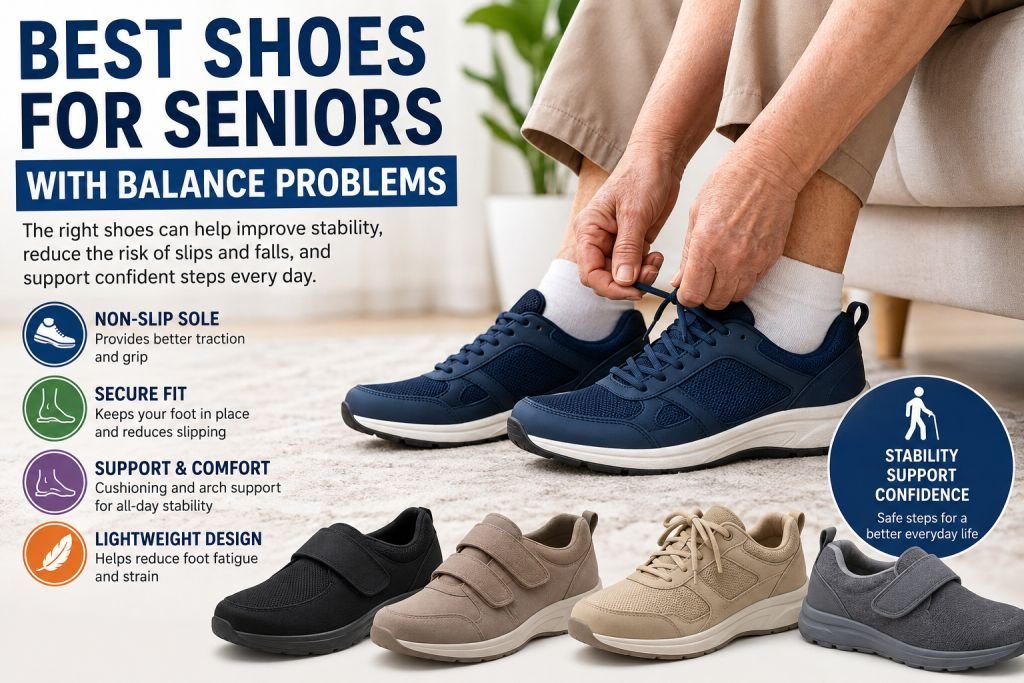
Finding the best shoes for seniors with balance problems is about more than comfort or appearance. The right pair can provide a steadier connection with the ground, help keep the foot securely inside the shoe, and make everyday walking feel more confident.
For an older adult who occasionally feels unsteady, small details can matter. A loose heel, slippery sole, narrow toe box, worn-out tread, or overly soft shoe may make walking more difficult. On the other hand, a properly fitted shoe with good traction, a stable heel, and adequate support can be a much better choice for everyday activities.
This is especially important because balance can change with age for many different reasons. Vision changes, muscle weakness, inner-ear problems, medications, foot conditions, and other health issues can all affect steadiness. The National Institute on Aging notes that balance problems can contribute to falls and recommends discussing recurring dizziness, unsteadiness, or falls with a healthcare professional.
That does not mean a particular shoe can prevent every fall. It cannot. Shoes are only one part of fall prevention.
Still, choosing footwear carefully is a practical step that many people can take every day.
In this guide, we’ll look at what makes a shoe safer for someone with balance concerns, what features to look for, which styles may be less suitable, how to check the fit, and what to do if balance problems continue even after changing shoes.
Why This Topic Matters
A pair of shoes may seem like a simple purchase, but your feet interact with the ground thousands of times during a normal day.
Every step requires your body to process information about pressure, movement, and position. Your feet, ankles, legs, eyes, inner ear, and brain all work together to help you remain upright.
As people get older, some of these systems may change.
The National Institute on Aging explains that balance involves several body systems, including vision, the vestibular system, and other sensory and motor functions. Changes in these systems can contribute to unsteadiness and falls.
Footwear can also play a role.
The CDC’s STEADI guidance for older adults recommends properly fitted, sturdy shoes with low heels, traction, and strong arch and heel support. It also identifies features such as a firm heel collar, textured sole, broad heel, and secure fastening as characteristics of safer footwear.
So when you’re shopping for shoes for an older parent, spouse, grandparent, or yourself, don’t focus only on cushioning or brand names.
Think about stability, fit, traction, and how securely the shoe stays on the foot.
What Are the Best Shoes for Seniors With Balance Problems?
There is no single shoe that is best for every senior.
The ideal shoe depends on foot shape, walking ability, activity level, existing foot problems, and the reason someone has balance difficulties.
However, several characteristics are generally worth looking for.
1. A Wide and Stable Base
A shoe with a reasonably broad sole can provide a stable platform underneath the foot.
This does not mean choosing the widest or bulkiest shoe available. The shoe should still match the person’s actual foot shape.
A stable base is especially useful for walking on ordinary household and outdoor surfaces where the foot needs a predictable connection with the ground.
2. Good Traction
Look closely at the outsole.
A treaded, nonslip outsole is generally preferable to a smooth sole. The CDC specifically recommends textured soles and traction for older adults.
This is particularly important when walking across:
- Tile
- Hardwood floors
- Concrete
- Wet sidewalks
- Grocery-store floors
- Outdoor paths
- Slightly uneven surfaces
Keep in mind that no shoe can make every surface completely safe. Wet, icy, oily, or highly polished surfaces can still be hazardous.
3. A Secure Heel
The heel should stay inside the shoe when walking.
A shoe that slips up and down with every step can make walking feel unstable and may increase the chance of catching the foot.
The CDC’s footwear guidance recommends a firm heel collar for stability.
When trying on shoes, walk around for several minutes rather than simply standing in them.
4. Low Heel Height
High heels generally aren’t a good choice for someone who already has balance concerns.
The National Institute on Aging recommends avoiding high heels and choosing nonskid, rubber-soled, low-heeled shoes for people dealing with balance problems.
A low, stable heel can make it easier to maintain a comfortable walking position.
5. A Secure Closure
Shoes that can be securely fastened are often preferable to loose slip-ons.
Depending on hand strength and dexterity, this could mean:
- Traditional laces
- Elastic laces
- Hook-and-loop straps
- Adjustable closures
The important thing is that the shoe stays securely on the foot.
If someone has arthritis or limited hand movement, a shoe with an easy-to-use adjustable closure may be more practical than traditional laces.
6. Enough Room for the Toes
Your toes should not be squeezed together.
Older adults may experience changes in foot shape over time. The American Geriatrics Society notes that feet can become wider and longer with age and that poorly fitting shoes can contribute to foot problems and falls.
A comfortable toe box should allow the toes to move naturally without rubbing against the sides or front of the shoe.
7. A Firm, Supportive Construction
Extremely soft footwear can feel comfortable at first but may not provide the stability some people need.
The CDC recommends sturdy footwear and identifies a thin, firm midsole as one feature of safer footwear.
This doesn’t mean shoes must feel hard.
Instead, look for a balance between comfort and structure.
What Features Should You Look for in Shoes for Balance Problems?
When comparing several pairs, use this simple checklist.
| Shoe Feature | What to Look For | Why It Matters |
|---|---|---|
| Sole | Textured, good traction | Helps provide grip |
| Heel | Low and stable | Supports a steady walking position |
| Heel collar | Firm and secure | Helps prevent heel movement |
| Toe box | Roomy but not loose | Allows natural toe movement |
| Closure | Laces or adjustable strap | Keeps shoe securely attached |
| Midsole | Supportive and reasonably firm | Provides stability |
| Arch support | Comfortable and appropriate | Supports the foot without excessive pressure |
| Weight | Manageable | Easier for everyday walking |
| Fit | Snug without squeezing | Reduces movement inside the shoe |
| Outsole condition | Good tread | Worn soles may provide less traction |
The goal isn’t to find a shoe with every possible feature.
The goal is to find a shoe that fits the individual foot and provides a stable, secure walking experience.
Are Walking Shoes Good for Seniors With Balance Problems?
For many people, a properly fitted walking shoe can be a practical everyday option.
Walking shoes are often designed with a stable outsole, supportive upper, and cushioning suitable for regular walking.
However, don’t assume that every walking shoe is appropriate simply because it is labeled a “walking shoe.”
Check the actual construction.
A lightweight shoe with a flexible sole may work well for one person but feel unstable to another. Someone with significant balance impairment may need a more structured design.
If you’re unsure, take the shoes to a physical therapist, podiatrist, or other qualified healthcare professional who can evaluate the person’s walking pattern and foot needs.
Are Athletic Shoes Good for Seniors With Balance Problems?
Athletic shoes can be a good option when they fit properly and provide appropriate traction and stability.
They are especially useful for people who walk regularly or participate in exercise programs.
The National Institute on Aging recommends shoes that fit well, provide appropriate support, have nonskid soles, leave enough room for the toes, and provide appropriate heel and arch support.
But again, the label matters less than the construction.
An athletic shoe that is extremely soft, unstable, worn out, or too loose may not be the best choice.
What About Slip-On Shoes?
Slip-on shoes can be convenient, especially for someone who has difficulty bending down or tying laces.
But convenience should not come at the expense of security.
A loose slip-on can allow the foot to move around inside the shoe.
If someone needs a slip-on design, look for a model that fits securely around the heel and midfoot.
Avoid shoes that easily slide off when walking.
Backless slippers and loose footwear can be particularly problematic around the house. The NIA specifically advises against walking in socks or slippers with smooth soles when balance is an issue.
Are Slippers Safe for Seniors With Balance Problems?
This is one of the most important questions for people who spend a lot of time at home.
Many older adults wear slippers because they are comfortable and easy to put on.
The problem is that some slippers have:
- Smooth soles
- Loose heels
- Minimal structure
- Poor traction
- Soft sides that collapse
- No secure closure
That combination isn’t ideal for someone who already feels unsteady.
If slippers are necessary, choose a pair with a secure fit, supportive construction, and a nonslip outsole.
For someone with significant balance problems, a properly fitted indoor shoe may be a better everyday option than a loose slipper.
What Shoes Are Best for Seniors With Arthritis and Balance Problems?
Arthritis can make shoe shopping more complicated.
A person may need stability while also needing additional room for swollen or painful joints.
Look for:
- A roomy toe box
- Adjustable closures
- Soft material around sensitive areas
- A stable sole
- Adequate traction
- A comfortable heel
- Enough depth for the foot
Avoid forcing a painful foot into a narrow shoe simply because the shoe looks attractive.
If foot pain, deformity, or swelling makes normal shoes difficult to wear, a podiatrist can help determine whether specialized footwear is appropriate.
The American Geriatrics Society notes that arthritis, bunions, deformities, neuropathy, and other foot conditions can contribute to foot problems in older adults.
What About Shoes for Seniors With Diabetes or Neuropathy?
People with diabetes or reduced sensation in their feet may need extra care when selecting footwear.
Reduced sensation can make it harder to notice pressure, rubbing, blisters, or minor injuries.
That means comfort should not be judged only by how the shoe feels during the first few minutes.
Check the feet regularly for:
- Red areas
- Blisters
- Cuts
- Pressure spots
- Swelling
- Skin irritation
If someone has diabetes, neuropathy, circulation problems, or a history of foot ulcers, footwear choices should be discussed with their healthcare professional or podiatrist.
The CDC identifies reduced sensation from neuropathy as one foot-related factor associated with fall risk.
How Should Seniors Measure Their Shoes?
A shoe that technically matches your usual size can still fit poorly.
Feet change over time, and one foot may be slightly different from the other.
When shopping:
- Measure both feet.
- Use the larger foot when selecting size.
- Try shoes on later in the day if possible.
- Wear the socks normally used with the shoes.
- Stand up while checking the fit.
- Walk around before deciding.
- Make sure the toes aren’t touching the front.
- Check that the heel doesn’t slide excessively.
- Make sure the shoe isn’t squeezing the widest part of the foot.
Don’t assume your shoe size has stayed exactly the same for decades.
The CDC’s footwear assessment materials emphasize checking length, width, depth, and overall fit rather than relying only on the labeled shoe size.
How Much Space Should Be in the Toe Box?
There should be enough room for the toes to sit naturally without being squeezed.
At the same time, excessive space isn’t ideal because the foot may slide around.
The right fit feels secure around the heel and midfoot while leaving comfortable room around the toes.
If you have bunions, hammertoes, swelling, or other foot changes, you may need a wider or deeper shoe rather than simply going up several sizes.
Should Seniors Wear Shoes Inside the House?
For someone with balance problems, wearing appropriate footwear indoors can be worth considering.
People often think falls happen mainly outdoors, but everyday activities around the home can also create hazards.
Walking quickly from the bedroom to the bathroom in socks, for example, may provide less traction than walking in properly fitted footwear.
The NIA advises people with balance problems not to walk in socks or smooth-soled slippers and recommends nonskid, low-heeled footwear.
That doesn’t necessarily mean wearing heavy outdoor shoes inside all day.
A lightweight, supportive indoor shoe with a secure fit may be a reasonable alternative.
How Do You Know When Shoes Need to Be Replaced?
Shoes don’t necessarily need replacing because they look old.
The more important question is whether they still provide the structure and traction they were designed to provide.
Consider replacing footwear when:
- The tread is noticeably worn.
- The sole has become smooth.
- The heel is leaning or uneven.
- The shoe has stretched significantly.
- The upper no longer holds the foot securely.
- The midsole has become compressed.
- The shoe causes new discomfort.
- The foot moves excessively inside the shoe.
The NIA recommends replacing shoes when they become worn out and no longer feel sturdy or supportive.
Can the Right Shoes Improve Balance?
It’s important to be realistic.
Shoes don’t treat an underlying balance disorder.
They may provide better traction, fit, and stability, but they cannot correct conditions involving the inner ear, nervous system, vision, medications, muscle weakness, or other medical causes.
The NIA explains that balance problems can have many causes, including medications and medical conditions.
Think of good footwear as one piece of a larger fall-prevention plan.
That plan may also include:
- Strength training
- Balance exercises
- Vision checks
- Medication reviews
- Home safety improvements
- Appropriate walking aids
- Treatment of foot problems
- Evaluation of dizziness or vertigo
The American Geriatrics Society recommends properly fitting shoes along with exercise programs that include muscle strengthening and balance training and home safety assessments as part of fall-prevention care.
What Are the Best Shoe Styles for Everyday Use?
For everyday walking, consider these categories.
Supportive Walking Shoes
These can be a strong all-purpose choice for errands, neighborhood walks, and daily activities.
Look for:
- Stable outsole
- Good traction
- Secure heel
- Roomy toe box
- Adjustable closure
- Moderate cushioning
Supportive Athletic Shoes
These may work well for people who exercise or walk frequently.
Choose stability and fit over appearance.
Low-Cut Supportive Shoes
These can be useful for everyday indoor and outdoor activities when they securely hold the foot.
Adjustable Shoes
These may be especially useful for people whose feet swell during the day or who have foot deformities.
Hook-and-loop closures can also be easier for people with limited hand dexterity.
Supportive Indoor Shoes
For people who spend much of the day at home, a supportive indoor shoe may be more appropriate than socks or loose slippers.
What Shoes Should Seniors Avoid if They Have Balance Problems?
Some footwear styles are less suitable when stability is a concern.
High Heels
High heels can change the position of the body and reduce walking stability.
Flip-Flops
Flip-flops may not securely hold the foot and can move or fold underfoot.
Backless Slippers
These may slip off or cause the wearer to shuffle.
Smooth-Sole Shoes
A smooth outsole may provide less traction than a properly textured sole.
Oversized Shoes
A shoe that’s too large can allow excessive movement inside the shoe.
Very Narrow Shoes
Narrow footwear can squeeze the toes and may be uncomfortable for feet that have changed shape with age.
Worn-Out Shoes
Even a high-quality shoe becomes less useful when the tread and structure have deteriorated.
Common Mistakes to Avoid
Choosing the best shoes for seniors with balance problems isn’t just about buying an expensive pair.
Avoid these common mistakes.
Mistake 1: Choosing Comfort Without Checking Stability
A very soft shoe can feel wonderful when you first put it on.
But comfort alone doesn’t tell you whether the shoe provides enough stability.
Mistake 2: Buying Based Only on Shoe Size
Two shoes with the same labeled size can fit very differently.
Always consider width, depth, heel fit, and toe space.
Mistake 3: Ignoring the Sole
People often focus on cushioning and forget to inspect the outsole.
Turn the shoe over.
Look at the tread.
If it is smooth or heavily worn, consider replacing it.
Mistake 4: Wearing the Same Shoes for Every Activity
A shoe that’s appropriate for casual indoor walking may not be the right choice for hiking or exercise.
Choose footwear according to the activity and surface.
Mistake 5: Buying Shoes Without Walking in Them
Standing in a shoe for 30 seconds isn’t enough.
Walk around.
Turn.
Take a few normal steps.
Pay attention to heel movement and whether your foot slides forward.
Mistake 6: Keeping Old Shoes Because They’re Familiar
Familiar doesn’t necessarily mean safe.
If a favorite pair has lost its traction or structure, replacing it may be a better choice.
What Should You Do If You Still Have Balance Problems?
If someone continues to feel unsteady despite wearing supportive shoes, don’t simply keep buying different footwear.
There may be another reason for the problem.
Balance difficulties can be related to medications, vision, inner-ear conditions, neurological problems, cardiovascular issues, muscle weakness, and other medical conditions.
Talk with a healthcare professional if you:
- Frequently feel unsteady
- Have repeated falls
- Experience dizziness or spinning
- Feel faint
- Notice new walking difficulties
- Have unexplained changes in balance
- Have developed a fear of falling
A healthcare professional may recommend further evaluation or physical therapy depending on the situation.
What Exercises Can Help Older Adults With Balance?
Shoes are only one part of maintaining mobility.
Balance and strength exercises can also be useful for many older adults, although the appropriate exercises depend on a person’s health and physical abilities.
Examples of commonly used activities include:
- Sit-to-stand exercises
- Supported heel raises
- Gentle leg strengthening
- Balance exercises while holding a stable surface
- Walking programs
- Physical therapy exercises
Do not start challenging balance exercises alone if you are already at high risk of falling.
A physical therapist can demonstrate exercises and adjust them to your ability.
The NIA notes that patient-specific exercises may be developed by physical therapists or other professionals familiar with balance disorders.
A Simple Shoe-Testing Routine
Before buying a pair, try this five-minute test.
Step 1: Stand Naturally
Notice whether your feet feel evenly supported.
Step 2: Walk Normally
Take several steps at your normal pace.
Step 3: Turn
Make a few gentle turns.
Does the shoe stay securely on your foot?
Step 4: Stop and Start
Walk, stop, and start again.
Pay attention to whether your foot slides forward.
Step 5: Check Your Feet
After wearing the shoes for a while, check for rubbing or pressure points.
A good shoe should feel secure without creating painful pressure.
What If Putting Shoes On Is Difficult?
Some older adults struggle with bending, arthritis, reduced flexibility, or limited hand strength.
That doesn’t mean they should choose an unstable shoe simply because it’s easier to put on.
Consider features such as:
- Long shoehorns
- Elastic laces
- Hook-and-loop closures
- Wide openings
- Adjustable uppers
- Supportive slip-on designs with secure heels
The priority is to find something that is both manageable and secure.
If a caregiver helps with footwear, make sure the shoe is properly fastened rather than simply placed loosely on the foot.
When Should a Podiatrist Evaluate the Feet?
A podiatrist can be particularly helpful when someone has ongoing foot pain, deformities, recurring pressure areas, or difficulty finding shoes that fit.
Consider professional evaluation if you have:
- Persistent foot pain
- Bunions
- Hammertoes
- Significant swelling
- Neuropathy
- Repeated blisters
- Skin breakdown
- Difficulty walking
- A history of foot ulcers
- Major changes in foot shape
The CDC recommends discussing foot concerns with a healthcare provider or podiatrist and notes that podiatrists can evaluate and treat foot conditions.
A Practical Shopping Checklist
Before purchasing, ask these questions:
- Does the shoe fit both feet comfortably?
- Is there enough room for my toes?
- Does my heel stay securely in place?
- Is the sole textured and in good condition?
- Is the heel low and stable?
- Can I fasten the shoe securely?
- Does it feel stable when I turn?
- Does it work for the surface where I’ll use it?
- Does it cause pressure or rubbing?
- Can I comfortably walk in it for several minutes?
If several answers are “no,” keep looking.
Who Should Be Especially Careful?
People with certain conditions may need more individualized footwear advice.
This includes older adults with:
- Diabetes
- Neuropathy
- Severe arthritis
- Foot deformities
- Significant swelling
- Circulation problems
- Previous foot ulcers
- Repeated falls
- Severe dizziness or vertigo
- Major changes in walking ability
In these situations, buying a generic shoe online may not be enough.
A healthcare professional can help identify the underlying issue and determine whether specialized footwear or another intervention is appropriate.
Frequently Asked Questions
What are the best shoes for seniors with balance problems?
Generally, look for properly fitted shoes with a stable base, low heel, good traction, secure heel, adequate toe room, and supportive construction. The right choice varies by foot shape and individual health needs.
Are walking shoes good for seniors with balance problems?
A properly fitted walking shoe can be a good everyday option for many older adults. Look for a stable sole, good traction, secure heel, and enough room for the toes.
Should seniors with balance problems wear slippers?
Loose slippers with smooth soles or backless designs may be less suitable for someone with balance concerns. A secure indoor shoe or supportive slipper with a nonslip sole may be a better option.
Are slip-on shoes safe for older adults?
It depends on the design. A secure slip-on that holds the heel firmly may work for some people, while a loose shoe that easily slides off can be problematic.
What type of sole is best for balance problems?
A textured outsole with good traction is generally preferable to a smooth or worn-out sole. The CDC recommends traction and textured soles for safer footwear in older adults.
Should seniors wear shoes inside the house?
For someone who has balance problems, properly fitted footwear indoors may provide better traction than socks or smooth-soled slippers. Individual needs vary.
Are expensive shoes better for balance?
Not necessarily. Price does not guarantee stability. Fit, traction, heel security, and construction are more important factors.
How often should seniors replace their shoes?
There is no universal replacement schedule. Check the outsole, heel, midsole, and overall structure. Replace shoes when they become worn, lose traction, stop feeling sturdy, or no longer fit properly.
Can shoes fix balance problems?
No. Shoes can improve traction and provide a more stable platform, but they do not treat medical causes of balance problems.
When should an older adult see a doctor about balance problems?
If balance problems are recurring, worsening, associated with dizziness, causing falls, or interfering with daily activities, talk with a healthcare professional. New or sudden balance symptoms deserve prompt medical attention.
Final Thoughts
The best shoes for seniors with balance problems are not necessarily the most expensive, newest, or most fashionable shoes.
They’re the ones that fit correctly, stay securely on the foot, provide useful traction, have a stable base, and match the person’s walking needs.
For many older adults, a supportive walking shoe with a low heel, textured outsole, secure heel, and comfortable toe box is a sensible starting point.
But footwear is only one part of fall prevention.
If someone continues to feel dizzy or unsteady, has repeated falls, or notices a significant change in walking ability, it’s important to look beyond the shoes. Balance problems can have many causes, and addressing the underlying issue may be more important than changing footwear.
A good pair of shoes should make everyday movement feel secure and comfortable—not promise something it cannot deliver.
For additional information about balance, falls, and safe footwear, readers can consult the National Institute on Aging’s balance and fall-prevention resources and the CDC STEADI footwear guidance. These sources provide additional information for older adults, families, and caregivers.
Health Disclaimer
This article is for general educational purposes only and is not a substitute for personalized medical advice, diagnosis, or treatment. Footwear recommendations can vary based on a person’s medical history, foot structure, mobility, and balance condition. If you have recurring falls, significant dizziness, foot pain, diabetes-related foot problems, neuropathy, or another ongoing health concern, speak with a qualified healthcare professional.
Also Read –
Salmon Benefits: Powerful Reasons to Eat More Salmon
Blueberries: 25 Powerful Health Benefits for a Healthier Life
30 Super Foods for a Healthier You: Eat Better Every Day
Written by
Kanhaiya Solanki is a dedicated online researcher, content writer, and blogger passionate about publishing high-quality, research-based articles. His goal is to provide accurate, easy-to-understand, and practical information on health, technology, senior care, and lifestyle topics for readers worldwide.CategoriesHealth & Wellness