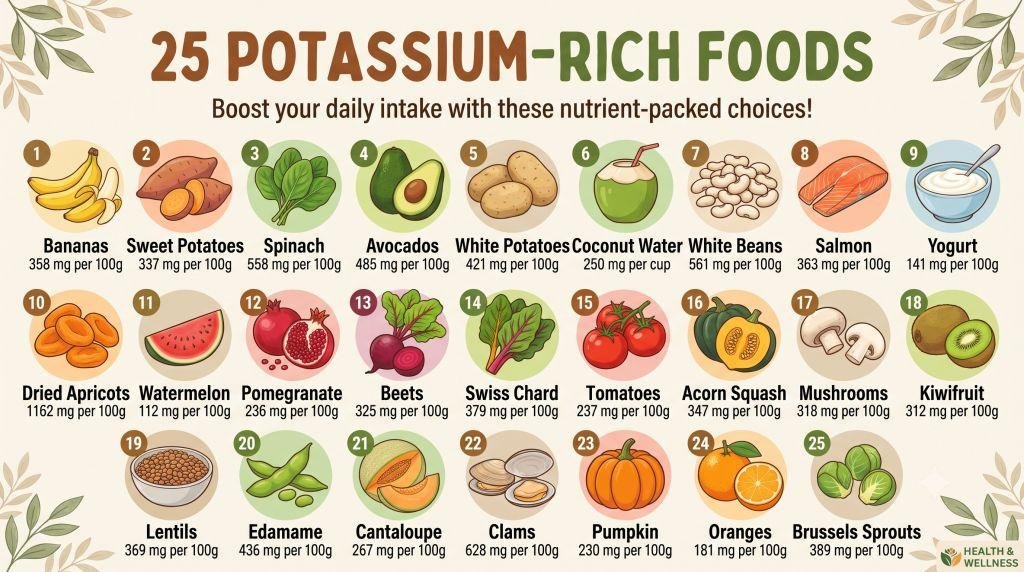
If you are looking for a simple potassium rich foods chart, the good news is that potassium is found in many everyday foods. Potatoes, beans, lentils, spinach, yogurt, milk, tomatoes, bananas, dried fruit, fish, and several other foods can help you add potassium to your diet.
Potassium is an essential mineral involved in fluid balance, muscle contraction, nerve signaling, and normal heart function. It also works closely with sodium in the body, which is one reason potassium-rich eating patterns are often discussed in relation to healthy blood pressure.
For adults age 51 and older, the current adequate intake is 3,400 mg of potassium per day for men and 2,600 mg per day for women. These amounts are intended for generally healthy people and do not apply in the same way to people whose kidneys cannot properly remove potassium or who take certain medications that affect potassium levels.
This guide provides a practical potassium food chart, explains how much potassium common foods contain, discusses the potential benefits, and shows how adults over 50 can include potassium-rich foods safely.
Quick Answer: Which Foods Are High in Potassium?
Some of the better potassium-rich foods include:
- Dried apricots
- Lentils
- Baked potatoes
- Kidney beans
- Prunes
- Raisins
- Acorn squash
- Orange juice
- Soybeans
- Bananas
- Milk
- Spinach
- Yogurt
- Salmon
- Chicken
- Tomatoes
- Broccoli
- Cantaloupe
- Avocado
- Nuts
A medium banana contains about 422 mg of potassium, while a medium baked potato with the flesh only provides about 610 mg. One cup of cooked lentils provides about 731 mg.
However, more potassium is not automatically better for everyone. People with kidney disease and people taking certain medications may need to limit potassium or carefully monitor their intake.
What Is Potassium?
Potassium is an essential mineral and electrolyte.
An electrolyte is a mineral that carries an electrical charge in body fluids. Potassium is particularly important for normal nerve signals and muscle contractions, while also helping maintain normal fluid balance.
Your heart is a muscle, so potassium also has an important role in normal heart function. The kidneys help regulate potassium by removing excess amounts through urine.
Potassium is naturally present in many foods. Fruits and vegetables are well-known sources, but potassium is also found in beans, lentils, dairy products, fish, poultry, meat, nuts, and whole grains.
This is important because you do not need to rely on bananas alone to get potassium.
In fact, a varied diet can provide potassium while also supplying fiber, protein, calcium, vitamins, and other nutrients.
Potassium Rich Foods Chart
The following chart uses selected food amounts reported by the National Institutes of Health Office of Dietary Supplements. Values can vary depending on the variety, preparation method, brand, and serving size.
| Food | Serving | Approx. Potassium |
|---|---|---|
| Dried apricots | ½ cup | 755 mg |
| Lentils, cooked | 1 cup | 731 mg |
| Acorn squash, mashed | 1 cup | 644 mg |
| Prunes | ½ cup | 635 mg |
| Baked potato, flesh | 1 medium | 610 mg |
| Kidney beans, canned | 1 cup | 607 mg |
| Raisins | ½ cup | 618 mg |
| Orange juice | 1 cup | 496 mg |
| Soybeans, boiled | ½ cup | 443 mg |
| Banana | 1 medium | 422 mg |
| Milk, 1% | 1 cup | 366 mg |
| Spinach, raw | 2 cups | 334 mg |
| Chicken breast | 3 oz | 332 mg |
| Fruit yogurt | 6 oz | 330 mg |
| Salmon | 3 oz | 326 mg |
| Beef top sirloin | 3 oz | 315 mg |
| Tomato | 1 medium | 292 mg |
| Soy milk | 1 cup | 287 mg |
| Greek yogurt, plain nonfat | 6 oz | 240 mg |
| Broccoli, cooked | ½ cup | 229 mg |
| Cantaloupe | ½ cup | 214 mg |
| Turkey breast | 3 oz | 212 mg |
| Asparagus, cooked | ½ cup | 202 mg |
| Apple with skin | 1 medium | 195 mg |
| Cashews | 1 oz | 187 mg |
These figures are useful for comparison rather than as exact laboratory values for every serving. The NIH notes that USDA FoodData Central provides more detailed nutrient information for individual foods and brands.
How to Read the Potassium Chart
A food containing 200 mg of potassium is still contributing to your daily intake, even though it is not considered a particularly high source.
Under FDA labeling guidance, 20% or more of the Daily Value is generally considered a high amount of a nutrient, while 5% or less is considered low. The current FDA Daily Value for potassium is 4,700 mg.
That Daily Value is a labeling reference and should not be confused with the age- and sex-specific adequate intakes established by the National Academies.
Best High-Potassium Foods
1. Lentils
Lentils are one of the easiest ways to add a substantial amount of potassium to a meal.
One cup of cooked lentils provides about 731 mg of potassium.
They also provide plant protein and fiber, making them particularly useful for adults who are trying to build more nutrient-dense meals.
Try lentils in:
- Soup
- Salads
- Grain bowls
- Vegetable stews
- Lentil curry
2. Potatoes
Potatoes sometimes get a bad reputation because of how they are prepared.
A plain baked potato can actually be a valuable source of potassium. A medium baked potato with the flesh provides about 610 mg.
The bigger issue is often what gets added to the potato.
Instead of loading it with large amounts of butter, cheese, bacon, or salty toppings, try:
- Plain Greek yogurt
- Chopped vegetables
- Beans
- Herbs
- A small amount of olive oil
3. Dried Apricots
Half a cup of dried apricots contains approximately 755 mg of potassium, making them one of the most potassium-dense foods on this list.
There is one important consideration: dried fruit is concentrated. A small serving can contain considerably more calories and natural sugar than the same fruit in its fresh form.
A small portion can work well as a snack.
4. Beans
Beans are versatile, inexpensive, and nutrient-dense.
One cup of canned kidney beans provides about 607 mg of potassium.
Other beans also contribute potassium.
If you use canned beans, look for lower-sodium varieties or rinse them before eating when appropriate. This can help reduce sodium in the meal.
5. Bananas
Bananas remain one of the most convenient potassium-rich foods.
One medium banana provides about 422 mg of potassium.
They are inexpensive, portable, naturally sweet, and require no preparation.
For a more balanced snack, pair a banana with:
- Plain Greek yogurt
- Unsalted nuts
- Natural peanut butter
- Oatmeal
6. Spinach
Two cups of raw spinach provide approximately 334 mg of potassium.
Spinach can be added to eggs, salads, sandwiches, soups, pasta, or smoothies.
Cooking changes the volume of leafy greens substantially, so serving sizes should be considered when comparing raw and cooked vegetables.
7. Yogurt
Yogurt can contribute potassium along with protein and calcium.
Six ounces of fruit yogurt provides about 330 mg, while six ounces of plain nonfat Greek yogurt provides about 240 mg in the NIH’s selected-food table.
For everyday eating, plain or lower-added-sugar yogurt may be preferable if you are trying to limit added sugar.
8. Salmon
Potassium is not limited to fruits and vegetables.
A 3-ounce serving of cooked Atlantic salmon provides approximately 326 mg.
Salmon also supplies protein and omega-3 fatty acids, making it a useful part of an overall heart-conscious eating pattern.
9. Tomatoes
A medium raw tomato provides about 292 mg of potassium.
Tomatoes can be an easy addition to sandwiches, salads, omelets, soups, and grain bowls.
Tomato sauce and other processed tomato products can also contain potassium, but sodium levels can vary significantly between brands.
Check the Nutrition Facts label when buying packaged products.
10. Orange Juice
One cup of orange juice provides about 496 mg of potassium.
Although it can contribute potassium, whole oranges generally provide fiber that juice does not provide in the same way.
For everyday eating, whole fruit is often an easy choice, while a moderate portion of juice can still fit into a balanced diet.
Potassium Needs After Age 50
Potassium requirements do not simply increase because someone turns 50.
According to current National Academies guidance summarized by NIH, adults age 51 and older have an adequate intake of:
| Group | Potassium per day |
|---|---|
| Men 51+ | 3,400 mg |
| Women 51+ | 2,600 mg |
These figures are for healthy individuals. They are not intended for people with impaired potassium excretion, such as some people with kidney disease, or for everyone taking medications that can increase potassium levels.
For older adults, the goal should not be to chase a specific food.
Instead, think about the overall quality of the diet.
A meal containing vegetables, beans, whole grains, a protein source, and a potassium-rich food can be much more useful than simply eating several bananas.
If you are already working on healthy eating after 50, you may also want to read our guide to Top 10 Foods You Must Eat After 50. It covers several nutrient-dense foods that can fit into a balanced older-adult diet.
Potential Health Benefits
Supports Normal Muscle Function
Potassium helps nerves communicate with muscles and plays a role in muscle contraction.
That includes the muscles involved in everyday movement as well as the heart.
This does not mean eating a potassium-rich food will immediately relieve muscle cramps or weakness. Muscle symptoms can have many causes, including dehydration, medications, electrolyte disturbances, and medical conditions.
Helps Maintain Normal Nerve Function
Nerve cells depend on electrical gradients involving potassium and other electrolytes.
Maintaining appropriate potassium levels therefore supports normal nerve signaling.
Helps Maintain Fluid Balance
Potassium is one of the electrolytes involved in maintaining fluid balance inside cells.
It works alongside sodium and other electrolytes rather than functioning independently.
May Support Healthy Blood Pressure
One of the best-known reasons to pay attention to potassium is its relationship with blood pressure.
Higher potassium intake can increase urinary sodium excretion and may promote vasodilation, potentially helping lower blood pressure in some people. The effect can vary between individuals.
Potassium is one component of the broader DASH-style eating pattern, which emphasizes fruits, vegetables, legumes, whole grains, and lower-fat dairy foods.
If blood pressure is one of your main concerns, our Normal Blood Pressure Chart can help you understand the commonly used adult blood pressure categories.
You can also see our Healthy Blood Pressure Chart by Age for a more detailed discussion of blood pressure in adults from their 40s through 80s and beyond.
May Be Part of a Heart-Healthy Eating Pattern
Potassium-rich foods often overlap with foods encouraged in generally healthy eating patterns.
For example:
- Beans provide potassium and fiber.
- Potatoes provide potassium and other nutrients.
- Fruits provide potassium plus vitamins and fiber.
- Yogurt provides potassium and protein.
- Vegetables provide potassium along with numerous other nutrients.
The benefit comes from the overall dietary pattern rather than potassium acting as a stand-alone treatment.
Potassium and Blood Pressure
It is tempting to think of potassium as a simple “blood pressure mineral,” but the relationship is more complicated.
Sodium intake, potassium intake, overall diet quality, body weight, physical activity, genetics, kidney function, and medications can all influence blood pressure.
For some people, increasing potassium-rich foods while reducing excessive sodium may be helpful.
But someone with kidney disease may have the opposite problem: too much potassium can become dangerous.
That is why a general potassium chart should be used as nutrition education rather than as a personal prescription.
Our Blood Pressure Chart for Seniors also explains why adults should not assume that higher blood pressure is automatically normal simply because they are older.
Potassium-Rich Foods vs Potassium Supplements
For most people, food is the better starting point.
Potassium-rich foods provide other nutrients at the same time.
For example, a serving of beans gives you more than potassium. It can also provide protein and fiber. A potato contributes potassium along with other nutrients. Yogurt supplies protein and calcium in addition to potassium.
Potassium supplements are different.
The amount of potassium in many over-the-counter supplements is relatively small, and supplements can be inappropriate for people at risk of high potassium levels.
The NIH specifically advises caution with potassium-containing products and salt substitutes in people with kidney disease or those taking certain medications.
Do not start a high-dose potassium supplement simply because a food chart suggests you need more potassium.
If you think you are deficient, talk with a healthcare professional about whether testing, medication review, or dietary changes are appropriate.
Potential Risks and Who Should Be Careful
Potassium is essential, but more is not always better.
People With Kidney Disease
Healthy kidneys remove excess potassium from the blood.
When kidney function is reduced, potassium can accumulate.
For this reason, someone with chronic kidney disease may be given a potassium limit that is very different from the general recommendations for healthy adults.
People Taking Certain Medications
Some medications can increase potassium levels, while others can cause potassium losses.
Examples include certain blood pressure medicines, potassium-sparing diuretics, and some other prescription drugs.
The important point is not to memorize a medication list.
Instead, if you take prescription medication regularly, ask your healthcare professional or pharmacist whether potassium-rich foods or potassium-containing salt substitutes are appropriate for you.
People Using Potassium-Based Salt Substitutes
Some salt substitutes use potassium chloride instead of sodium chloride.
These products can be useful for some people, but they are not automatically safe for everyone.
If you have kidney disease or take medicines that affect potassium, ask your healthcare professional before using them.
People With Severe Potassium Loss
Low potassium, called hypokalemia, can occur for reasons other than simply not eating enough potassium.
Certain medications, prolonged diarrhea, vomiting, and other medical conditions can affect potassium levels.
Symptoms can include weakness, fatigue, constipation, and abnormal heart rhythms when potassium becomes significantly low.
A suspected electrolyte problem should be evaluated medically rather than treated blindly with supplements.
How to Add More Potassium to Your Diet
You do not need to completely change your diet.
Try these simple strategies.
1. Add One Potassium-Rich Food to Each Meal
Breakfast:
- Banana
- Yogurt
- Orange
- Milk
Lunch:
- Beans
- Tomato
- Spinach
- Baked potato
Dinner:
- Lentils
- Salmon
- Broccoli
- Squash
2. Upgrade Your Snacks
Instead of chips or highly processed snacks every day, try:
- Banana with unsalted peanut butter
- Plain yogurt with fruit
- Cantaloupe
- A small portion of dried apricots
- Unsalted nuts
3. Choose Beans More Often
Beans can be added to soups, salads, tacos, chili, rice bowls, and casseroles.
They are one of the easiest ways to increase both potassium and fiber.
4. Keep Potatoes on the Menu
A plain baked potato can be nutritious.
The preparation and toppings matter.
Try herbs, vegetables, beans, salsa, or plain yogurt rather than automatically covering the potato with high-sodium processed toppings.
5. Eat More Vegetables
Spinach, tomatoes, broccoli, squash, and other vegetables can contribute meaningful amounts of potassium.
You do not need to eat enormous portions.
Small additions throughout the day can add up.
A Simple One-Day Potassium-Friendly Meal Plan
This is an example, not a prescribed diet.
Breakfast
- Oatmeal
- One medium banana
- Plain Greek yogurt
- Unsalted nuts
This combination provides protein, fiber, and potassium.
Lunch
- Lentil soup
- Tomato and spinach salad
- Whole-grain bread
- Piece of fruit
Afternoon Snack
- Cantaloupe
- Small handful of unsalted cashews
Dinner
- Baked potato
- Grilled salmon
- Steamed broccoli
- Side salad
Evening
If you are hungry, a small serving of plain yogurt or fruit can be a simple option.
The goal is not to calculate every milligram of potassium every day.
For most healthy people, building meals around a variety of nutrient-rich foods is more practical.
Common Mistakes When Trying to Increase Potassium
Eating Only Bananas
Bananas are useful, but they are not the only potassium-rich food.
Beans, lentils, potatoes, leafy greens, dairy products, fish, dried fruit, tomatoes, and many other foods contribute potassium.
Assuming “Healthy” Means Unlimited
Even nutritious foods need to fit your overall calorie and carbohydrate needs.
Dried fruit, fruit juice, nuts, and large portions of starchy foods can add substantial calories.
Ignoring Sodium
Potassium should not be considered in isolation.
A diet built around vegetables, fruits, beans, whole grains, and minimally processed foods may improve the overall balance of potassium and sodium.
Taking Supplements Without Advice
A potassium supplement is not a harmless replacement for a balanced diet.
If you have kidney problems or take certain medications, unnecessary potassium can be risky.
Using a Generic Chart for a Medical Condition
Nutrition recommendations for a healthy adult are not necessarily appropriate for someone with chronic kidney disease, heart failure, diabetes with kidney complications, or other medical conditions.
Common Potassium Myths
Myth: Bananas are the highest-potassium food.
Fact: Bananas contain useful amounts of potassium, but several foods provide more per typical serving. Lentils, dried apricots, potatoes, kidney beans, prunes, and other foods can contain considerably more.
Myth: Everyone should eat more potassium.
Fact: Potassium is essential, but people with impaired kidney function or certain medication-related risks may need to limit it.
Myth: Potassium supplements are better than food.
Fact: Food is generally the preferred way to obtain nutrients for healthy people because potassium-rich foods also provide other beneficial nutrients.
Myth: Potassium automatically lowers blood pressure.
Fact: Higher potassium intake may help blood pressure in some people, but blood pressure is influenced by many factors. Potassium is not a substitute for prescribed treatment.
Myth: Potatoes are unhealthy.
Fact: A plain baked potato can be a nutrient-rich potassium source. The nutritional picture changes when it is heavily loaded with high-sodium or high-calorie toppings.
Myth: If you have muscle cramps, you definitely need potassium.
Fact: Muscle cramps have many possible causes. Potassium deficiency is only one possibility and should not be assumed without considering the broader picture.
Myth: Older adults should automatically eat more potassium.
Fact: Adults over 50 have established potassium intake recommendations, but individual needs can differ significantly when kidney function, medications, or medical conditions are involved.
Who Should Be More Careful?
The general potassium chart in this article is most appropriate as educational information for generally healthy adults.
Talk with a healthcare professional before deliberately increasing potassium if you:
- Have chronic kidney disease
- Have reduced kidney function
- Have been told your potassium is high or low
- Take medications that affect potassium
- Use potassium-based salt substitutes
- Have a medical condition affecting fluid or electrolyte balance
- Have experienced prolonged vomiting or diarrhea
- Have been prescribed a potassium-restricted diet
Older adults deserve particular attention because medication use and chronic health conditions become more common with age.
This does not mean people over 50 should avoid potassium.
It means the right amount depends on the individual.
Potassium and a Healthy Diet After 50
Potassium is only one piece of good nutrition.
After 50, it can be helpful to think beyond individual nutrients and build meals around several priorities:
- Adequate protein
- Vegetables and fruit
- Fiber-rich foods
- Whole grains
- Healthy fats
- Calcium-rich foods
- Adequate hydration
- Reasonable sodium intake
- Foods with potassium when medically appropriate
For more ideas, see our guide to Healthy Soft Foods for Elderly People, particularly if chewing or appetite makes regular meals difficult.
Our guide to Best Fruits for Elderly Digestion is another useful resource for readers looking for easy-to-eat fruit options.
Frequently Asked Questions
1. What are the best potassium-rich foods?
Some of the strongest food sources include lentils, dried apricots, potatoes, kidney beans, prunes, raisins, acorn squash, orange juice, soybeans, bananas, milk, spinach, yogurt, salmon, and tomatoes.
2. What food has the most potassium?
Among the selected foods listed by NIH, half a cup of dried apricots provides about 755 mg and one cup of cooked lentils provides about 731 mg of potassium. Exact values vary by food and serving size.
3. How much potassium should a woman over 50 get?
The adequate intake for women age 51 and older is 2,600 mg per day for generally healthy individuals.
4. How much potassium should a man over 50 get?
The adequate intake for men age 51 and older is 3,400 mg per day for generally healthy individuals.
5. Is a banana high in potassium?
Yes. A medium banana contains approximately 422 mg of potassium according to the NIH’s selected-food table.
6. Are potatoes high in potassium?
Yes. A medium baked potato with the flesh provides approximately 610 mg of potassium. Preparation and serving size matter.
7. Is yogurt a good source of potassium?
Yes. Yogurt contributes potassium along with other nutrients such as protein and calcium. The amount varies by type and brand.
8. Can potassium help lower blood pressure?
A diet containing adequate potassium may help support healthy blood pressure in some people. Potassium works as part of an overall dietary pattern and should not be viewed as a stand-alone treatment.
9. Can I eat high-potassium foods if I have kidney disease?
Not necessarily. Some people with kidney disease need to limit potassium because their kidneys may not remove it efficiently. Follow the potassium recommendation given by your healthcare professional.
10. Are potassium supplements safe?
They are not appropriate for everyone. Certain medications and medical conditions can increase the risk of potassium becoming too high. Talk with a healthcare professional before using potassium supplements.
11. Can potassium help with muscle cramps?
Potassium is important for normal muscle function, but cramps have many possible causes. Do not assume that cramps mean you need a potassium supplement.
12. Is avocado high in potassium?
Avocado contains potassium and can fit into a balanced diet. The exact amount depends on the portion size.
13. Are dried fruits high in potassium?
Yes. Dried apricots, prunes, and raisins can contain substantial amounts of potassium. However, drying concentrates calories and natural sugars, so portion size matters.
14. Does milk contain potassium?
Yes. One cup of 1% milk contains approximately 366 mg of potassium in the NIH selected-food table.
15. What is the easiest way to get more potassium?
Add potassium-containing foods to meals you already eat. For example, add a banana to breakfast, beans or tomatoes to lunch, and a baked potato or vegetables to dinner.
Final Takeaway
A potassium rich foods chart can make healthy food choices much easier, especially when you want to compare everyday foods without guessing.
You do not have to rely on one “superfood.” Lentils, beans, potatoes, leafy greens, tomatoes, yogurt, milk, fruit, fish, and other foods can all contribute meaningful amounts of potassium.
For most healthy adults, getting potassium from a varied diet is a sensible approach. But if you have kidney disease, abnormal potassium levels, or take medications that affect potassium, your ideal intake may be different.
The best goal is not simply to eat as much potassium as possible. It is to build a balanced diet that provides the nutrients your body needs while fitting your individual health situation.
Medical Disclaimer
This article is for general educational and informational purposes only. It is not a substitute for individualized medical advice, diagnosis, or treatment. If you have kidney disease, abnormal potassium levels, heart or other chronic health conditions, or take medications that affect potassium, speak with your healthcare professional before making significant changes to your potassium intake.
Trusted Sources
- NIH Office of Dietary Supplements — Potassium Fact Sheet
- FDA — Daily Value on Nutrition Facts Labels
- FDA — Nutrition Facts Label for Older Adults
- USDA FoodData Central
Written by
Kanhaiya Solanki is a dedicated online researcher, content writer, and blogger passionate about publishing high-quality, research-based articles. His goal is to provide accurate, easy-to-understand, and practical information on health, technology, senior care, and lifestyle topics for readers worldwide.