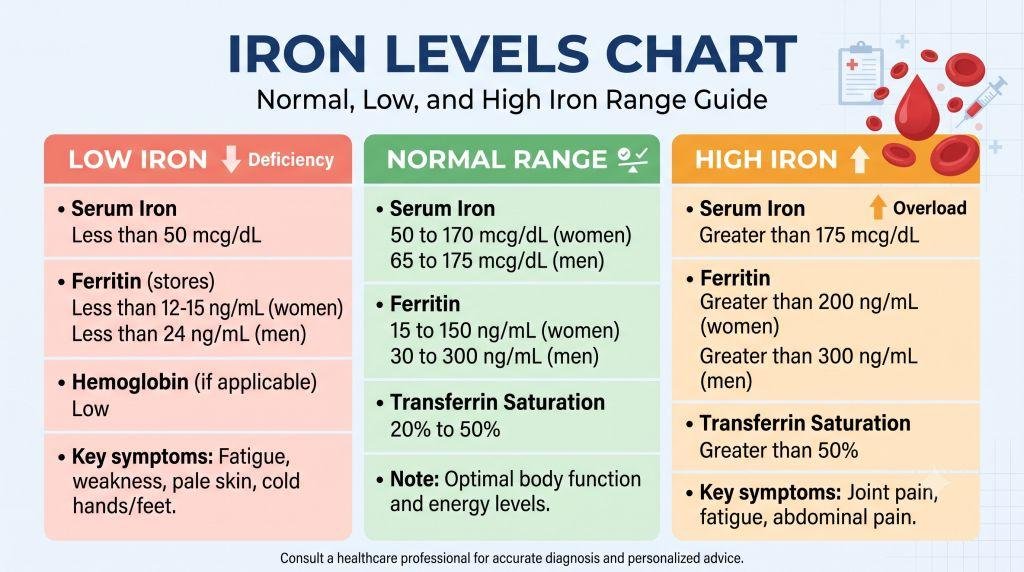
If you have recently had an iron blood test, seeing numbers such as serum iron, ferritin, TIBC, and transferrin saturation on your lab report can be confusing. An iron levels chart can provide a useful starting point, but there is no single number that tells the whole story.
For adults, commonly used reference ranges for serum iron are about 59–158 mcg/dL for men and 37–145 mcg/dL for women, while commonly listed ferritin ranges are about 30–400 ng/mL for men and 13–150 ng/mL for women. However, laboratories can use different reference ranges, and your result needs to be interpreted alongside other blood tests, symptoms, medications, and medical history.
This is particularly important after age 50. Low iron may contribute to iron-deficiency anemia, while an unexpectedly high iron or ferritin result can have several possible explanations, including inflammation, liver problems, or iron overload.
In this guide, you’ll learn how to read an iron levels chart, what the major iron tests measure, what low and high results can mean, how much iron adults need each day, which foods provide iron, and when an abnormal result deserves medical follow-up.
Quick Answer: What Are Normal Iron Levels?
There is no single “normal iron level” because healthcare professionals use several different tests to evaluate iron status.
Here are commonly used adult reference ranges:
| Iron Test | Common Reference Range | What It Measures |
|---|---|---|
| Serum iron — men | 59–158 mcg/dL | Iron circulating in the blood |
| Serum iron — women | 37–145 mcg/dL | Iron circulating in the blood |
| Ferritin — men | 30–400 ng/mL | Stored iron |
| Ferritin — women | 13–150 ng/mL | Stored iron |
| Transferrin saturation — men | 20%–50% | Percentage of transferrin carrying iron |
| Transferrin saturation — women | 15%–45% | Percentage of transferrin carrying iron |
| TIBC — men | 171–505 mcg/dL | Blood’s iron-binding capacity |
| TIBC — women | 149–492 mcg/dL | Blood’s iron-binding capacity |
These are commonly reported ranges, not universal treatment targets. Your own laboratory may use different reference intervals.
The key point: Don’t judge your iron status from serum iron alone. Ferritin, transferrin saturation, TIBC, hemoglobin, hematocrit, and other tests may be considered together.
What Is Iron?
Iron is an essential mineral your body needs to make hemoglobin, the protein in red blood cells that carries oxygen from your lungs to tissues throughout the body.
Iron is also involved in myoglobin, which helps supply oxygen to muscles, as well as several other biological processes.
Your body gets iron from food and supplements. There are two main types:
- Heme iron: Found mainly in meat, poultry, and seafood.
- Nonheme iron: Found in plant foods and fortified foods.
Heme iron is generally absorbed more efficiently than nonheme iron. Vitamin C can improve the absorption of nonheme iron from plant foods.
Iron matters because both too little and too much can cause problems.
Low iron can contribute to iron-deficiency anemia. Excess iron, particularly from supplements or certain medical conditions, can also be harmful.
Iron Levels Chart Explained
The phrase “iron level” can mean several different things on a blood test.
That’s one reason people sometimes become confused when their lab report shows a normal serum iron level but an abnormal ferritin result—or the other way around.
Serum Iron
Serum iron measures the amount of iron circulating in your blood at the time of the test.
Common reference ranges are approximately:
- Men: 59–158 mcg/dL
- Women: 37–145 mcg/dL
Serum iron can change during the day and may be affected by recent food or iron intake. Because of this, healthcare professionals often interpret it alongside other iron tests rather than using it by itself.
Ferritin
Ferritin is a protein that stores iron.
A ferritin blood test therefore provides information about your body’s stored iron.
Commonly listed adult ranges are:
- Men: 30–400 ng/mL
- Women: 13–150 ng/mL
Laboratory ranges differ, however, and ferritin can also increase with inflammation, infection, liver disease, and other conditions.
This means a high ferritin result does not automatically mean you have too much iron.
TIBC
TIBC stands for total iron-binding capacity.
It reflects how much iron your blood can potentially bind to transferrin, a protein that transports iron.
A commonly reported range is approximately:
- Men: 171–505 mcg/dL
- Women: 149–492 mcg/dL
TIBC is often higher when the body’s iron stores are low, although interpretation depends on the overall clinical picture.
Transferrin Saturation
Transferrin saturation tells you what percentage of transferrin is carrying iron.
Common reference ranges are approximately:
- Men: 20%–50%
- Women: 15%–45%
It is often calculated from serum iron and TIBC.
This test can help healthcare professionals distinguish different patterns of iron deficiency and iron overload.
Serum Iron vs Ferritin vs TIBC vs Transferrin Saturation
| Test | Simple Explanation | Why It Matters |
|---|---|---|
| Serum iron | Iron currently circulating in blood | Shows available circulating iron at the time of testing |
| Ferritin | Iron stored in the body | Helps estimate iron stores |
| TIBC | How much iron the blood can bind | Can increase when iron stores are low |
| Transferrin saturation | Percentage of transferrin carrying iron | Helps assess iron availability and possible overload |
| Hemoglobin | Oxygen-carrying protein in red blood cells | Helps identify anemia |
| CBC | Broad blood-cell assessment | Provides additional information about red blood cells |
Healthcare professionals may order several of these tests together because no single result always provides the full picture.
What Does a Low Iron Level Mean?
A low iron result may mean that your body does not have enough available iron, but it does not automatically prove iron-deficiency anemia.
Iron deficiency and anemia are related but different.
Iron deficiency means the body’s iron supply is inadequate.
Iron-deficiency anemia occurs when iron deficiency becomes severe enough to interfere with the production of healthy red blood cells.
Possible causes include:
- Not getting enough iron from food
- Poor absorption of iron
- Chronic blood loss
- Frequent blood donation
- Certain digestive conditions
- Some medications
- Increased nutritional needs
- Chronic health conditions
Healthcare professionals may use a CBC, hemoglobin, ferritin, serum iron, TIBC, and other tests to investigate the cause.
Signs of Low Iron
Iron deficiency may cause symptoms such as:
- Fatigue
- Weakness
- Dizziness
- Shortness of breath
- Reduced exercise tolerance
- Pale skin
- Headaches
- Rapid or irregular heartbeat in more significant cases
Some people have low iron without obvious symptoms, especially early in the process.
That’s why unexplained fatigue shouldn’t automatically be blamed on getting older.
For an adult over 50, persistent fatigue deserves a broader evaluation because many conditions can cause it.
Why Iron Can Be Low After 50
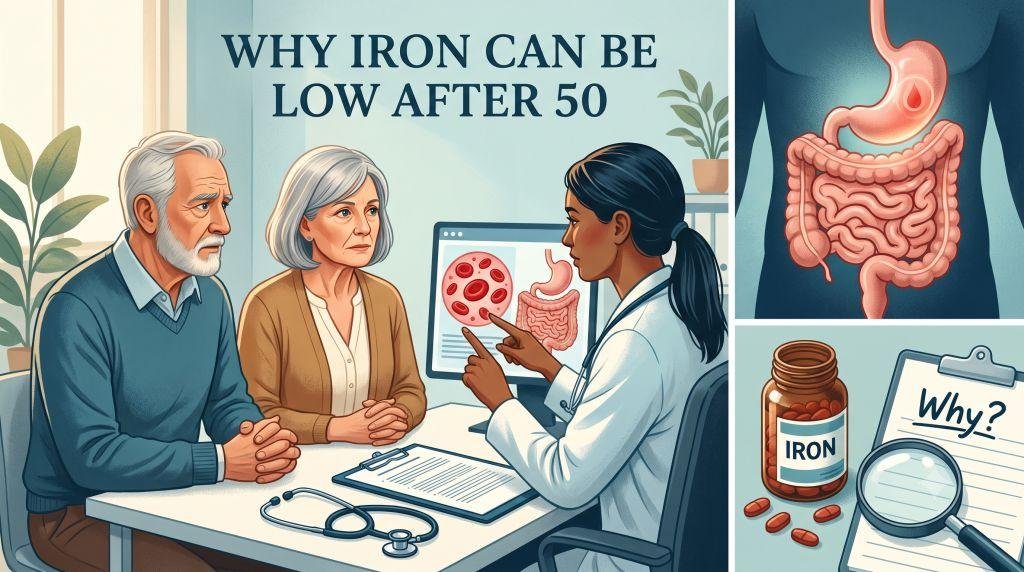
Iron deficiency deserves particular attention in older adults.
For someone who is postmenopausal or an older man, unexplained iron-deficiency anemia may sometimes be related to blood loss in the digestive tract.
That does not mean an abnormal iron result automatically indicates a serious disease. There are many possible causes.
However, persistent iron deficiency should not simply be treated with an iron supplement without investigating why it happened.
Potential contributors can include:
1. Digestive Blood Loss
Small amounts of blood loss from the gastrointestinal tract may not be visible.
Some medications, including certain pain relievers and blood thinners, can also influence bleeding risk.
2. Reduced Absorption
Conditions affecting the digestive tract can interfere with iron absorption.
Celiac disease and inflammatory bowel disease are examples.
3. Reduced Food Intake
Some older adults eat less because of reduced appetite, dental problems, difficulty chewing, changes in taste, or other reasons.
A smaller overall diet can make it harder to obtain enough nutrients.
4. Chronic Health Conditions
Kidney disease, heart failure, inflammation, and other chronic conditions can affect iron metabolism and anemia.
5. Blood Donation
Frequent blood donation can reduce iron stores in some people.
For older adults with confirmed iron deficiency, finding the underlying reason is often more important than simply taking iron.
Research and clinical guidance emphasize evaluating unexplained iron-deficiency anemia in older adults because gastrointestinal blood loss can be an important cause.
What Does a High Iron Level Mean?
A high iron result also needs context.
Possible explanations include:
- Iron supplementation
- Certain liver conditions
- Iron overload disorders
- Repeated blood transfusions
- Some types of anemia
- Other medical conditions
A high ferritin result is particularly easy to misunderstand.
Ferritin can rise because of inflammation, infection, liver disease, obesity, autoimmune conditions, cancer, alcohol-related liver disease, and other conditions—not just because the body contains too much iron.
One inherited condition associated with excessive iron accumulation is hemochromatosis.
If your blood tests suggest possible iron overload, your healthcare professional may order additional testing rather than assuming the cause from one number.
How Much Iron Do Adults Need?
Your daily iron requirement changes with age and sex.
For adults in the United States:
| Age / Life Stage | Recommended Iron Per Day |
|---|---|
| Men 19–50 | 8 mg |
| Women 19–50 | 18 mg |
| Adults 51+ | 8 mg |
| Pregnant women | 27 mg |
| Breastfeeding women | 9 mg |
After age 51, the recommended amount for both men and women is generally 8 mg per day.
This is a dietary recommendation, not a target blood-test value.
Someone can consume enough iron but still develop deficiency if absorption is poor or if iron losses are occurring.
Likewise, taking extra iron does not necessarily improve health when your body already has adequate stores.
Iron-Rich Foods
Food is generally the best place to start when you’re trying to maintain adequate iron intake.
Animal-Based Sources
Heme iron is found in foods such as:
- Lean beef
- Chicken
- Turkey
- Fish
- Shellfish
- Other seafood
Plant-Based Sources
Nonheme iron is found in:
- Lentils
- White beans
- Kidney beans
- Peas
- Spinach
- Iron-fortified cereals
- Fortified breads
- Nuts
- Raisins and some other dried fruits
NIH notes that vitamin C-containing foods can improve absorption of nonheme iron.
Easy Food Combinations
Instead of thinking only about individual foods, think about combinations.
Try:
Breakfast: Iron-fortified cereal with strawberries.
Lunch: Lentil soup with tomatoes and a side salad.
Dinner: Lean beef with broccoli and a baked potato.
Vegetarian option: Lentils with bell peppers, tomatoes, and whole grains.
These combinations provide iron while also pairing plant-based iron with vitamin C-rich foods.
How to Improve Iron Absorption
Getting enough iron from food is only part of the equation. Your body also needs to absorb it.
Pair Plant Iron With Vitamin C
Vitamin C can increase absorption of nonheme iron.
Good pairings include:
- Lentils + tomatoes
- Beans + bell peppers
- Spinach + strawberries
- Fortified cereal + berries
- Beans + broccoli
Choose a Variety of Iron Sources
Don’t depend on one food.
A varied diet can provide iron from meat, seafood, beans, lentils, fortified grains, vegetables, and nuts.
Pay Attention to Supplements
Iron supplements can be useful when medically indicated, but more is not automatically better.
Some supplements contain substantially more iron than the daily requirement.
For adults, the tolerable upper intake level for iron is 45 mg per day from all sources, although healthcare professionals may intentionally prescribe higher amounts for treating confirmed deficiency.
Iron Supplements: When to Be Careful
Iron supplements can cause side effects, particularly at higher doses.
Possible effects include:
- Constipation
- Nausea
- Stomach discomfort
- Abdominal pain
- Diarrhea
- Vomiting
High-dose supplements can also be dangerous in certain circumstances.
Iron can also interact with medications.
For example, iron supplements can interfere with absorption of levothyroxine, and calcium may interfere with iron absorption when taken together. Some acid-reducing medicines may also affect absorption of nonheme iron.
If you take prescription medications, ask your doctor or pharmacist how to schedule iron and other supplements.
Do not start high-dose iron simply because you feel tired.
A blood test and medical evaluation can help determine whether iron is actually the problem.
Iron Levels and Adults Over 50
Adults over 50 often have a different nutritional situation than younger adults.
The recommended dietary intake drops to 8 mg per day for both men and women after age 51. At the same time, an abnormal iron result can have more than one possible explanation.
Older adults may have:
- Lower food intake
- Digestive disorders
- Chronic inflammation
- Kidney disease
- Medication-related issues
- Blood loss
- Reduced nutrient absorption
This is why an iron levels chart should be used as a reference—not as a diagnosis.
If you’re over 50 and your doctor tells you that your ferritin or iron is low, ask:
- Is my hemoglobin normal?
- What is my ferritin?
- What is my transferrin saturation?
- Is my TIBC normal?
- Could a medication be contributing?
- Do I need to investigate blood loss?
- Should I change my diet or take an iron supplement?
Those questions can lead to a much more useful conversation than focusing on one number.
If you’re also monitoring cardiovascular health, you may find our Cholesterol Levels Chart useful as another guide to understanding common blood-test results.
Likewise, our Blood Glucose Level Chart can help you understand another commonly reported blood-test category.
Common Iron-Test Mistakes
Mistake 1: Looking Only at Serum Iron
Serum iron changes throughout the day and can fluctuate.
It should generally be interpreted alongside other iron markers.
Mistake 2: Assuming Low Iron Always Means Anemia
Iron deficiency can exist before anemia develops.
Your hemoglobin and other CBC measurements help determine whether anemia is present.
Mistake 3: Assuming High Ferritin Means Too Much Iron
Ferritin is also influenced by inflammation and several medical conditions.
A high result does not automatically equal iron overload.
Mistake 4: Taking Iron Without Testing
Fatigue alone isn’t enough to establish iron deficiency.
Unnecessary supplementation can cause side effects and, in some situations, contribute to excessive iron.
Mistake 5: Ignoring Persistent Iron Deficiency
Especially after menopause or in older men, unexplained iron deficiency deserves appropriate medical evaluation.
Mistake 6: Comparing Your Result With Someone Else’s
Laboratories can use different reference ranges.
Always look at the reference interval printed on your own report.
Real-Life Examples
Example 1: Low Ferritin With Fatigue
A 62-year-old woman feels increasingly tired. Her serum iron is within her laboratory’s range, but ferritin is low.
Rather than assuming everything is normal because the serum iron is acceptable, her healthcare professional may look at the complete iron panel and CBC and investigate why her iron stores are low.
Example 2: High Ferritin
A 68-year-old man has a ferritin level above the laboratory’s reference range.
That does not automatically mean iron overload.
His doctor may consider inflammation, liver health, alcohol intake, other medical conditions, and additional iron studies before reaching a conclusion.
Example 3: Low Iron With Digestive Symptoms
A 71-year-old man has iron-deficiency anemia and no obvious source of blood loss.
Rather than simply starting an iron supplement indefinitely, his healthcare professional may investigate whether there is gastrointestinal blood loss or another underlying cause.
This is especially important in older adults because unexplained iron-deficiency anemia can have multiple causes.
Common Myths About Iron
Myth: A normal serum iron means my iron status is definitely normal.
Fact: Serum iron is only one part of an iron evaluation. Ferritin, TIBC, transferrin saturation, CBC, and other information may be needed.
Myth: High ferritin always means iron overload.
Fact: Ferritin can increase because of inflammation, infection, liver disease, and other conditions.
Myth: Everyone over 50 should take an iron supplement.
Fact: Adults 51 and older generally need 8 mg of iron per day from their diet, but routine high-dose supplementation is not appropriate for everyone.
Myth: More iron is always better.
Fact: Excess iron can cause harmful effects, especially from high-dose supplements.
Myth: Iron deficiency always causes obvious symptoms.
Fact: Low iron may not cause noticeable symptoms until the deficiency becomes more significant.
Myth: Spinach is the only important plant source of iron.
Fact: Beans, lentils, peas, fortified cereals, nuts, and other foods can also provide iron.
Myth: If my iron is low, I only need to eat more iron-rich food.
Fact: Diet may help, but the underlying reason for deficiency also matters. Blood loss, poor absorption, medications, and chronic conditions may require medical evaluation.
Who Should Be More Careful?
Some people should be particularly cautious about interpreting or treating abnormal iron results on their own.
Adults Over 50
Persistent iron deficiency should be evaluated rather than automatically attributed to diet or aging.
Postmenopausal Women
Because menstrual blood loss is no longer a routine explanation, persistent iron deficiency may deserve investigation for other causes.
Older Men
Unexplained iron-deficiency anemia should be discussed with a healthcare professional.
People Taking Blood Thinners
Medications that increase bleeding risk may be relevant when iron deficiency or anemia is present.
People With Digestive Conditions
Celiac disease, inflammatory bowel disease, previous gastrointestinal surgery, and other digestive conditions can affect iron absorption.
People With Liver Disease or Inflammation
Ferritin may be elevated for reasons other than excess iron.
People With Hemochromatosis
People with hereditary hemochromatosis should not casually take iron supplements and should follow their healthcare professional’s recommendations. NIH specifically advises people with this condition to avoid iron supplements.
How to Get Started
If you’re trying to understand your iron status, keep it simple.
1. Find the Exact Test
Look at your report and identify whether the number is:
- Serum iron
- Ferritin
- TIBC
- Transferrin saturation
- Hemoglobin
- Hematocrit
2. Check Your Laboratory’s Reference Range
Don’t compare your result with a random internet chart alone.
The reference range printed on your report is the most relevant starting point.
3. Look at the Whole Panel
Ask how your results fit together rather than focusing on one number.
4. Review Your Diet
Include a variety of iron-containing foods.
5. Review Your Medications
Ask whether any medication could affect iron absorption or contribute to blood loss.
6. Don’t Self-Treat High or Low Results
A supplement may be appropriate in some cases and unnecessary in others.
7. Investigate Persistent Abnormal Results
Especially after age 50, unexplained iron deficiency should be properly evaluated.
Frequently Asked Questions
1. What is a normal iron level for adults?
Common serum iron reference ranges are approximately 59–158 mcg/dL for men and 37–145 mcg/dL for women. Your laboratory may use different ranges.
2. What is a normal ferritin level?
Commonly listed adult ferritin ranges are approximately 30–400 ng/mL for men and 13–150 ng/mL for women. Interpretation depends on the laboratory and clinical situation.
3. Is a ferritin level of 20 low?
It may be considered low by some laboratories, particularly when evaluating iron stores, but the correct interpretation depends on the laboratory range, symptoms, CBC results, inflammation, and other factors.
4. Is ferritin more important than serum iron?
Not necessarily. They measure different things. Ferritin reflects stored iron, while serum iron reflects circulating iron. Healthcare professionals often consider several tests together.
5. What does low ferritin mean?
Low ferritin generally suggests that the body’s iron stores are low. It can be associated with iron deficiency and may occur before anemia develops.
6. What does high ferritin mean?
High ferritin can occur with iron overload, but also with inflammation, infection, liver disease, autoimmune conditions, obesity, and other health problems. It needs context.
7. What is a normal iron level for someone over 50?
There is not a separate universal serum-iron range simply because someone is over 50. Your laboratory’s reference range and the complete pattern of test results are more important.
For dietary intake, adults age 51 and older generally need 8 mg of iron per day.
8. Can low iron cause tiredness?
Yes. Fatigue and weakness are common symptoms associated with low iron and iron-deficiency anemia, although many other conditions can also cause fatigue.
9. Should adults over 50 take iron supplements?
Not automatically. If testing confirms iron deficiency, a healthcare professional may recommend iron treatment. Taking high-dose iron without a clear reason can cause side effects and may be inappropriate for people with certain conditions.
10. Can you get enough iron from food?
Yes. Many people can meet their iron needs through a varied diet that includes meat, seafood, poultry, beans, lentils, fortified grains, vegetables, nuts, and other iron-containing foods.
11. Does vitamin C help absorb iron?
Yes. Vitamin C can improve absorption of nonheme iron from plant foods. Examples of vitamin C-rich foods include citrus fruits, strawberries, peppers, tomatoes, and broccoli.
12. Can iron supplements cause constipation?
Yes. Constipation, nausea, stomach discomfort, abdominal pain, and other digestive side effects can occur with iron supplements, particularly at higher doses.
13. Can high iron be harmful?
Yes. Excessive iron can cause harmful effects, especially when high doses come from supplements or when a person has an iron-overload condition.
14. Why would iron be low if I eat iron-rich foods?
Possible reasons include poor absorption, chronic blood loss, digestive conditions, medication effects, or increased losses. That’s why persistent low results deserve evaluation rather than simply adding more iron to the diet.
15. When should I talk with my doctor about an iron result?
Discuss an abnormal result with your healthcare professional, especially if you have persistent fatigue, weakness, shortness of breath, unexplained anemia, digestive symptoms, unexplained weight loss, signs of bleeding, or repeatedly abnormal iron studies.
Final Takeaway
An iron levels chart is helpful for understanding your blood-test report, but it should not be used to diagnose yourself from one number.
Serum iron tells you about circulating iron. Ferritin gives information about stored iron. TIBC and transferrin saturation provide additional clues about how iron is being transported and used.
For adults over 50, the most important question isn’t simply, “Is my iron number normal?” It’s why the number is high or low and what the complete set of results shows.
A balanced diet can help maintain healthy iron intake, but unexplained iron deficiency—particularly in older adults—should be investigated rather than treated indefinitely with supplements.
If you have your own lab results, use the reference range printed by your laboratory and discuss anything outside that range with a qualified healthcare professional.
Medical Disclaimer
This article is for general educational and informational purposes only. It does not provide individualized medical advice, diagnosis, or treatment. Iron-test results can be affected by medical conditions, medications, inflammation, recent food or supplement intake, and laboratory methods. Do not start or stop iron supplements based solely on this article. If you have abnormal test results or concerning symptoms, speak with a qualified healthcare professional.
Trusted Sources
NIH Office of Dietary Supplements — Iron Fact Sheet — dietary requirements, food sources, upper limits and supplement interactions. ODSMedlinePlus — Iron Tests — explanation of serum iron, ferritin, TIBC and other iron tests. MedlinePlusMedlinePlus — Ferritin Blood Test — ferritin interpretation and reasons for high or low results. MedlinePlusNIH/NHLBI — Iron-Deficiency Anemia — diagnosis and causes of iron-deficiency anemia.
Written by
Kanhaiya Solanki is a dedicated online researcher, content writer, and blogger passionate about publishing high-quality, research-based articles. His goal is to provide accurate, easy-to-understand, and practical information on health, technology, senior care, and lifestyle topics for readers worldwide.