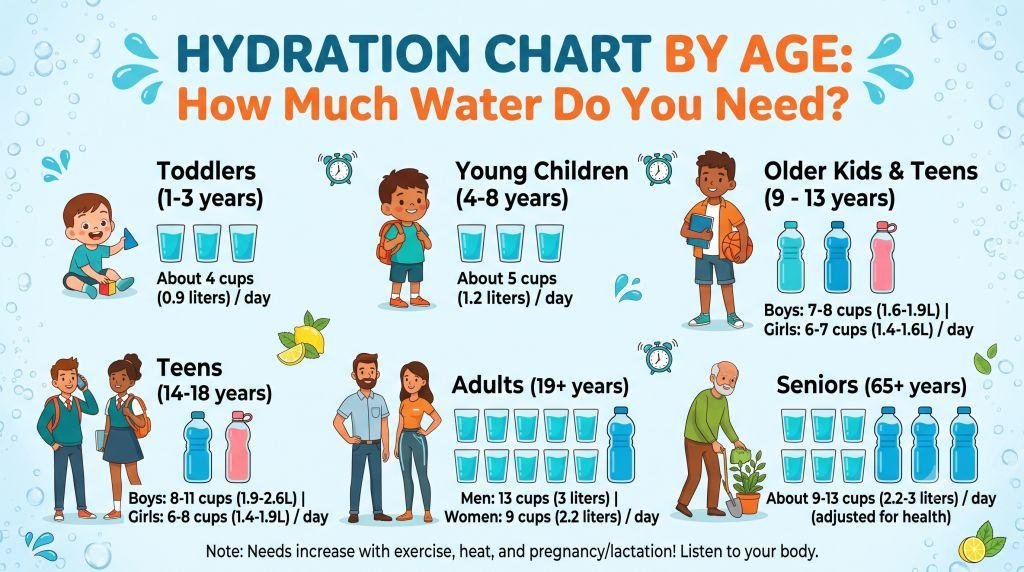
Staying hydrated is important at every stage of life, but the amount of water a person needs can vary with age, sex, activity level, weather, diet, medications, and health conditions. If you are searching for a hydration chart by age, there is one important detail to understand first: there is no single water requirement that fits every person in a particular age group.
For healthy adults, the U.S. National Academies lists an adequate intake of about 3.7 liters (125 ounces) of total water per day for men and 2.7 liters (91 ounces) for women. These numbers include water from beverages, drinking water, and food—not just plain water.
Age also matters in practical ways. Older adults may be more vulnerable to dehydration, and some people may not notice thirst as strongly as they once did. Certain medications and health conditions can also change how much fluid is appropriate.
This guide explains how hydration needs change with age, how much fluid comes from food, what adults over 50 should know, signs of dehydration, situations that require more fluids, and when drinking too much water can actually be a problem.
Quick Answer: How Much Water Do You Need by Age?
There is not a separate official daily water requirement for every individual age. For healthy people, the National Academies’ adequate intake values are grouped by life stage.
| Age group | Male total water | Female total water | Important note |
|---|---|---|---|
| 0–6 months | 0.7 L/day | 0.7 L/day | Primarily from breast milk or formula |
| 7–12 months | 0.8 L/day | 0.8 L/day | Includes fluids from foods and beverages |
| 1–3 years | 1.3 L/day | 1.3 L/day | Total water |
| 4–8 years | 1.7 L/day | 1.7 L/day | Total water |
| 9–13 years | 2.4 L/day | 2.1 L/day | Total water |
| 14–18 years | 3.3 L/day | 2.3 L/day | Total water |
| 19–50 years | 3.7 L/day | 2.7 L/day | Total water |
| 51–70 years | 3.7 L/day | 2.7 L/day | Total water |
| 71+ years | 3.7 L/day | 2.7 L/day | Total water |
These are total-water values, meaning they include water from drinking water, other beverages, and food. They are not prescriptions for how many ounces of plain water you personally must drink.
For adults over 50, the most useful takeaway is this: your basic reference intake does not automatically fall just because you are older, but your individual hydration needs and your ability to maintain hydration can change.
What Is Hydration?
Hydration refers to having enough fluid in your body for normal physiological functions.
Water is involved in many everyday processes. Your body uses water to regulate temperature, transport nutrients, support digestion, lubricate tissues, and remove waste through urine and other routes.
You lose water continuously through urine, sweat, breathing, and bowel movements. You replace it through beverages and the foods you eat.
That means hydration is not simply a matter of drinking glasses of water.
A bowl of soup, a glass of milk, yogurt, watermelon, oranges, cucumbers, and other water-rich foods all contribute to your overall fluid intake.
The National Academies’ water recommendations are therefore expressed as total water intake, rather than simply “plain water.”
Why Does Hydration Matter?
When fluid losses become greater than fluid intake, dehydration can develop.
Mild dehydration may cause thirst, dry mouth, fatigue, darker urine, dizziness, or reduced urination. More serious dehydration can cause confusion, fainting, rapid heartbeat, and other potentially dangerous symptoms.
For older adults, maintaining regular fluid intake deserves particular attention because some people experience changes in thirst with aging, while medications, mobility issues, illness, and chronic health conditions can further complicate hydration.
Hydration Chart by Age
The chart below is based on the National Academies’ Dietary Reference Intakes for total water.
Infants: 0–12 Months
For infants, hydration is different from adult hydration.
The National Academies lists an adequate intake of approximately:
- 0–6 months: 0.7 liters of total water per day
- 7–12 months: 0.8 liters of total water per day
For young infants, breast milk or infant formula provides the primary source of fluids and nutrition. Parents should not simply apply an adult “8 glasses of water” rule to babies.
Parents should follow their pediatrician’s guidance, particularly when a baby has vomiting, diarrhea, fever, feeding problems, or fewer wet diapers.
Children: 1–8 Years
For children:
- 1–3 years: about 1.3 liters of total water per day
- 4–8 years: about 1.7 liters per day
These amounts include water from food and beverages. The National Academies estimates that a substantial portion of children’s total water intake comes from food.
Children who are very active, playing outside in hot weather, or experiencing vomiting or diarrhea may need additional attention to fluids.
Teenagers
For teenagers, the reference values differ by sex:
- Boys 9–13: about 2.4 liters per day
- Girls 9–13: about 2.1 liters per day
- Boys 14–18: about 3.3 liters per day
- Girls 14–18: about 2.3 liters per day
Again, these are total-water figures rather than plain-water targets.
Adults: 19–50 Years
For healthy adults:
- Men: about 3.7 liters, or 125 ounces, of total water per day
- Women: about 2.7 liters, or 91 ounces, of total water per day
The amount actually coming from beverages will generally be lower because food also contains water.
Adults: 51–70 Years
For adults ages 51–70, the National Academies maintains the same basic total-water adequate intake:
- Men: 3.7 liters per day
- Women: 2.7 liters per day
That does not mean every 60-year-old needs exactly the same amount of fluid every day.
A person who spends several hours gardening in hot weather may need considerably more fluid than someone sitting indoors in a cool environment.
Adults: 71 Years and Older
For adults over 70, the reference values also remain:
- Men: 3.7 liters per day
- Women: 2.7 liters per day
But older adults may require more individualized hydration planning because health conditions, medications, mobility, kidney function, heart function, and appetite can all affect fluid balance.
How Much Water Should Adults Over 50 Drink?
This is where online hydration advice often becomes confusing.
You may have heard that everyone should drink eight 8-ounce glasses of water each day.
That’s a simple rule, but it does not accurately describe everyone’s fluid needs.
For adults, the National Academies’ reference values are approximately 91 ounces of total water for women and 125 ounces for men. These totals include food and all beverages.
So an adult woman does not necessarily need to drink 91 ounces of plain water every day.
If her diet provides water from fruits, vegetables, soup, yogurt, milk, and other foods, those fluids count toward total intake.
The same principle applies to men.
For older adults, however, simply waiting until you feel extremely thirsty may not be the best strategy. Research and clinical guidance emphasize regular fluid intake because older people can be vulnerable to low-intake dehydration.
Total Water vs. Plain Drinking Water
This distinction is worth remembering.
Total Water
Total water includes:
- Plain drinking water
- Coffee and tea
- Milk
- Other beverages
- Water contained in foods
- Soups and other liquid foods
Plain Water
Plain water is simply the water you drink directly.
If a hydration chart says “2.7 liters of total water,” you should not automatically interpret that as “drink 2.7 liters of plain water.”
The National Academies specifically defines total water as the combination of drinking water and water contained in foods and beverages.
This is one reason there is no universal number of water bottles that every adult needs.
Why Hydration Matters as You Age
Hydration is important throughout life, but several factors can make maintaining adequate fluid intake more challenging in older adulthood.
1. Thirst May Not Always Be a Reliable Reminder
Some older adults may experience changes in thirst sensation.
That means a person can go several hours without drinking simply because they do not feel particularly thirsty.
MedlinePlus lists older adults among groups at increased risk of dehydration and notes that some people lose part of their sense of thirst with age.
A practical solution is to make drinking part of your routine rather than relying entirely on thirst.
2. Medications Can Affect Fluid Balance
Some medications can increase urination or otherwise affect fluid balance.
Diuretics, sometimes called water pills, are one example.
That does not mean you should change or stop a medication because you are concerned about hydration.
Instead, ask your healthcare professional how much fluid is appropriate for you.
3. Illness Can Increase Fluid Loss
Fever, vomiting, diarrhea, and heavy sweating can all increase fluid losses.
During an illness, replacing lost fluids becomes especially important.
If you cannot keep fluids down, are urinating very little, or develop severe dizziness or confusion, seek medical advice rather than trying to manage significant dehydration yourself.
4. Hot Weather Changes the Equation
Hot and humid conditions can increase fluid losses through sweating.
This is especially important for older adults because heat-related illness can become serious.
The National Institute on Aging recommends that older adults take precautions during hot weather and recognize dehydration as a risk factor for heat-related illness.
5. Physical Activity Increases Fluid Needs
Walking, cycling, gardening, hiking, yard work, and exercise can all increase fluid losses.
A person who exercises outdoors in July will have different hydration needs from someone who spends the same day indoors in an air-conditioned home.
6. Diet Contributes to Hydration
Food can provide a meaningful amount of water.
Good examples include:
- Watermelon
- Oranges
- Grapefruit
- Strawberries
- Cantaloupe
- Cucumbers
- Tomatoes
- Lettuce
- Soups
- Yogurt
- Oatmeal
This is another reason not to judge hydration solely by the number of glasses of water you drink.
7. Caffeine Does Not Automatically “Dehydrate” You
Coffee and tea contain water and can contribute to total fluid intake.
The idea that every caffeinated drink automatically causes dehydration is too simplistic.
However, beverages high in added sugar may add unnecessary calories, and individual tolerance to caffeine varies.
For everyday hydration, plain water is an easy default choice.
8. Alcohol Is Not a Good Hydration Strategy
Alcohol can contribute to fluid loss and can interfere with good hydration habits.
It should not be used as a source of hydration.
9. Swallowing Problems Can Change Hydration
Some older adults have difficulty swallowing liquids safely.
If drinking causes coughing, choking, a wet-sounding voice, or repeated difficulty swallowing, talk with a healthcare professional rather than simply forcing yourself to drink more.
A speech-language pathologist may sometimes be involved in evaluating swallowing problems.
10. Chronic Conditions Can Change Fluid Requirements
Heart failure, kidney disease, advanced liver disease, and certain other conditions may require individualized fluid guidance.
For some people, too much fluid can be a problem, just as too little can be.
That is why a general hydration chart should be viewed as a reference—not a personal medical prescription.
Signs You May Be Dehydrated
Your body can give you several clues that fluid intake may be inadequate.
Common symptoms include:
- Increased thirst
- Dry mouth
- Darker urine
- Urinating less frequently
- Tiredness
- Dizziness
- Dry skin
- Headache
- Muscle cramps
MedlinePlus lists thirst, dry mouth, reduced urination, dark-colored urine, fatigue, and dizziness among common symptoms of dehydration.
More Serious Warning Signs
Severe dehydration can cause:
- Confusion
- Fainting
- Very little or no urination
- Rapid heartbeat
- Rapid breathing
- Severe weakness
- Loss of consciousness
These symptoms require prompt medical attention.
Don’t assume that severe dizziness or confusion is simply “because you’re getting older.”
Best Drinks and Foods for Hydration
For most healthy adults, water is an excellent everyday beverage.
You can also obtain fluid from a variety of foods and beverages.
Hydrating Choices
- Plain or sparkling water
- Milk
- Unsweetened tea
- Decaffeinated coffee
- Broth-based soups
- Water-rich fruits
- Water-rich vegetables
- Yogurt
- Smoothies with nutritious ingredients
If plain water is boring, try adding:
- Lemon or lime
- Fresh mint
- Cucumber slices
- A small amount of fruit
What About Sports Drinks?
Sports drinks can be useful in certain situations involving prolonged, vigorous exercise and substantial sweat losses.
But they are not automatically necessary for a normal day of walking, working around the house, or sitting at a desk.
Many sports drinks contain added sugar and sodium.
For routine hydration, water is usually a simpler choice.
Can You Drink Too Much Water?
Yes.
Hydration is about maintaining an appropriate fluid balance—not drinking as much water as possible.
Drinking excessive amounts of water over a short period can dilute sodium in the blood, a condition called hyponatremia.
The risk is particularly important for people with certain medical conditions or those taking medications that affect fluid and electrolyte balance.
People with heart failure, kidney disease, severe liver disease, or other conditions involving fluid retention may have specific fluid limits.
If your doctor has given you a daily fluid limit, follow that individualized recommendation rather than an internet hydration challenge.
10 Hydration Mistakes to Avoid After 50
1. Waiting Until You’re Extremely Thirsty
Make drinking part of your routine instead of waiting for intense thirst.
2. Treating 8 Glasses as a Medical Rule
Eight 8-ounce glasses is an easy memory aid, not a universal prescription.
3. Counting Only Plain Water
Food and other beverages also contribute to total water intake.
4. Drinking Most of Your Fluids at Night
Large amounts of fluid right before bed can mean more nighttime bathroom trips.
Spreading fluids throughout the day is often more practical.
5. Ignoring Hot Weather
Your usual routine may not be enough during a heat wave or prolonged outdoor activity.
6. Assuming Dark Urine Always Means Dehydration
Urine color can be influenced by several factors, including some foods, supplements, and medications. Consider the overall picture rather than relying on color alone.
7. Using Sports Drinks for Every Workout
Most ordinary daily activities don’t require a sugary sports drink.
8. Increasing Water Dramatically When Taking Medication
Do not make major changes to your fluid intake without considering your medications and medical conditions.
9. Ignoring Repeated Dizziness
Dizziness can have many causes, including dehydration, low blood pressure, medications, and heart problems.
If it keeps happening, discuss it with a healthcare professional.
10. Assuming More Water Is Always Better
The goal is adequate hydration—not maximum hydration.
Simple Daily Hydration Routine for Adults Over 50
A routine can make hydration easier without forcing yourself to count every ounce.
Morning
Have a glass of water with breakfast unless you have been given a fluid restriction.
Mid-Morning
Keep water nearby while working, reading, or doing household tasks.
Lunch
Drink water or another unsweetened beverage with your meal.
Include a water-rich food such as fruit, vegetables, yogurt, or soup.
Afternoon
Drink regularly, especially if you’re exercising, gardening, walking, or spending time outdoors.
Dinner
Have a beverage with your meal.
Evening
Continue drinking according to your needs, but avoid forcing large amounts immediately before bed if nighttime urination is a problem.
The goal is consistency rather than trying to “catch up” with several large glasses at once.
Real-Life Hydration Examples
Example 1: A 55-Year-Old Woman Working From Home
She drinks coffee in the morning, has water with lunch, eats fruit and yogurt during the day, and drinks water throughout the afternoon.
Her hydration does not come from plain water alone.
The water in her food, coffee, yogurt, and other beverages also contributes to total water intake.
Example 2: A 68-Year-Old Man Who Gardens
His baseline fluid needs may be different from his needs on a hot afternoon when he spends two hours gardening.
Sweating increases fluid loss.
He should plan regular opportunities to drink and take breaks in a cool environment during excessive heat.
Example 3: An 80-Year-Old With Heart Failure
This person should not simply follow a generic internet recommendation to “drink a gallon of water.”
Heart failure can involve fluid retention, and some patients receive individualized fluid guidance.
His healthcare team should determine an appropriate intake.
Example 4: A 72-Year-Old Taking a Diuretic
A water pill can increase urination.
Instead of changing the medication or dramatically increasing water intake, the person should ask the prescribing clinician how much fluid is appropriate.
Common Hydration Myths
Myth: Everyone Needs Exactly 8 Glasses of Water
Fact: There is no single eight-glass rule that fits everyone. Water needs vary, and official reference values include fluid from foods and all beverages.
Myth: Older Adults Need Much Less Water
Fact: The National Academies’ adult total-water adequate intake does not automatically decrease after age 70. However, individual needs can vary considerably.
Myth: Coffee Always Dehydrates You
Fact: Coffee contains water and can contribute to total fluid intake. However, moderation and individual tolerance still matter.
Myth: Clear Urine Is Always Healthier
Fact: Urine color can provide a rough clue about hydration, but it is not a perfect standalone test.
Myth: If You’re Not Thirsty, You Don’t Need to Drink
Fact: Thirst is useful, but some older adults may experience changes in thirst and may be at greater risk of inadequate intake.
Myth: You Can’t Drink Too Much Water
Fact: Excessive water intake can disturb electrolyte balance and may be dangerous in some circumstances.
Myth: Sports Drinks Are Better Than Water
Fact: Sports drinks can have a role during prolonged strenuous activity with substantial sweat loss, but they are not necessary for routine hydration for most people.
Who Should Be More Careful With Hydration?
Some people need more individualized advice than a general hydration chart can provide.
Adults Over 65
Older adults may be more vulnerable to dehydration, particularly when illness, heat, medications, mobility problems, or reduced thirst are involved.
People With Kidney Disease
Kidney problems can affect the body’s ability to regulate fluid and electrolytes.
People With Heart Failure
Some people with heart failure are advised to limit fluids.
People Taking Diuretics
Diuretics increase urine production and can affect fluid and electrolyte balance.
People With Vomiting or Diarrhea
Fluid losses can increase quickly.
People Exercising in Hot Weather
Sweating increases fluid loss, and additional fluids may be needed.
People With Swallowing Problems
Difficulty safely swallowing liquids should be evaluated rather than managed simply by drinking more.
How to Get Started With Better Hydration
You don’t need a complicated tracking system.
Step 1: Start With Your Normal Routine
Notice what you currently drink during a typical day.
Step 2: Keep Water Accessible
A reusable bottle or glass within reach can make drinking easier.
Step 3: Drink With Meals
Making fluids part of breakfast, lunch, and dinner creates natural reminders.
Step 4: Add Water-Rich Foods
Fruit, vegetables, yogurt, soups, and other foods can contribute to total water intake.
Step 5: Increase Attention During Heat or Exercise
Hot weather and physical activity can increase fluid needs.
Step 6: Consider Your Medications
If you take diuretics or other medications that affect fluid balance, ask your healthcare professional what intake is appropriate.
Step 7: Don’t Force Excessive Water
More is not automatically better.
Step 8: Watch for Warning Signs
Persistent dizziness, very little urine, confusion, fainting, or other severe symptoms deserve medical attention.
Frequently Asked Questions About Hydration Chart by Age
1. How much water should a 50-year-old drink per day?
There is no single age-specific number. The National Academies lists total-water adequate intake at about 3.7 liters per day for men and 2.7 liters for women, including water from foods and all beverages.
2. How much water should a 60-year-old drink?
A healthy 60-year-old does not automatically need less water because of age. The National Academies’ adult reference values remain about 3.7 liters of total water for men and 2.7 liters for women. Individual needs can be higher or lower depending on activity, climate, diet, medications, and health conditions.
3. How much water should a 70-year-old drink?
The reference intake remains approximately 3.7 liters of total water for men and 2.7 liters for women. Remember that these figures include water from food and beverages, not just plain water.
4. How much water should an 80-year-old drink?
There is no universal amount that applies to every 80-year-old. The National Academies’ general adult reference values remain 3.7 liters for men and 2.7 liters for women as total water, but an individual’s medical conditions and medications may require a different plan.
5. Do older adults need more water?
Not necessarily more than younger adults by a fixed amount. However, older adults can be more vulnerable to dehydration because of changes in thirst, illness, medications, and other factors.
6. Does coffee count toward daily hydration?
Yes. Coffee contains water and contributes to total fluid intake. However, water and other low-calorie beverages are generally simple choices for everyday hydration.
7. Does tea count as water intake?
Yes. Tea contributes fluid to your daily intake. If caffeine affects your sleep, heart rate, or anxiety, choose a lower-caffeine or decaffeinated option.
8. Does fruit count toward hydration?
Yes. Fruits contain water and contribute to total water intake. Watermelon, strawberries, oranges, grapefruit, and melon are examples of water-rich fruits.
9. What are the first signs of dehydration?
Thirst, dry mouth, darker urine, reduced urination, fatigue, and dizziness are common signs.
10. Can dehydration cause dizziness?
Yes. Dehydration can contribute to dizziness, particularly when fluid loss is significant. However, dizziness has many possible causes, so repeated or unexplained dizziness should be discussed with a healthcare professional.
11. Is drinking a gallon of water a day healthy?
Not for everyone. A gallon is about 128 ounces, which may exceed the needs of some people, while others may require additional fluid under certain circumstances. People with heart, kidney, or liver conditions may have specific fluid recommendations.
12. Is clear urine a sign that you’re perfectly hydrated?
Not necessarily. Urine color can offer a rough indication of hydration but should not be treated as a precise medical test.
13. Can drinking too much water be harmful?
Yes. Excessive water intake can dilute blood sodium and contribute to hyponatremia. The risk depends on the amount consumed, the speed of consumption, and individual health factors.
14. Do older adults need to drink water even when they aren’t thirsty?
Regular fluid intake can be helpful because some older adults may have a reduced sense of thirst.
15. What is the best drink for everyday hydration?
For most healthy adults, plain water is an excellent everyday choice. Milk, unsweetened tea, and water-containing foods can also contribute to total fluid intake.
Related Health Guides From EverAgeWell
If you’re trying to monitor your health after 50, hydration is only one piece of the picture. These related EverAgeWell guides may also help:
- [Healthy Blood Pressure Chart by Age] — understand blood pressure categories and what changes after 50. Healthy Blood Pressure Chart by Age
- [Normal Blood Pressure Chart] — a straightforward guide to adult blood pressure numbers. Normal Blood Pressure Chart
- [Blood Pressure Chart for Seniors] — helpful for understanding blood pressure readings in older adults. Blood Pressure Chart for Seniors
- [Blood Glucose Level Chart] — learn how fasting glucose, A1C, and other glucose measurements differ. Blood Glucose Level Chart
- [Heart Rate Chart for Seniors] — understand normal resting pulse ranges and factors that can affect heart rate. Heart Rate Chart for Seniors
Final Takeaway
A hydration chart by age is useful as a starting point, but it should not be treated as a rigid prescription.
For healthy adults, the National Academies’ reference values are about 3.7 liters (125 ounces) of total water per day for men and 2.7 liters (91 ounces) for women, including water from food and beverages. Those reference values remain the same for adults over 50 and over 70.
What changes with age is often the context around hydration.
Older adults may have changes in thirst, take medications that affect fluid balance, have chronic health conditions, or be more vulnerable to dehydration during illness and hot weather.
The practical goal is not to force yourself to drink a certain number of bottles every day. Instead, drink regularly, include hydrating foods and beverages, pay attention to fluid losses, and follow individualized medical advice when you have a condition that affects fluid balance.
Good hydration is about balance, consistency, and paying attention to what your body and healthcare team are telling you.
Medical Disclaimer
This article is for general educational and informational purposes only. It is not a substitute for individualized medical advice, diagnosis, or treatment. Fluid needs can be different for people with kidney disease, heart failure, liver disease, diabetes, swallowing problems, or other medical conditions. If you have been given a fluid restriction or specific hydration plan, follow your healthcare professional’s instructions rather than a general hydration chart.
Written by
Kanhaiya Solanki is a dedicated online researcher, content writer, and blogger passionate about publishing high-quality, research-based articles. His goal is to provide accurate, easy-to-understand, and practical information on health, technology, senior care, and lifestyle topics for readers worldwide.