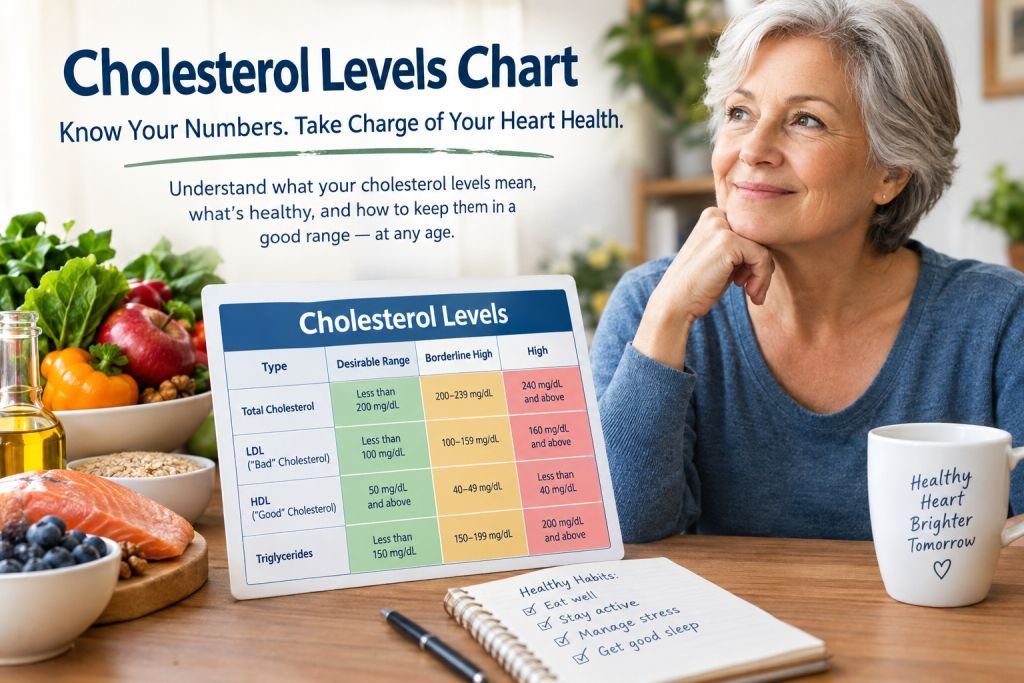
If you have recently received a cholesterol test, the numbers can be confusing. A cholesterol levels chart makes it easier to understand whether your total cholesterol, LDL, HDL, and triglycerides are generally considered healthy, borderline, or high.
For most adults, especially those over 50, cholesterol should not be judged by one number alone. Your age, blood pressure, smoking status, diabetes, family history, previous heart disease or stroke, and other risk factors can change what cholesterol level is appropriate for you.
A useful starting point is an LDL cholesterol level around 100 mg/dL or lower, HDL of at least 40 mg/dL in men and 50 mg/dL in women, triglycerides below 150 mg/dL, and total cholesterol below 200 mg/dL as general reference points. However, current cardiovascular guidance emphasizes individualized risk rather than treating total cholesterol as a stand-alone target.
In this guide, you’ll learn what each number means, how to read a cholesterol chart, what changes after age 50, which foods and habits can help, and when it makes sense to talk with your healthcare professional.
Quick Answer: What Are Healthy Cholesterol Levels?
Here is a simple adult cholesterol levels chart:
| Cholesterol measurement | General healthy/reference level | What it means |
|---|---|---|
| Total cholesterol | Below 200 mg/dL | Generally desirable |
| LDL cholesterol | Around 100 mg/dL or lower | Lower is generally better |
| HDL cholesterol — men | 40 mg/dL or higher | Higher levels are generally associated with lower risk |
| HDL cholesterol — women | 50 mg/dL or higher | Higher levels are generally associated with lower risk |
| Triglycerides | Below 150 mg/dL | Generally healthy |
| Non-HDL cholesterol | Below 130 mg/dL | General healthy reference |
These are general reference points, not personal treatment targets. Someone who already has cardiovascular disease or has a particularly high cardiovascular risk may have a lower LDL goal.
What Is Cholesterol?
Cholesterol is a waxy, fat-like substance that your body needs. Your liver makes cholesterol, and your body uses it for important functions, including making hormones and helping digest fats.
The problem isn’t cholesterol itself. The concern is having unhealthy amounts or combinations of blood lipids that contribute to plaque buildup in arteries.
A cholesterol test is usually called a lipid panel or lipid profile. It commonly measures:
- Total cholesterol
- LDL cholesterol
- HDL cholesterol
- Triglycerides
Some tests also report non-HDL cholesterol and other measurements.
Why Does Cholesterol Matter?
Excess LDL cholesterol can contribute to plaque buildup inside artery walls. Over time, this process, called atherosclerosis, can narrow arteries and increase cardiovascular risk.
That’s why cholesterol is particularly important as you get older. A person may feel completely healthy while having elevated LDL because high cholesterol generally does not cause obvious symptoms.
Cholesterol Levels Chart for Adults
One of the easiest ways to understand your lab report is to look at each measurement separately.
Total Cholesterol Chart
| Total cholesterol | General interpretation |
|---|---|
| Below 200 mg/dL | Desirable |
| 200–239 mg/dL | Borderline high |
| 240 mg/dL or higher | High |
A total cholesterol reading below 200 mg/dL has traditionally been considered desirable. However, the American Heart Association emphasizes that total cholesterol should not be interpreted by itself or used as the sole treatment target.
LDL Cholesterol Chart
| LDL cholesterol | General interpretation |
|---|---|
| Below 100 mg/dL | Optimal/reference level for many adults |
| 100–129 mg/dL | Near optimal |
| 130–159 mg/dL | Borderline high |
| 160–189 mg/dL | High |
| 190 mg/dL or higher | Very high |
LDL is often called “bad” cholesterol because elevated LDL can contribute to plaque formation in arteries.
Importantly, an LDL of 110 mg/dL does not mean exactly the same thing for everyone. Your healthcare professional may recommend a different goal depending on your overall cardiovascular risk.
HDL Cholesterol Chart
| HDL cholesterol | General reference |
|---|---|
| Men: below 40 mg/dL | Low |
| Women: below 50 mg/dL | Low |
| 40+ mg/dL in men | General minimum reference |
| 50+ mg/dL in women | General minimum reference |
| 60+ mg/dL | Often considered favorable |
HDL is commonly called “good” cholesterol because it helps transport cholesterol back toward the liver. But having a high HDL does not simply cancel out a high LDL level.
Triglyceride Chart
| Triglycerides | General interpretation |
|---|---|
| Below 150 mg/dL | Healthy |
| 150–199 mg/dL | Borderline high |
| 200–499 mg/dL | High |
| 500 mg/dL or higher | Very high |
Very high triglycerides deserve medical attention because levels above 500 mg/dL can increase the risk of acute pancreatitis.
Understanding LDL, HDL, and Triglycerides
Think of your lipid panel as several pieces of the same puzzle.
| Measurement | Simple explanation | Why it matters |
|---|---|---|
| LDL | Carries cholesterol around the body | Higher levels can contribute to artery plaque |
| HDL | Helps transport cholesterol back toward the liver | Higher levels are generally associated with lower cardiovascular risk |
| Triglycerides | A type of fat used for stored energy | High levels can add to cardiovascular risk |
| Total cholesterol | Overall cholesterol measurement | Useful for context but shouldn’t be viewed alone |
| Non-HDL | Total cholesterol minus HDL | Captures cholesterol in several potentially harmful particles |
Current cardiovascular guidance recognizes that LDL isn’t the only lipid-related factor that matters. Non-HDL cholesterol, triglyceride-rich particles, lipoprotein(a), and other measures can also help refine cardiovascular risk in appropriate patients.
What Your Total Cholesterol Number Means
Suppose your lab report says:
Total cholesterol: 205 mg/dL
That number alone doesn’t tell you whether you need medication or whether you are at high cardiovascular risk.
For example, two people could both have total cholesterol of 205 mg/dL but have very different LDL, HDL, triglyceride, blood pressure, diabetes, smoking, and family-history profiles.
That’s why doctors generally look at the complete lipid panel along with other cardiovascular risk factors.
What Your LDL Number Means
LDL is usually the number that receives the most attention.
When LDL particles remain elevated in the bloodstream, they can contribute to plaque buildup in artery walls. Over time, plaque can make arteries narrower and less flexible.
For many adults, an LDL around 100 mg/dL or lower is a useful general reference point. But people at higher cardiovascular risk may have substantially lower LDL treatment goals.
Why LDL Can Be Especially Important After 50
After 50, you may have accumulated more cardiovascular risk factors over the years.
For example:
- Blood pressure may be higher than it was in your 30s.
- Physical activity may have decreased.
- Body composition may have changed.
- Blood sugar may have become harder to control.
- Family history becomes more relevant as your overall risk is assessed.
- You may already have cardiovascular disease.
This doesn’t mean that high cholesterol is inevitable with aging. It means your healthcare professional may consider the complete risk picture rather than looking at one lab number.
What Your HDL Number Means
HDL is commonly known as “good” cholesterol.
HDL helps transport cholesterol back toward the liver. Higher HDL levels are generally associated with lower cardiovascular risk.
But there is an important point that often gets missed:
A high HDL does not make a high LDL harmless.
For example, someone could have:
- LDL: 165 mg/dL
- HDL: 70 mg/dL
- Triglycerides: 120 mg/dL
The HDL number may look favorable, but the LDL is still elevated and deserves attention.
The goal isn’t to chase one “good” number. It’s to understand the whole lipid profile.
What Your Triglyceride Number Means
Triglycerides are different from cholesterol. They are a type of fat in your blood that your body can use for energy.
High triglycerides can occur alongside high LDL or low HDL, increasing overall cardiovascular risk.
Triglycerides can be affected by:
- Excess calories
- Alcohol
- High intake of added sugars
- Obesity
- Diabetes
- Certain medications
- Some medical conditions
- Genetic factors
Very high triglycerides are particularly important because they can increase the risk of pancreatitis.
Why Cholesterol Matters More After 50
Being over 50 doesn’t automatically mean your cholesterol should be higher.
In fact, the idea that an older person’s cholesterol is “supposed to be high” can be misleading.
What changes is the importance of looking at cholesterol as part of your overall cardiovascular risk.
For adults over 50, cholesterol management may be considered alongside:
- Blood pressure
- Blood sugar or diabetes
- Smoking
- Physical activity
- Weight and body composition
- Family history
- Kidney health
- Previous heart attack or stroke
- Other cardiovascular conditions
The 2026 American Heart Association/American College of Cardiology dyslipidemia guideline also incorporates newer risk-assessment tools and additional markers such as lipoprotein(a), with treatment goals adjusted according to risk.
10 Factors That Can Affect Cholesterol
1. Saturated Fat Intake
A diet high in saturated fat can raise LDL cholesterol.
Common sources include fatty cuts of meat, butter, full-fat dairy products, and some processed foods.
Replacing some saturated fats with unsaturated fats can be a useful dietary strategy.
2. Physical Activity
Regular physical activity can support a healthier lipid profile and overall cardiovascular health.
Walking, swimming, cycling, dancing, and other activities can be practical choices.
If you’re over 50 and haven’t exercised recently, gradually increasing activity is generally more realistic than suddenly starting an intense workout.
For ideas, see our guide to easiest walking exercises for seniors.
3. Weight Changes
Excess body weight can be associated with higher triglycerides and LDL and lower HDL.
That doesn’t mean weight loss is the only answer. Nutrition quality, activity, sleep, medications, genetics, and medical conditions also matter.
4. Diabetes and Blood Sugar
Type 2 diabetes can affect the lipid profile and increase cardiovascular risk.
If you’re monitoring both cholesterol and glucose, it can be useful to understand how the numbers fit together rather than treating them as completely separate issues.
5. Smoking
Smoking increases cardiovascular risk and is one of the modifiable factors considered in cardiovascular risk assessment.
6. Family History
Some people inherit conditions that cause very high cholesterol.
If close family members have had unusually high cholesterol or heart disease at relatively young ages, tell your healthcare professional.
7. Age
Age itself is a cardiovascular risk factor. You cannot change your age, but you can address many of the other factors that contribute to cardiovascular risk.
8. Certain Medical Conditions
Conditions affecting the thyroid, kidneys, liver, or metabolism can sometimes affect cholesterol levels.
An unexpectedly abnormal lipid panel may therefore lead your healthcare professional to look for other contributing factors.
9. Medications
Some medications can affect cholesterol or triglyceride levels.
Don’t stop or change a prescription medication simply because your cholesterol has changed. Discuss the result with your healthcare professional.
10. Genetics
Lifestyle matters, but genetics matter too.
Some people have high LDL despite eating a balanced diet and exercising regularly. That’s one reason cholesterol management shouldn’t be reduced to “just eat better.”
Foods That May Help Support Healthy Cholesterol
Diet can’t replace medical treatment when treatment is indicated, but food choices can be an important part of cholesterol management.
The NHLBI Therapeutic Lifestyle Changes approach emphasizes reducing saturated fat, increasing soluble fiber, and including foods such as fruits, vegetables, legumes, whole grains, nuts, and healthy oils.
Oats and Other Whole Grains
Oats contain soluble fiber, which can help reduce cholesterol absorption.
Try:
- Oatmeal with berries
- Oats with plain yogurt
- Barley in soup
- Whole-grain cereal with low-fat milk
Beans and Lentils
Beans and lentils provide fiber and plant-based protein.
Good choices include:
- Black beans
- Kidney beans
- Chickpeas
- Lentils
- Navy beans
Vegetables
Build meals around vegetables such as:
- Broccoli
- Spinach
- Carrots
- Bell peppers
- Brussels sprouts
- Green beans
Fruits
Whole fruit provides fiber and nutrients.
Good options include:
- Apples
- Oranges
- Pears
- Berries
- Peaches
Nuts
Walnuts, almonds, pistachios, and other nuts contain unsaturated fats.
Because nuts are calorie-dense, portions still matter.
Fish
Fatty fish such as salmon, sardines, trout, and mackerel provide omega-3 fatty acids and can fit into a heart-healthy eating pattern.
Olive Oil
Using olive oil instead of some solid fats can increase the proportion of unsaturated fat in your diet.
Foods to Limit
You don’t necessarily need to completely eliminate a favorite food.
Instead, pay attention to foods that can make it easier to consume large amounts of saturated fat, added sugar, or calories.
Consider limiting:
- Fatty processed meats
- Bacon and sausage
- Large amounts of butter
- Full-fat dairy products
- Deep-fried foods
- Commercial baked goods high in saturated fat
- Foods containing trans fats
- Sugar-sweetened beverages
- Excess alcohol, especially when triglycerides are high
The overall eating pattern matters more than one meal.
Lifestyle Habits That Can Help
Walk Regularly
A daily walk is a realistic starting point for many adults.
If 30 minutes feels like too much, begin with shorter sessions and build gradually.
Add Strength Training
Strength training becomes increasingly useful as we age because maintaining muscle supports mobility and independence.
It can be as simple as resistance bands, body-weight exercises, or appropriately chosen weights.
Eat More Soluble Fiber
Try adding oats, beans, lentils, apples, pears, and other fiber-rich foods regularly.
Replace Rather Than Simply Remove
Instead of thinking:
“Never eat fat.”
Think:
“Can I replace some saturated fat with unsaturated fat?”
For example, use olive oil instead of butter for some meals.
Don’t Ignore Blood Pressure
Cholesterol is only one piece of cardiovascular health.
EverAgeWell’s blood pressure chart for seniors can help you understand another important heart-health measurement.
Keep Your Brain and Heart Habits Connected
Many habits that support cardiovascular health—regular movement, nutritious food, adequate sleep, and controlling risk factors—also fit into an overall healthy-aging routine.
You can read more in our guide on how to keep your mind sharp at any age.Real-Life Example
Imagine a 62-year-old man receives these results:
| Test | Result |
|---|---|
| Total cholesterol | 218 mg/dL |
| LDL | 142 mg/dL |
| HDL | 52 mg/dL |
| Triglycerides | 120 mg/dL |
At first glance, he might focus only on the total cholesterol of 218.
But the complete picture is more useful.
His triglycerides are below 150 mg/dL, and his HDL is above the general minimum reference for men. His LDL, however, is above the level generally considered optimal.
What happens next depends on his overall cardiovascular risk.
His doctor may consider his blood pressure, diabetes status, smoking history, family history, kidney health, previous cardiovascular disease, and other factors before deciding whether lifestyle changes, medication, additional testing, or some combination is appropriate.
That is why a cholesterol chart is a starting point—not a diagnosis.
Common Cholesterol Myths
Myth 1: “All cholesterol is bad.”
Fact: Your body needs cholesterol for important functions. The concern is having unhealthy levels or combinations of blood lipids that increase cardiovascular risk.
Myth 2: “If my total cholesterol is under 200, I’m automatically healthy.”
Fact: Total cholesterol shouldn’t be interpreted by itself. LDL, HDL, triglycerides, and your other cardiovascular risk factors also matter.
Myth 3: “High HDL cancels out high LDL.”
Fact: HDL is generally associated with lower cardiovascular risk, but a favorable HDL level does not make elevated LDL irrelevant.
Myth 4: “High cholesterol always causes symptoms.”
Fact: High cholesterol usually does not produce noticeable symptoms. A blood test is needed to measure it.
Myth 5: “Only overweight people have high cholesterol.”
Fact: People of any body size can have elevated cholesterol. Genetics, age, diet, medical conditions, medications, and other factors can all play a role.
Myth 6: “If I start a cholesterol medication, I don’t need to change my diet.”
Fact: Medication and lifestyle changes can sometimes be used together. The appropriate approach depends on the person’s cardiovascular risk and medical history.
Myth 7: “Cholesterol naturally becomes high with age, so nothing can be done.”
Fact: Age is a risk factor, but many modifiable factors—including diet, physical activity, smoking, and weight management—can affect cardiovascular risk.
Who Should Pay Particular Attention?
Adults over 50 should take cholesterol results seriously, especially when other cardiovascular risk factors are present.
It’s particularly important to discuss results with a healthcare professional if you have:
- Diabetes
- High blood pressure
- A history of heart disease
- Previous heart attack or stroke
- Kidney disease
- A strong family history of cardiovascular disease
- Very high LDL cholesterol
- Very high triglycerides
- A history of smoking
- Multiple cardiovascular risk factors
Adults who already have cardiovascular disease may have substantially lower LDL treatment goals than the general reference values shown in a basic cholesterol chart.When Should You Talk With a Doctor?
Make an appointment to discuss your cholesterol if your results are repeatedly outside the healthy/reference range.
You should be especially proactive about discussing:
- LDL of 190 mg/dL or higher
- Triglycerides of 500 mg/dL or higher
- A history of heart attack or stroke
- A strong family history of early cardiovascular disease
- Diabetes plus abnormal cholesterol
- Multiple cardiovascular risk factors
Very high triglycerides can increase pancreatitis risk, while very high LDL may indicate a particularly high cardiovascular risk or an inherited lipid disorder.
How to Get Started
If your cholesterol isn’t where you want it to be, avoid trying to change everything overnight.
1. Understand Your Complete Lipid Panel
Write down your:
- Total cholesterol
- LDL
- HDL
- Triglycerides
- Non-HDL cholesterol, if provided
2. Ask About Your Overall Cardiovascular Risk
Don’t ask only, “Is my cholesterol high?”
Also ask:
“What does my cholesterol mean for my overall cardiovascular risk?”
3. Improve One Meal at a Time
Add oatmeal at breakfast, beans to lunch, vegetables to dinner, or nuts as a portion-controlled snack.
4. Increase Movement Gradually
Start with walking or another activity you can do consistently.
5. Review Medications With Your Healthcare Professional
If medication has been recommended, don’t stop or change it without medical guidance.
For adults 40–75 without established cardiovascular disease, the USPSTF recommendations consider cholesterol and other cardiovascular risk factors together with estimated 10-year cardiovascular risk when discussing statin therapy. The evidence and recommendations are different for adults age 76 and older.
6. Recheck as Recommended
Your healthcare professional can determine how often you need another lipid panel based on your health and treatment plan.
Frequently Asked Questions
1. What is a normal cholesterol level?
For many adults, total cholesterol below 200 mg/dL, LDL around or below 100 mg/dL, triglycerides below 150 mg/dL, and HDL at least 40 mg/dL in men or 50 mg/dL in women are commonly used general reference points. Individual targets can be lower depending on cardiovascular risk.
2. What is a good cholesterol level for a 50-year-old?
There isn’t a special cholesterol target simply because someone is 50. The same general lipid reference ranges apply, but the appropriate LDL goal can depend on the person’s overall cardiovascular risk.
3. Is LDL of 100 good?
An LDL of about 100 mg/dL is commonly considered a desirable reference level for many adults. However, people at higher cardiovascular risk may have a lower recommended LDL goal.
4. Is LDL of 130 considered high?
An LDL of 130 mg/dL falls into the commonly used borderline-high range. Whether it requires medication depends on the person’s overall cardiovascular risk and medical history.
5. Is total cholesterol of 220 high?
A total cholesterol of 220 mg/dL is generally considered borderline high. However, the number should be interpreted alongside LDL, HDL, triglycerides, and other cardiovascular risk factors.
6. What is the ideal HDL level?
As a general reference, HDL of at least 40 mg/dL in men and 50 mg/dL in women is considered healthy. HDL of 60 mg/dL or higher is often considered favorable.
7. Are triglycerides the same as cholesterol?
No. Triglycerides are a different type of blood fat. Both triglycerides and cholesterol are commonly measured in a lipid panel.
8. Can you have high cholesterol and feel fine?
Yes. High cholesterol generally doesn’t cause symptoms, which is why blood testing is important.
9. Does exercise lower cholesterol?
Regular physical activity can improve the overall lipid profile and support cardiovascular health. Exercise can help lower LDL and triglycerides and may help raise HDL.
10. What foods help lower LDL cholesterol?
Foods rich in soluble fiber—such as oats, beans, lentils, fruits, and some whole grains—can be useful parts of a heart-healthy eating pattern. Replacing some saturated fats with unsaturated fats may also help.
11. Should I avoid eggs if my cholesterol is high?
Not necessarily. Cholesterol management is more complicated than avoiding one food. Your overall dietary pattern, particularly saturated fat intake, matters. Discuss your individual diet with your healthcare professional if you have significantly elevated cholesterol or cardiovascular disease.
12. Does losing weight lower cholesterol?
For people who are overweight or have obesity, losing excess weight can improve several cardiovascular risk factors, including triglycerides and cholesterol. The amount of change varies from person to person.
13. How often should cholesterol be checked?
Healthy adults may have lipid testing about every five years, although people with elevated cholesterol, diabetes, kidney disease, cardiovascular disease, or other risk factors may need testing more often.
14. Do I need to fast before a cholesterol test?
Not always. Some lipid tests can be performed without fasting, while certain situations may call for fasting. NHLBI and CDC advise following the specific preparation instructions given by your healthcare professional or laboratory.
15. What cholesterol level is dangerous?
There isn’t one number that determines immediate danger for every person. However, LDL of 190 mg/dL or higher and triglycerides above 500 mg/dL are levels that deserve prompt medical discussion.
Final Takeaway
A cholesterol levels chart can help you understand your blood test, but it should not be used as a stand-alone diagnosis.
For many adults, LDL around 100 mg/dL or lower and triglycerides below 150 mg/dL are useful general reference points, while HDL of at least 40 mg/dL for men and 50 mg/dL for women is generally considered a healthy minimum. Total cholesterol below 200 mg/dL is also commonly used as a desirable reference.
But your ideal cholesterol levels may be different depending on your cardiovascular risk.
If you’re over 50, the most useful question isn’t simply, “Is my cholesterol normal?”
It’s:
“What do these numbers mean for my overall heart and blood-vessel health?”
Understanding that bigger picture can help you and your healthcare professional decide whether lifestyle changes, monitoring, medication, or additional testing makes sense.
For more heart-health information, you can also explore EverAgeWell’s Heart Rate Chart for Seniors and Blood Pressure Chart for Seniors.
Medical Disclaimer
This article is for general educational and informational purposes only. It is not a substitute for individualized medical advice, diagnosis, or treatment. Cholesterol goals can vary based on your health history and cardiovascular risk. Talk with a qualified healthcare professional about your personal cholesterol results, medications, and treatment options.
Recommended EverageWell Reading
- How Protein Can Help You Lose Weight After 50
- Fastest Way to Shrink Visceral Fat Safely After 50
- How Many Eggs Should a Senior Eat Per Day?
- Sleep Problems After 50: Causes and Solutions
- 10 Health Benefits of Raspberries
Written by
Kanhaiya Solanki is a dedicated online researcher, content writer, and blogger passionate about publishing high-quality, research-based articles. His goal is to provide accurate, easy-to-understand, and practical information on health, technology, senior care, and lifestyle topics for readers worldwide.