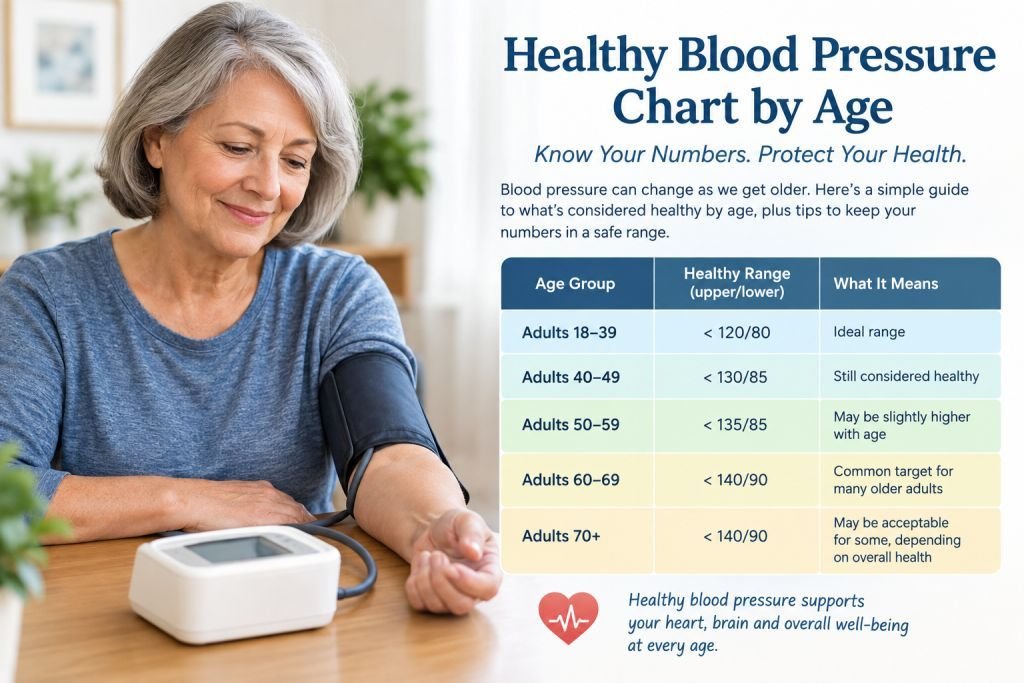
If you’re looking for a healthy blood pressure chart by age, one important point can prevent a lot of confusion: there is not a separate “normal” blood pressure range that automatically becomes higher just because you get older.
For most U.S. adults, including adults in their 50s, 60s, 70s, and beyond, blood pressure is classified using the same adult categories. A reading below 120/80 mm Hg is considered normal. Readings of 130/80 mm Hg or higher fall into a hypertension category, depending on the exact numbers.
Age still matters. Blood pressure tends to become more difficult to control as people get older, and older adults may have other conditions or take medications that affect treatment decisions. But age alone does not mean that a reading such as 150/90 should simply be considered “normal for your age.”
This guide explains what the numbers mean, provides an easy blood pressure chart, discusses what changes after age 50, and shows how to measure blood pressure accurately at home.
Quick Answer: What Is Healthy Blood Pressure by Age?
For U.S. adults, including adults over 50, the current adult blood pressure categories are:
| Blood pressure category | Systolic (top number) | Diastolic (bottom number) |
|---|---|---|
| Normal | Less than 120 | Less than 80 |
| Elevated | 120–129 | Less than 80 |
| Stage 1 hypertension | 130–139 | 80–89 |
| Stage 2 hypertension | 140 or higher | 90 or higher |
| Severe hypertension | Higher than 180 | and/or higher than 120 |
These categories are based on the American Heart Association/American College of Cardiology framework.
A single reading does not necessarily tell you whether you have hypertension. A healthcare professional generally looks at repeated, properly measured readings and may use home or ambulatory monitoring to confirm the diagnosis.
What Is Blood Pressure?
Blood pressure is the force of circulating blood against the walls of your arteries.
A blood pressure reading contains two numbers, such as 118/76 mm Hg.
The top number: systolic pressure
The first number is called systolic blood pressure.
It represents the pressure in your arteries when your heart contracts and pumps blood.
For example, in a reading of 118/76, the systolic pressure is 118.
The bottom number: diastolic pressure
The second number is called diastolic blood pressure.
It represents the pressure in your arteries between heartbeats, when the heart is relaxing.
In 118/76, the diastolic pressure is 76.
Blood pressure is measured in millimeters of mercury (mm Hg).
Both numbers matter.
For example, someone with a reading of 145/76 has a high systolic number even though the diastolic number is below 80.
Healthy Blood Pressure Chart by Age
One of the most common questions is, “What should my blood pressure be at my age?”
The answer is slightly more complicated than many online charts suggest.
Adult blood pressure categories
| Age | Normal category | Elevated category | Stage 1 hypertension | Stage 2 hypertension |
|---|---|---|---|---|
| 40–49 | <120/<80 | 120–129 and <80 | 130–139 or 80–89 | ≥140 or ≥90 |
| 50–59 | <120/<80 | 120–129 and <80 | 130–139 or 80–89 | ≥140 or ≥90 |
| 60–69 | <120/<80 | 120–129 and <80 | 130–139 or 80–89 | ≥140 or ≥90 |
| 70–79 | <120/<80 | 120–129 and <80 | 130–139 or 80–89 | ≥140 or ≥90 |
| 80+ | <120/<80* | 120–129 and <80* | 130–139 or 80–89* | ≥140 or ≥90* |
*The adult classification table does not mean that every older adult should automatically be treated to the same target without considering individual circumstances. The 2025 U.S. hypertension guideline describes an overall treatment goal of below 130/80 mm Hg while emphasizing additional considerations for people who require institutional care, have limited predicted life expectancy, or have other special circumstances. Treatment decisions should be individualized by a healthcare professional.
The important takeaway
You may see websites claiming that a blood pressure such as 140/90 is “normal” for someone in their 70s.
That is an oversimplification.
Getting older does not automatically move a person into a different adult blood pressure category. Instead, healthcare professionals consider the actual blood pressure, overall cardiovascular risk, other medical conditions, medications, functional status, and how the person responds to treatment.
Does Normal Blood Pressure Change With Age?
Not in the simple way many age-based charts suggest.
The current U.S. adult classification system defines normal blood pressure as less than 120/80 mm Hg, regardless of whether an adult is 45 or 75.
However, that does not mean everyone’s blood pressure will remain exactly the same throughout life.
Blood vessels can become less elastic with age, and other changes can contribute to rising systolic blood pressure.
This is one reason high blood pressure becomes particularly important to monitor as people get older.
Blood Pressure in Your 40s
Your 40s can be an important time to establish a baseline.
A reading below 120/80 is in the normal category.
If your readings regularly fall between 120 and 129 systolic while the diastolic remains below 80, the reading is considered elevated.
Lifestyle habits become increasingly important during this period.
Regular physical activity, maintaining a healthy weight, limiting excess sodium, eating a heart-healthy diet, avoiding tobacco, and moderating alcohol intake can all be part of a blood pressure-friendly lifestyle. The 2025 U.S. guideline recommends lifestyle changes for adults with elevated blood pressure or hypertension.
Blood Pressure in Your 50s
For many people, the 50s are when blood pressure deserves more regular attention.
A reading of 128/76 is not classified the same way as 138/86.
The first is elevated blood pressure.
The second falls into stage 1 hypertension because both the systolic and diastolic values can independently place a reading into a higher category.
Don’t judge your blood pressure from one unusual reading.
Instead, look for a pattern.
If you’re repeatedly getting readings around 130/80 or higher, discuss the results with your healthcare professional.
Blood Pressure in Your 60s
Blood pressure management becomes particularly relevant during the 60s.
Some people develop predominantly high systolic pressure, meaning the top number is high while the bottom number may remain below 80.
For example:
148/76
The diastolic number looks reasonable, but the systolic number is in the stage 2 hypertension range.
This pattern can become more common with aging and should not automatically be dismissed as “normal for your age.”
Your healthcare professional may look at repeated readings, your cardiovascular risk, kidney health, diabetes status, medications, and other factors when deciding what treatment is appropriate.
Blood Pressure in Your 70s
Adults in their 70s should continue to take elevated blood pressure seriously.
At the same time, treatment isn’t simply about getting the lowest possible number.
Some older adults have multiple health conditions or take several medications. A healthcare professional may need to balance blood pressure control with other considerations, including symptoms and individual circumstances.
The 2025 AHA/ACC guideline maintains an overall treatment goal of below 130/80 mm Hg for adults, with additional considerations for specific populations.
That is why an individualized plan is more useful than an age-only blood pressure chart.
Blood Pressure After Age 80
People in their 80s can still benefit from knowing and monitoring their blood pressure.
However, medical decisions become especially individualized when someone is very old, frail, has multiple medical conditions, or has a limited life expectancy.
If you’re over 80 and seeing consistently high or unusually low readings, don’t change your medication on your own.
Bring your home blood pressure log to your healthcare professional.
The goal is to understand what your numbers mean in the context of your overall health.
Systolic vs. Diastolic Blood Pressure: Which Number Matters More?
Both numbers matter, but they can tell different parts of the story.
High systolic pressure
High systolic blood pressure means the top number is elevated.
This is particularly common in older adults.
For example:
152/78
The systolic value is high even though the diastolic value is below 80.
High diastolic pressure
A reading such as:
126/86
has a systolic value in the elevated range but a diastolic value in the stage 1 hypertension range.
That’s why you shouldn’t look only at the top number.
What if only one number is high?
Either number can place the reading into a higher category.
For example, 138/92 is stage 2 hypertension because the diastolic number is 90 or higher.
The American Heart Association’s categories use “and/or” because either systolic or diastolic pressure can determine the category.
Why Blood Pressure Often Rises With Age
Several factors can contribute to higher blood pressure as people age.
1. Arteries can become less flexible
Arteries naturally change over time. Reduced elasticity can contribute to higher systolic pressure.
2. Weight can change
Weight gain around the middle is common with aging and can be associated with higher blood pressure.
3. Physical activity may decrease
Retirement, joint problems, busy schedules, or other lifestyle changes can reduce daily movement.
4. Diet can change
Restaurant meals, packaged foods, processed meats, and salty snacks can contribute substantial amounts of sodium.
5. Medications may affect blood pressure
Some prescription and over-the-counter medicines can influence blood pressure.
For example, certain decongestants and nonsteroidal anti-inflammatory drugs can raise blood pressure in some people.
6. Other health conditions can develop
Kidney disease, diabetes, sleep problems, and other conditions can affect cardiovascular health and blood pressure.
This is another reason blood pressure should be considered as part of your overall health rather than as an isolated number.
How to Check Blood Pressure Correctly at Home
Home monitoring can be extremely useful, but only when the measurement is done correctly.
The CDC recommends several steps for getting a more accurate reading.
Step 1: Avoid common triggers beforehand
For about 30 minutes before measuring, avoid:
- Exercise
- Caffeine
- Smoking
- Eating or drinking
Empty your bladder before the measurement.
Step 2: Sit quietly
Sit in a chair with your back supported.
Keep both feet flat on the floor and don’t cross your legs.
Rest quietly for at least five minutes.
Step 3: Position your arm correctly
Place the cuff on bare skin rather than over clothing.
Support your arm so the cuff is approximately at heart level.
Step 4: Don’t talk
Talking, moving around, or using your phone can interfere with an accurate reading.
Step 5: Take more than one reading
The American Heart Association recommends taking two readings about one minute apart and recording the results.
A single reading is a snapshot.
A series of properly measured readings gives your healthcare professional much more useful information.
Ten Things That Can Affect a Blood Pressure Reading
Your blood pressure can change throughout the day.
Here are some common factors that can temporarily affect a reading:
1. Caffeine
Coffee, energy drinks, and some teas contain caffeine that may temporarily affect blood pressure.
2. Exercise
Blood pressure naturally changes during and after physical activity.
3. Smoking
Nicotine can temporarily raise blood pressure.
4. Stress
Feeling anxious, rushed, or upset can affect your reading.
5. Talking
Even an ordinary conversation during measurement can influence the result.
6. A full bladder
The CDC recommends emptying your bladder before measuring blood pressure.
7. Poor sitting position
Unsupported back, crossed legs, or an unsupported arm can affect the measurement.
8. Incorrect cuff size
A cuff that doesn’t fit properly can produce inaccurate results.
9. Measuring over clothing
The cuff should be placed against the bare upper arm.
10. An unvalidated monitor
Not every blood pressure monitor provides equally reliable measurements.
An upper-arm monitor that has been validated for accuracy is generally preferred.
Lifestyle Habits That Support Healthy Blood Pressure
Lifestyle changes can be useful whether you’re trying to prevent high blood pressure or manage an existing diagnosis.
Eat a heart-healthy pattern
The DASH eating pattern is one example of a dietary approach recommended in U.S. blood pressure guidance.
It emphasizes foods such as vegetables, fruits, whole grains, beans, nuts, seeds, low-fat dairy, fish, and lean protein while limiting excess sodium and highly processed foods.
Watch sodium intake
You don’t have to think only about the salt shaker.
Bread, canned foods, sauces, deli meats, frozen meals, restaurant foods, and packaged snacks can all contribute sodium.
Reading Nutrition Facts labels can help you identify where your sodium is coming from.
Get regular physical activity
Walking is a simple option for many adults.
Depending on your health and fitness level, other activities might include cycling, swimming, strength training, or water exercise.
If you’ve been inactive for a long time or have a chronic condition, talk with your healthcare professional about an appropriate starting point.
Maintain a healthy weight
If you have excess weight, even modest lifestyle changes may be useful for cardiovascular health.
Weight management should focus on sustainable habits rather than crash diets.
Don’t smoke
If you smoke, quitting is one of the important steps you can take for cardiovascular health.
Be thoughtful about alcohol
The 2025 U.S. hypertension guideline recommends reducing or eliminating alcohol intake as part of blood pressure prevention and management.
Get enough sleep
Poor sleep can be associated with cardiovascular problems and may make healthy blood pressure management more difficult.
Persistent loud snoring, gasping during sleep, or significant daytime sleepiness may warrant a conversation with a healthcare professional about sleep disorders.
Foods That Can Fit Into a Blood Pressure-Friendly Diet
There is no single food that magically normalizes blood pressure.
Instead, think about your overall eating pattern.
Foods to eat more often
Depending on your individual health needs, consider:
- Leafy green vegetables
- Broccoli and other vegetables
- Berries and other fruits
- Beans and lentils
- Oatmeal and other whole grains
- Unsalted nuts and seeds
- Plain or low-fat yogurt
- Fish
- Skinless poultry
- Lower-sodium soups and canned foods
- Fresh or frozen vegetables without added sauces
Foods to limit
Consider reducing:
- Processed meats
- Highly salted snacks
- Fast food
- Large portions of restaurant meals
- Highly processed frozen meals
- Salty sauces and condiments
- Sugar-sweetened beverages
- Excess alcohol
Don’t automatically take potassium supplements
Potassium is an important nutrient, but supplements aren’t appropriate for everyone.
People with kidney disease or those taking certain medications may need to limit potassium or carefully monitor it.
If you’re considering potassium supplements specifically for blood pressure, ask your healthcare professional first.
What Are the Benefits of Keeping Blood Pressure in a Healthy Range?
Healthy blood pressure management is about more than a number on a home monitor.
It supports cardiovascular health
High blood pressure is an important risk factor for cardiovascular disease.
Managing it can help reduce cardiovascular risk over time.
It can reduce stroke risk
Long-term uncontrolled hypertension is associated with stroke.
Keeping blood pressure under appropriate control is an important part of stroke prevention.
It supports kidney health
The kidneys contain many small blood vessels and can be affected by long-term high blood pressure.
It can help protect overall health as you age
Blood pressure management is one part of maintaining cardiovascular health during your 50s, 60s, 70s, and later years.
The goal isn’t perfection at every individual reading. It’s consistent, appropriate management over time.
Potential Risks and Common Mistakes
Trying to improve blood pressure is generally a positive goal, but some approaches can create problems.
Stopping medication suddenly
Never stop a prescribed blood pressure medication simply because one reading looks good.
Your medication may be one reason the reading is controlled.
Chasing extremely low numbers
Lower isn’t automatically better for every individual.
If treatment causes dizziness, weakness, fainting, or other concerning symptoms, contact your healthcare professional.
Relying on one reading
A single reading can be affected by stress, caffeine, exercise, poor positioning, or measurement errors.
Using a poorly fitting cuff
The cuff must be appropriate for your arm size.
Changing your diet dramatically without considering medical conditions
For example, increasing potassium-rich foods can be helpful for many people, but people with kidney disease or certain medication regimens may need individualized advice.
What If Your Blood Pressure Is High?
First, don’t panic over one mildly elevated measurement.
Sit quietly and repeat the reading using proper technique.
If readings continue to be elevated, keep a record and discuss them with your healthcare professional.
High blood pressure is often diagnosed based on repeated readings rather than one isolated measurement. NHLBI notes that healthcare professionals may need two or more readings at separate appointments to confirm hypertension.
The USPSTF also recommends confirming hypertension outside the clinical setting with ambulatory or home blood pressure measurements before starting treatment in adults without known hypertension.
What If Your Blood Pressure Is Low?
Low blood pressure isn’t automatically dangerous.
Some healthy people naturally have lower readings and feel completely well.
The concern is when low blood pressure is associated with symptoms such as:
- Dizziness
- Fainting
- Weakness
- Confusion
- Blurred vision
- Unusual fatigue
Older adults taking blood pressure medications may be particularly interested in discussing these symptoms with their healthcare professional.
Do not reduce or stop medication without medical guidance.
When Is Blood Pressure an Emergency?
A reading higher than 180 systolic and/or higher than 120 diastolic is considered severe hypertension.
If the reading is this high, repeat it after resting quietly and contact a healthcare professional promptly if it remains elevated.
If blood pressure is above 180/120 and you also have symptoms such as chest pain, shortness of breath, back pain, numbness, weakness, vision changes, or difficulty speaking, call 911.
Don’t wait for the number to come down on its own when severe symptoms are present.
Real-Life Examples
Example 1: A healthy-looking reading
Reading: 116/74
This falls within the normal adult category.
If the person feels well, this is generally a reassuring reading.
Example 2: Elevated blood pressure
Reading: 126/76
The systolic value is elevated, although it is not classified as hypertension.
This may be a useful opportunity to review diet, physical activity, weight, sleep, alcohol intake, and other cardiovascular risk factors.
Example 3: Stage 1 hypertension
Reading: 134/84
Either the systolic or diastolic number can place a reading into stage 1 hypertension.
Repeated readings like this deserve attention.
Example 4: High systolic pressure
Reading: 148/76
The bottom number is below 80, but the top number is in the stage 2 hypertension range.
This is especially important for older adults because systolic hypertension is common with aging.
Example 5: Very high reading
Reading: 186/124
This is above the severe hypertension threshold.
The person should repeat the measurement correctly and seek prompt medical attention. If symptoms such as chest pain, shortness of breath, weakness, vision changes, or difficulty speaking are present, call 911.
Common Myths About Blood Pressure and Age
Myth: “High blood pressure is normal after 60.”
Fact: Blood pressure tends to become more difficult to control with age, but hypertension is not automatically considered normal simply because someone is older.
Myth: “Only the top number matters.”
Fact: Both systolic and diastolic pressure matter. Either number can place a reading into a higher category.
Myth: “One high reading means I have hypertension.”
Fact: A diagnosis generally requires confirmation through repeated measurements and clinical assessment.
Myth: “If I feel fine, my blood pressure must be fine.”
Fact: High blood pressure often has no noticeable warning signs or symptoms. Measuring it is the only way to know your number.
Myth: “Blood pressure medication means I failed.”
Fact: Medication is one of the established tools for managing hypertension. Some people need medication despite making healthy lifestyle changes.
Myth: “Home blood pressure monitors are always accurate.”
Fact: Accuracy depends on the device, cuff size, and measurement technique. Validated upper-arm monitors are preferred.
Myth: “The lower the blood pressure, the better.”
Fact: Blood pressure targets need to be considered in the context of the individual person. Excessively low pressure can be a concern when it causes symptoms or affects organ perfusion.
Who Should Pay Extra Attention to Blood Pressure?
Adults over 50
Blood pressure deserves regular attention as part of routine preventive care.
Adults over 65
Older adults may have additional cardiovascular risk factors and may take multiple medications, making individualized management particularly important.
People with diabetes
Diabetes and hypertension can both increase cardiovascular and kidney risks, so blood pressure management is especially important.
People with kidney disease
Kidney disease can be related to high blood pressure, and blood pressure treatment may require careful medication and dietary decisions.
People taking multiple medications
Prescription drugs, over-the-counter medicines, and supplements can interact or affect blood pressure.
People with frequent dizziness or falls
If you experience dizziness when standing, fainting, or repeated falls, discuss your blood pressure and medications with a healthcare professional.
How to Get Started With Blood Pressure Tracking
If you are over 50 and want to become more aware of your blood pressure, keep it simple.
1. Get a reliable monitor
Look for a validated upper-arm blood pressure monitor with an appropriately sized cuff.
2. Learn the correct technique
Sit quietly for five minutes.
Keep your back supported, feet flat, legs uncrossed, and arm supported at heart level.
3. Create a simple log
Write down:
- Date
- Time
- Systolic pressure
- Diastolic pressure
- Heart rate, if available
- Any unusual symptoms
- Relevant medication information
4. Look for patterns
Don’t become overly focused on a single number.
Patterns over several days can be much more informative.
5. Bring the log to appointments
Your healthcare professional can interpret your readings alongside your medical history and medications.
6. Make one change at a time
For example, start walking regularly or begin checking sodium labels.
Small changes are often easier to maintain than an extreme health overhaul.
Frequently Asked Questions
1. What is a healthy blood pressure for a 50-year-old?
For adults, a normal blood pressure is below 120/80 mm Hg. Age 50 does not create a separate normal category.
2. What is a good blood pressure for someone in their 60s?
A reading below 120/80 falls into the normal category. However, treatment goals should be individualized based on overall health, cardiovascular risk, medications, and other factors.
3. Is 140/90 normal for a 70-year-old?
No. Under current U.S. adult categories, 140 systolic or 90 diastolic falls into stage 2 hypertension.
4. Is 130/80 considered high blood pressure?
Yes. A reading of 130/80 falls into stage 1 hypertension under the current U.S. adult classification system.
5. Is 120/80 perfectly normal?
It is close to the normal threshold, but the current category technically defines normal as systolic below 120 and diastolic below 80. A systolic value of exactly 120 falls into the elevated category when the diastolic value is below 80.
6. What is considered high blood pressure?
For adults, stage 1 hypertension begins at 130–139 systolic or 80–89 diastolic. Stage 2 begins at 140 systolic or 90 diastolic.
7. Can blood pressure be high without symptoms?
Yes. High blood pressure commonly has no warning signs or symptoms, which is why regular measurement is important.
8. Should older adults check blood pressure at home?
Home monitoring can be useful, particularly when recommended by a healthcare professional. It can help identify patterns that aren’t visible from an occasional office measurement.
9. How often should I check my blood pressure?
The appropriate frequency depends on your health and whether you have hypertension. If your healthcare professional asks you to monitor at home, follow their schedule. For diagnostic evaluation, home measurements may be taken repeatedly over several days.
10. Is 150/80 high blood pressure?
Yes. The systolic reading of 150 falls into stage 2 hypertension even though the diastolic value is below 80.
11. Is 110/70 a healthy blood pressure?
For many adults, 110/70 falls within the normal range. If you have dizziness, fainting, weakness, or other symptoms, discuss the reading with your healthcare professional.
12. Can losing weight help blood pressure?
For people who have overweight or obesity, achieving a healthier weight can be part of a blood-pressure management plan. The 2025 U.S. guideline recommends maintaining or achieving a healthy weight as a lifestyle strategy.
13. Does salt raise blood pressure?
A diet high in sodium can contribute to elevated blood pressure in many people. Reducing sodium intake is one of the lifestyle measures recommended in current U.S. hypertension guidance.
14. What should I do if my blood pressure is over 180/120?
Repeat the reading after resting quietly. If it remains above 180/120, contact a healthcare professional promptly. If you also have chest pain, shortness of breath, back pain, numbness, weakness, vision changes, or difficulty speaking, call 911.
15. Can I stop blood pressure medication if my readings improve?
Don’t stop prescribed medication without speaking with your healthcare professional. Improved readings may be a result of the treatment working.
Final Takeaway
A healthy blood pressure chart by age can be useful, but it should not give the impression that high blood pressure becomes normal simply because someone gets older.
For most U.S. adults, less than 120/80 mm Hg is the normal category, while persistent readings of 130/80 or higher fall into a hypertension category under current U.S. guidance.
For adults over 50, the most useful approach is to know your numbers, measure them correctly, watch the trend over time, and discuss persistent changes with your healthcare professional.
Blood pressure is only one part of your health picture. Your age, medical history, medications, kidney health, diabetes status, cardiovascular risk, lifestyle, and symptoms all matter when deciding what your personal treatment goal should be.
Medical Disclaimer
This article is provided for general educational and informational purposes only. It is not a substitute for individualized medical advice, diagnosis, or treatment. Blood pressure targets and treatment decisions can vary from person to person. If you have consistently high or unusually low readings, symptoms, or questions about blood pressure medication, speak with a qualified healthcare professional. For severe blood pressure readings accompanied by emergency symptoms, call 911.
Also Read –
Heart Rate Chart for Seniors: 7 Normal Resting Pulse Ranges and Warning Signs
Daily Water Intake Chart for Seniors: Complete Hydration Guide for Healthy Aging
Blood Sugar Chart for Seniors: 2026 Complete Guide With Normal Ranges
Written by
Kanhaiya Solanki is a dedicated online researcher, content writer, and blogger passionate about publishing high-quality, research-based articles. His goal is to provide accurate, easy-to-understand, and practical information on health, technology, senior care, and lifestyle topics for readers worldwide.