For many adults over 50, forgetting an appointment, misplacing keys, or wondering what needs to be done next can be frustrating. A simple daily routine and a well-designed memory board can make everyday life easier by putting important information where it is easy to see.
Senior daily routine and memory boards are not intended to “fix” memory loss or prevent dementia. Instead, they are practical organization tools. A predictable routine reduces the number of things a person has to remember, while a memory board can provide visual reminders for appointments, medications, meals, activities, names, phone numbers, and other daily information.
Occasional forgetfulness can happen with normal aging. However, significant changes in memory, thinking, judgment, or the ability to complete everyday activities should not simply be dismissed as getting older. The National Institute on Aging recommends talking with a healthcare professional about memory changes that are concerning or interfere with daily life.
In this guide, you’ll learn how to create a realistic daily routine for an older adult, what to put on a memory board, how to use visual reminders effectively, common mistakes to avoid, and when memory problems deserve medical attention.
Do Daily Routines and Memory Boards Help Seniors?
Yes, they can be useful support tools. A consistent routine can make everyday tasks more predictable, while calendars, written daily plans, notes, medication reminders, and other visual aids can help someone manage memory difficulties.
The National Institute on Aging specifically describes tools such as large calendars, daily lists, written directions, safety notes, and medication reminders as strategies families may use to support someone with serious memory problems.
A good system should:
- Be simple enough to use every day
- Use large, easy-to-read writing
- Keep important information in one consistent location
- Follow roughly the same schedule each day
- Include appointments and important reminders
- Avoid overwhelming the person with too much information
- Be adjusted as their needs change
Most importantly, a memory board is a support tool, not a medical treatment.
What Is a Senior Daily Routine?
A senior daily routine is a predictable sequence of activities performed at approximately the same time each day.
For example:
- Wake up
- Get dressed
- Take prescribed morning medications
- Eat breakfast
- Take a short walk
- Complete household tasks
- Eat lunch
- Rest or participate in an activity
- Have dinner
- Prepare for bed
- Go to sleep
The exact schedule does not need to be rigid. The goal is to create enough consistency that the person knows what generally happens next.
This can be especially helpful when someone is becoming more forgetful or has difficulty organizing multiple tasks.
The National Institute on Aging notes that maintaining everyday routines can be part of supporting someone experiencing memory problems.
What Is a Memory Board?
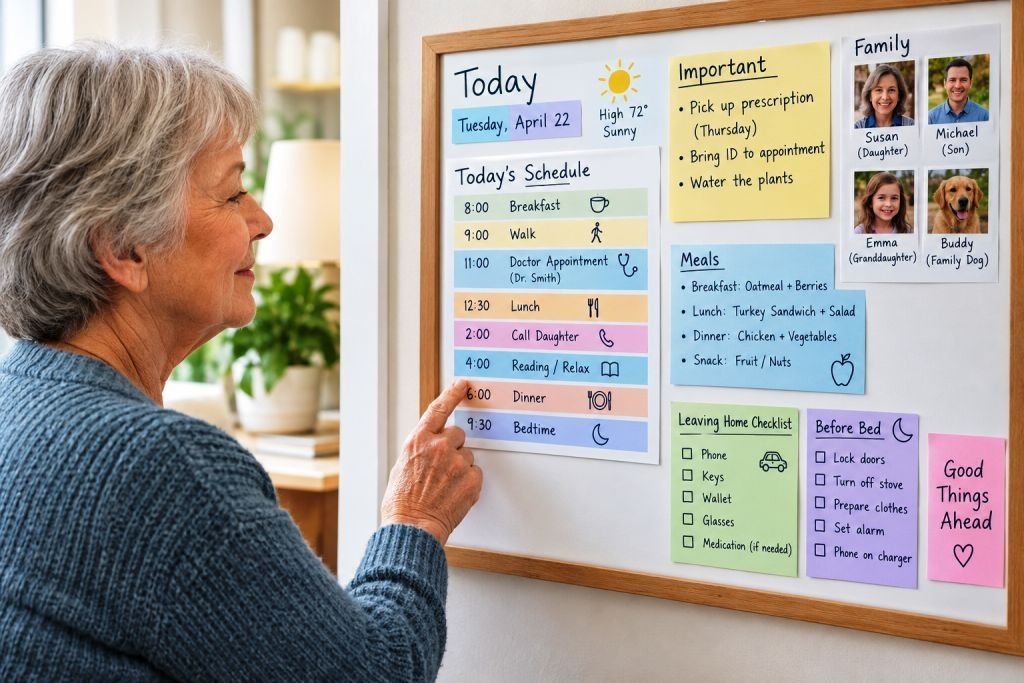
A memory board is a physical display that contains useful information and reminders.
It might be a whiteboard, corkboard, magnetic board, dry-erase calendar, or another easy-to-update surface.
A basic board could show:
Today: Tuesday
Date: September 15
Weather: Warm
Morning: Breakfast + walk
11:00 AM: Doctor appointment
Lunch: 12:30 PM
Afternoon: Call daughter
Evening: Dinner + television
Bedtime: 9:30 PM
A more advanced board might also include a weekly calendar, emergency contacts, medication reminders, family photographs, or instructions for common household tasks.
The best memory board is not necessarily the biggest one. It is the one the person can understand and use without becoming confused.
Senior Daily Routine vs. Memory Board
These two tools work together, but they are not the same thing.
| Feature | Daily Routine | Memory Board |
|---|---|---|
| Main purpose | Creates predictable habits | Provides visible reminders |
| Format | Sequence of activities | Written or visual information |
| Example | Breakfast at 8 AM | “Breakfast at 8 AM” |
| Frequency | Repeated daily | Updated as needed |
| Best for | Structure and consistency | Dates, tasks, appointments |
| Can involve family? | Yes | Yes |
| Can be digital? | Yes | Yes |
| Can be physical? | Yes | Yes |
Think of the routine as the plan and the memory board as the visual reminder of the plan.
Why Consistency Can Be Helpful
Memory is only one part of completing a task. People also need attention, planning, organization, and the ability to move from one step to another.
When activities happen in a familiar order, there may be fewer decisions to make.
For example, someone who always:
- Gets up
- Uses the bathroom
- Gets dressed
- Takes prescribed morning medication
- Eats breakfast
doesn’t have to decide from scratch what comes next each morning.
This does not mean a routine prevents cognitive decline. Rather, it can make daily life more manageable and reduce dependence on remembering every small step.
NIA explains that cognitive health affects everyday activities such as taking medicine, cooking, driving, paying bills, and other routine tasks.
What Should You Put on a Senior Memory Board?
A memory board should contain information that is genuinely useful.
1. Today’s Date
Place the day and date at the top.
For example:
Tuesday, September 15, 2026
For someone who sometimes loses track of dates, seeing the date regularly can provide useful orientation.
2. Daily Schedule
List only the most important activities.
Instead of writing:
“8:00 breakfast, 8:30 dishes, 9:00 read newspaper, 9:30 laundry, 10:00 clean kitchen…”
consider:
- Breakfast
- Morning walk
- Doctor appointment
- Lunch
- Family phone call
- Dinner
Too much information can make the board harder to use.
3. Appointments
Include:
- Doctor visits
- Dental appointments
- Haircuts
- Social events
- Church or community activities
- Physical therapy appointments
- Family visits
Write the time and location when appropriate.
4. Important Phone Numbers
Depending on the person’s needs, the board might include:
- Spouse or caregiver
- Adult child
- Primary healthcare provider
- Emergency contact
Avoid displaying sensitive financial information, passwords, Social Security numbers, or other private information.
5. Medication Reminders
A board can say:
Morning medication — check medication organizer
However, medication instructions should come from the person’s healthcare professional or pharmacist.
A memory board should not be used to independently change medication doses or schedules.
6. Meals
Simple meal reminders can help structure the day.
For example:
Breakfast: Oatmeal + berries
Lunch: Turkey sandwich + vegetables
Dinner: Chicken + brown rice + salad
The actual food should be individualized to the person’s health needs.
7. Family Photos and Names
For someone experiencing memory difficulties, photographs labeled with names can sometimes serve as useful visual cues.
For example:
Susan — Daughter
Mike — Son
Emma — Granddaughter
This can also make the board feel personal rather than like a medical chart.
8. Safety Reminders
Depending on the situation, a small section might say:
- Turn off stove after cooking
- Lock the door
- Take phone when leaving
- Bring keys
- Check that the car is locked
Safety reminders should be personalized to the person’s actual needs.
9. Weather and Clothing
A simple weather reminder can help someone decide what to wear.
For example:
Today’s weather: Cool and rainy
Bring jacket and umbrella
10. One Positive Activity
Don’t make the board entirely about chores and medical appointments.
Include something enjoyable:
- Call a friend
- Garden
- Listen to music
- Read
- Walk outside
- Work on a puzzle
- Visit family
Daily life should include enjoyable activities, not just responsibilities.
How to Build a Simple Morning Routine
Mornings often set the tone for the rest of the day.
A practical routine might look like this:
Step 1: Wake Up at a Consistent Time
Try to maintain a reasonably consistent wake-up schedule.
Step 2: Bathroom and Personal Care
Allow enough time for:
- Bathroom use
- Brushing teeth
- Washing
- Dressing
- Grooming
Step 3: Review the Memory Board
Make checking the board part of the routine.
The person can look at:
- Today’s date
- Weather
- Appointments
- Important activities
- Meal plans
Step 4: Breakfast
Choose a balanced breakfast appropriate for the person’s dietary needs.
Examples include:
- Oatmeal with berries and nuts
- Eggs with whole-grain toast
- Greek yogurt with fruit
- Vegetable omelet
- Peanut butter on whole-grain toast
Step 5: Physical Activity
A short walk, stretching session, gardening, or another appropriate activity can be included.
Regular physical activity has benefits for cardiovascular health, sleep, mood, physical function, and brain health. CDC guidance notes that physical activity can help maintain thinking skills and is associated with a lower risk of cognitive decline and dementia.
Creating an Afternoon and Evening Routine
The afternoon can include practical activities without becoming overly scheduled.
A sample structure:
12:30 PM: Lunch
1:30 PM: Rest
2:00 PM: Hobby or household activity
3:30 PM: Snack or hydration
4:00 PM: Short walk or social activity
5:30 PM: Dinner preparation
6:30 PM: Dinner
7:30 PM: Relaxing activity
9:00 PM: Prepare for bed
The schedule should be adjusted for the person’s energy, medical needs, work responsibilities, and sleep habits.
For adults 65 and older, CDC recommendations include aerobic activity, muscle-strengthening activity, and balance activities each week, adjusted to individual abilities and health conditions.
10 Practical Memory-Board Ideas
1. Today Board
Keep only today’s most important information visible.
2. Weekly Calendar
Use a seven-day calendar for appointments and activities.
3. Medication Check Area
Use a simple reminder such as:
Morning — checked
Afternoon — checked
Evening — checked
This should complement, not replace, a proper medication-management system.
4. Family Board
Include photographs and names of frequently contacted family members.
5. “Leaving Home” Checklist
A small checklist might say:
- Phone
- Keys
- Wallet
- Glasses
- Medication if needed
6. “Before Bed” Checklist
For example:
- Lock doors
- Turn off stove
- Set alarm
- Put phone on charger
- Prepare clothes for tomorrow
7. Important Events Board
Use a separate section for birthdays, appointments, family visits, and other major events.
8. Meal Board
List breakfast, lunch, dinner, and planned snacks.
9. Activity Board
Include walking, exercise, hobbies, social events, and appointments.
10. Combined Family Board
A caregiver and older adult can review the board together once or twice a day.
Exercise, Sleep, and Brain Health
A memory board is only one part of supporting healthy aging.
Daily habits matter too.
Physical Activity
Movement can support overall health and brain health. CDC information notes that physical activity can improve thinking and learning and may reduce the risk of cognitive decline.
A person who cannot perform traditional exercise may still be able to participate in activities such as:
- Walking
- Gardening
- Dancing
- Water exercise
- Chair exercises
- Light household activities
The right activity depends on individual abilities and medical conditions.
Sleep
Poor sleep can make concentration and memory feel worse.
A consistent bedtime routine can help establish predictable sleep habits.
A nighttime routine might include:
- Reduce stimulating activities
- Dim the lights
- Take prescribed nighttime medication as directed
- Brush teeth
- Prepare clothes for tomorrow
- Go to bed at a consistent time
Persistent sleep problems should be discussed with a healthcare professional.
Social Connection
Social activities can also be an important part of a healthy routine.
Consider:
- Calling family
- Meeting a friend
- Attending a community group
- Participating in a hobby
- Volunteering
- Joining an exercise class
The goal is not to create a perfect schedule. It is to build a life that is structured while still enjoyable.
Medication and Appointment Reminders
Medication management deserves special attention.
A memory board can remind someone that medication time has arrived, but it should not become the only system for medication management.
Depending on the person’s needs, families may also use:
- Pill organizers
- Pharmacy packaging
- Smartphone reminders
- Medication reminder devices
- Caregiver check-ins
NIA describes medication reminders, including mobile technology, as one tool families may use to support people experiencing memory problems.
If someone repeatedly forgets whether medication was taken, accidentally takes a dose twice, or has difficulty managing prescriptions, speak with a healthcare professional or pharmacist rather than relying solely on a written reminder.
Common Mistakes to Avoid
Making the Board Too Complicated
A board filled with 30 tasks can become another source of confusion.
Keep the most important information visible.
Changing the Layout Constantly
Put the date, schedule, appointments, and reminders in consistent locations.
Using Tiny Writing
Older adults may have difficulty reading small text.
Use large, high-contrast lettering that is easy to read.
Treating the Board Like a Test
Don’t repeatedly ask:
“What day is it?”
“Do you remember where you’re going?”
The goal is to provide support, not test the person’s memory.
Including Sensitive Information
Do not place passwords, bank information, Social Security numbers, or other confidential information on an exposed board.
Using the Board Instead of Medical Evaluation
A memory board can make daily life easier, but it cannot determine why someone is experiencing memory loss.
Potential Benefits of a Routine and Memory Board
Better Organization
A visible schedule can reduce the need to remember every appointment or task mentally.
Greater Independence
Some people may be able to complete more daily activities when reminders are available.
Less Caregiver Guesswork
Family members can see what is planned and identify areas where additional support may be needed.
More Predictable Days
A consistent routine can make daily activities easier to anticipate.
Better Communication
A shared board can give family members and caregivers a common reference point.
Support for Everyday Tasks
Written instructions and reminders can make familiar activities easier to manage.
NIA resources specifically recommend tools such as large calendars, daily plans, written directions, and safety notes for people experiencing significant memory problems.
What Memory Boards Cannot Do
It is important not to overstate what these tools can accomplish.
A memory board cannot:
- Cure dementia
- Reverse Alzheimer’s disease
- Guarantee better memory
- Replace a doctor
- Replace appropriate medication management
- Diagnose cognitive impairment
- Prevent every accident
- Replace supervision when supervision is medically necessary
Think of it as an environmental support tool.
The goal is to make important information easier to access.
Sample Daily Routine for an Adult Over 50
Here is an example of a relatively simple routine.
| Time | Activity |
|---|---|
| 7:00 AM | Wake up and personal care |
| 7:30 AM | Breakfast |
| 8:00 AM | Review memory board |
| 8:30 AM | Walk or appropriate exercise |
| 9:15 AM | Shower and household tasks |
| 10:30 AM | Hobby, reading, or social activity |
| 12:30 PM | Lunch |
| 1:30 PM | Rest |
| 2:00 PM | Errands, hobby, or family call |
| 4:00 PM | Light activity and hydration |
| 6:00 PM | Dinner |
| 7:00 PM | Relaxing activity |
| 8:30 PM | Prepare for tomorrow |
| 9:30 PM | Bedtime routine |
This is only an example. A person’s actual schedule should reflect their health, responsibilities, preferences, and sleep needs.
Sample Memory Board Layout
A simple physical board could be divided into five sections:
TODAY
Date: __________
TODAY’S PLAN
- Breakfast
- Walk
- Appointment
- Lunch
- Family call
- Dinner
IMPORTANT
- Doctor appointment: 2:00 PM
- Pick up prescription: Thursday
PEOPLE
- Susan — Daughter
- Michael — Son
BEFORE BED
- Lock doors
- Turn off stove
- Prepare tomorrow’s clothes
- Set alarm
This format is intentionally simple.
If a person has cognitive impairment, the board may need to be even simpler.
Common Myths About Senior Memory and Routines
Myth: Forgetting things always means dementia.
Fact: Occasional forgetfulness can occur with normal aging. More serious or progressively worsening problems that interfere with everyday activities deserve medical evaluation.
Myth: A memory board can prevent dementia.
Fact: A memory board is an organizational aid. It does not prevent or cure dementia.
Myth: Older adults should avoid exercise to protect their brains.
Fact: Physical activity is generally beneficial for older adults and is associated with important physical and brain-health benefits. Activity should be adapted to individual abilities and medical conditions.
Myth: The more information on a memory board, the better.
Fact: Too much information can make the board difficult to understand. Simple and relevant information is usually more practical.
Myth: A routine must happen at exactly the same minute every day.
Fact: Consistency is useful, but a routine does not need to be rigid. Flexibility is important for appointments, family activities, travel, and unexpected events.
Myth: Memory problems are simply a normal part of getting older.
Fact: Some forgetfulness is common, but dementia is not considered a normal part of aging. Significant changes should be discussed with a healthcare professional.
Who Should Be More Careful?
A routine and memory board can be useful for many adults, but additional care may be needed when someone has:
- Mild cognitive impairment
- Alzheimer’s disease or another dementia
- Significant medication-management problems
- Frequent falls
- Wandering or getting lost
- Difficulty cooking safely
- Problems managing money
- Major changes in judgment
- Severe vision or hearing problems
Someone with significant memory impairment may need more than reminders.
For example, if a person repeatedly leaves the stove on despite seeing a reminder, the issue is no longer simply a lack of organization. The household may need additional safety measures and professional guidance.
NIA identifies problems such as poor judgment, difficulty handling bills, getting lost, and trouble completing familiar daily activities as potential signs of more significant cognitive problems.
When Should Memory Problems Be Discussed With a Doctor?
A doctor should be contacted when memory or thinking changes are persistent, worsening, or interfering with everyday life.
Examples include:
- Frequently forgetting important recent events
- Repeatedly asking the same questions
- Having increasing difficulty paying bills
- Getting lost in familiar places
- Struggling with familiar tasks
- Significant changes in judgment
- Major personality or behavior changes
- Difficulty managing medications
- Memory problems that concern the person or family
These symptoms do not automatically mean Alzheimer’s disease. Memory and thinking problems can have different causes, and identifying the cause is important.
How to Get Started With a Senior Memory Board
1. Choose One Location
Pick a location that the person naturally sees every morning.
A kitchen, hallway, bedroom entrance, or home office may work.
2. Keep the Design Simple
Start with only:
- Date
- Today’s schedule
- Appointments
- Important reminders
3. Use Large, Clear Text
Avoid decorative fonts and crowded writing.
4. Establish a Daily Review
Make checking the board part of the morning routine.
5. Update It at the Same Time
A family member or caregiver can update the board every evening for the following day.
6. Add Information Slowly
Don’t add ten new sections on the first day.
Start with the information that solves the biggest problem.
7. Review What Works
After a week or two, ask:
- Is the board being used?
- Is anything confusing?
- Is there unnecessary information?
- Are important appointments easy to find?
Then adjust it.
Frequently Asked Questions
1. What is a senior daily routine and memory board?
It is a combination of a predictable daily schedule and a visual reminder system designed to make everyday information easier to remember and access.
2. Can a memory board help with forgetfulness?
It can provide external reminders for appointments, tasks, dates, meals, and other information. It does not treat the underlying cause of memory loss.
3. What should go on a senior memory board?
Useful information can include the date, appointments, daily activities, important contacts, meal plans, safety reminders, and family names or photographs.
4. Where should a memory board be placed?
Choose a location the person naturally visits every day, such as the kitchen or near the bedroom.
5. Should a memory board include medications?
It can include a reminder to take medication, but it should not replace appropriate medication-management systems or professional instructions.
6. What is the best daily routine for someone over 50?
There is no single perfect routine. A useful routine generally includes regular meals, appropriate physical activity, personal care, social or mentally engaging activities, rest, and a consistent sleep schedule.
7. Does a daily routine improve memory?
A routine can make daily activities more predictable and reduce the amount of information someone has to remember. It should not be described as a treatment for memory loss.
8. Can exercise help brain health in older adults?
Yes. Regular physical activity is associated with benefits for brain health and may reduce the risk of cognitive decline.
9. Should older adults exercise every day?
Some form of movement can be incorporated frequently, but the type and intensity should match the person’s abilities and health. Adults 65 and older are generally advised to include aerobic, muscle-strengthening, and balance activities each week.
10. Is forgetfulness normal after age 50?
Occasional forgetfulness can happen with normal aging. However, memory problems that interfere with everyday life should be discussed with a healthcare professional.
11. Can a memory board prevent Alzheimer’s disease?
No. A memory board is a practical organizational tool, not a treatment or prevention method for Alzheimer’s disease.
12. How often should a memory board be updated?
Daily information should generally be reviewed and updated every day. A weekly calendar can be updated as appointments and activities change.
13. What if the person refuses to use the memory board?
Avoid treating it like homework or a test. Make it easy, attractive, and relevant. Let the person participate in choosing the layout and deciding what information is included.
14. Can a smartphone replace a physical memory board?
Sometimes. Digital calendars, alarms, reminder apps, and wearable devices can be useful. However, a physical board may be easier to see and use for someone who is uncomfortable with technology.
15. When should memory problems be evaluated?
If memory or thinking changes are persistent, worsening, or interfering with everyday tasks, talk with a healthcare professional.
Final Takeaway
A good senior daily routine and memory board doesn’t have to be complicated. In fact, the simplest systems are often the easiest to maintain.
Start with one predictable daily routine and one clearly visible board. Put the date, important appointments, a few daily activities, and essential reminders where they can be seen easily. Then build from there if additional support is needed.
Remember that visual reminders are tools for organization, not treatments for dementia or significant memory loss. If someone is increasingly struggling with familiar tasks, finances, medication management, judgment, or everyday activities, don’t assume it is simply normal aging. A healthcare professional can help determine what may be causing the changes and what support is appropriate.
The goal is not to create a perfectly scheduled life. It is to make everyday life safer, more predictable, and easier to navigate while preserving as much independence as possible.
Disclaimer:
This article is for general educational and informational purposes only. It does not provide individualized medical advice, diagnosis, or treatment. Memory changes can have many possible causes. If you or someone you care for has concerning or worsening changes in memory, thinking, behavior, or daily functioning, speak with a qualified healthcare professional.
Also Read:
- Salmon Benefits: Powerful Reasons to Eat More Salmon
- Blueberries: 25 Powerful Health Benefits for a Healthier Life
- 30 Super Foods for a Healthier You: Eat Better Every Day
Written by:
Kanhaiya Solanki is a dedicated online researcher, content writer, and blogger passionate about publishing high-quality, research-based articles. His goal is to provide accurate, easy-to-understand, and practical information on health, technology, senior care, and lifestyle topics for readers worldwide.