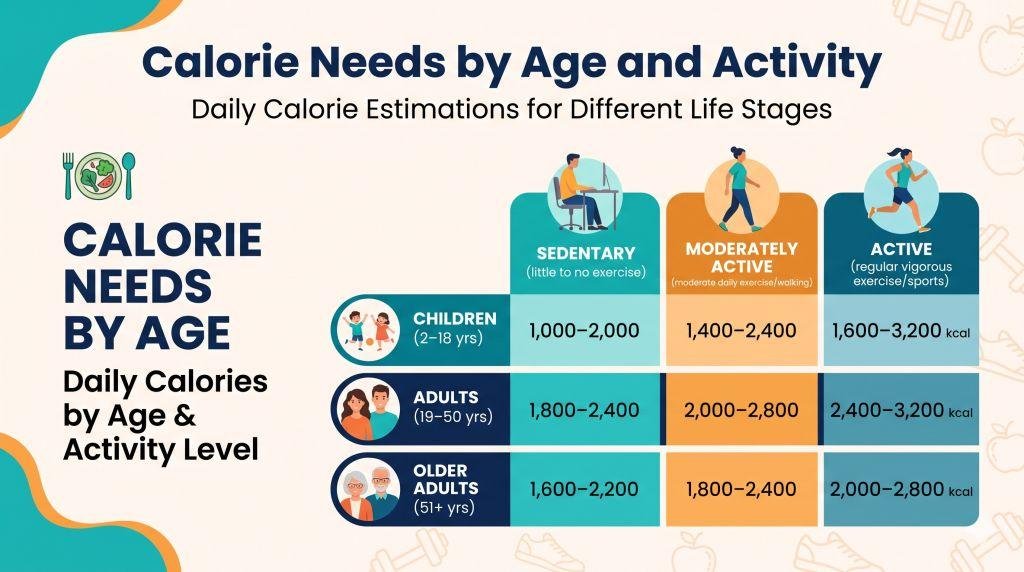
How many calories do you actually need each day? There is no single number that works for everyone. Your calorie needs depend on several factors, including age, sex, activity level, body size, and overall health.
Still, a calorie needs by age chart can provide a useful starting point. U.S. dietary guidance estimates that calorie requirements generally decline as adults get older, particularly when physical activity also decreases. For example, a sedentary woman age 61–65 may need about 1,600 calories per day, while a sedentary man in the same age group may need about 2,000 calories.
That does not mean every 65-year-old woman should eat exactly 1,600 calories or every 65-year-old man should eat exactly 2,000. These are population-level estimates, not personalized prescriptions.
This becomes especially important after age 50. Many older adults need fewer calories than they did when they were younger, but they still need plenty of protein, fiber, vitamins, minerals, and other nutrients. The National Institute on Aging notes that older adults often need fewer calories while still needing nutrient-dense foods.
In this guide, you’ll find a practical calorie chart by age, sex, and activity level, along with tips for maintaining weight, losing weight safely, avoiding under-eating, and making your calories count.
Quick Answer: How Many Calories Do You Need by Age?
For adults, daily calorie needs generally fall within these broad ranges:
- Women age 51–60: about 1,600–2,200 calories per day
- Women age 61 and older: about 1,600–2,000 calories per day
- Men age 51–60: about 2,200–2,800 calories per day
- Men age 61 and older: about 2,000–2,600 calories per day
The lower end generally applies to sedentary adults, while the higher end applies to more active adults.
Your personal calorie requirement may be higher or lower depending on your height, weight, muscle mass, activity, medications, and health conditions.
What Are Calorie Needs?
A calorie is a unit used to measure energy. Your body gets energy from food and beverages and uses that energy for everything from breathing and circulating blood to walking, exercising, digesting food, and maintaining body temperature.
Your daily calorie requirement is sometimes called your energy need.
Think of it as your body’s daily energy budget.
If you regularly consume approximately as much energy as your body uses, your weight may remain relatively stable. If you consistently consume more than you use, weight gain can occur. If you consume less than you use, weight loss can occur.
But the process is not quite as simple as a calculator might make it seem.
Your calorie needs can change with:
- Age
- Sex
- Height
- Weight
- Muscle mass
- Physical activity
- Daily movement
- Health conditions
- Certain medications
- Changes in body composition
The CDC also notes that age, sleep, medications, medical conditions, genes, and physical activity can all influence weight management.
Calorie Needs by Age Chart
The following table provides estimated daily calorie needs for adults based on age, sex, and activity level.
These estimates are based on U.S. dietary guidance and are intended as a general reference rather than an individualized diet prescription.
Daily Calorie Needs for Adult Men
| Age | Sedentary | Moderately Active | Active |
|---|---|---|---|
| 19–20 | 2,600 | 2,800 | 3,000 |
| 21–25 | 2,400 | 2,800 | 3,000 |
| 26–30 | 2,400 | 2,600 | 3,000 |
| 31–35 | 2,400 | 2,600 | 3,000 |
| 36–40 | 2,400 | 2,600 | 2,800 |
| 41–45 | 2,200 | 2,600 | 2,800 |
| 46–50 | 2,200 | 2,400 | 2,800 |
| 51–55 | 2,200 | 2,400 | 2,800 |
| 56–60 | 2,200 | 2,400 | 2,600 |
| 61–65 | 2,000 | 2,400 | 2,600 |
| 66–70 | 2,000 | 2,200 | 2,600 |
| 71–75 | 2,000 | 2,200 | 2,600 |
| 76+ | 2,000 | 2,200 | 2,400 |
Daily Calorie Needs for Adult Women
| Age | Sedentary | Moderately Active | Active |
|---|---|---|---|
| 19–20 | 2,000 | 2,200 | 2,400 |
| 21–25 | 2,000 | 2,200 | 2,400 |
| 26–30 | 1,800 | 2,000 | 2,400 |
| 31–35 | 1,800 | 2,000 | 2,200 |
| 36–40 | 1,800 | 2,000 | 2,200 |
| 41–45 | 1,800 | 2,000 | 2,200 |
| 46–50 | 1,800 | 2,000 | 2,200 |
| 51–55 | 1,600 | 1,800 | 2,200 |
| 56–60 | 1,600 | 1,800 | 2,200 |
| 61–65 | 1,600 | 1,800 | 2,000 |
| 66–70 | 1,600 | 1,800 | 2,000 |
| 71–75 | 1,600 | 1,800 | 2,000 |
| 76+ | 1,600 | 1,800 | 2,000 |
These figures are estimates. The original U.S. guidance defines sedentary as activity limited to normal independent living, moderately active as activity roughly equivalent to walking 1.5–3 miles per day at 3–4 mph in addition to daily living, and active as activity equivalent to walking more than 3 miles per day at that pace.
Understanding Sedentary, Moderately Active, and Active
The word active can be confusing.
Someone may exercise three times a week but still spend most of the day sitting. Another person may not visit a gym but walk, garden, do household work, and stay on their feet for much of the day.
Here is a simple way to understand the categories.
Sedentary
A sedentary lifestyle generally means your daily movement is limited to routine activities such as:
- Cooking
- Shopping
- Walking around the house
- Basic household tasks
- Normal activities of independent living
It does not necessarily mean you never exercise.
Moderately Active
Moderately active generally means you do regular movement beyond everyday living.
This could include:
- Brisk walking
- Gardening
- Regular recreational activities
- Walking several miles throughout the day
- Exercise sessions combined with an active lifestyle
Active
An active lifestyle involves substantially more physical movement.
Examples may include:
- Regular aerobic exercise
- Long walks
- Hiking
- Cycling
- Frequent sports
- Physically demanding work
Your activity level can change from one year to the next, so your calorie needs can change too.
How Calorie Needs Change With Age
One reason people search for daily calorie needs by age is that the number they needed in their 30s may no longer feel appropriate in their 60s or 70s.
Several changes can contribute.
1. Muscle Mass May Decline
Muscle tissue uses energy even when you’re resting.
As people age, muscle mass can decline, particularly when they are not doing regular resistance exercise. This can contribute to lower overall energy requirements.
That doesn’t mean losing muscle is inevitable. Strength training and adequate nutrition can help older adults maintain physical function and muscle.
2. Physical Activity May Decrease
Retirement, joint problems, changes in work routines, or simply spending more time at home can reduce daily movement.
Even small changes can add up.
Someone who walked several miles during a workday at age 45 may burn substantially fewer calories after retirement if most of the day is spent sitting.
3. Body Composition Changes
The CDC notes that body composition gradually changes with age, with muscle generally decreasing and body fat increasing. These changes can slow metabolism and make weight gain easier for some people.
4. Appetite May Not Match Nutritional Needs
Older adults may need fewer calories, but they still need essential nutrients.
This creates an important nutrition challenge:
Fewer calories does not mean fewer nutritional needs.
A 1,600-calorie diet made mostly of refined carbohydrates, sweets, and sugary drinks is very different from a 1,600-calorie diet containing vegetables, fruit, beans, whole grains, lean protein, dairy or fortified alternatives, nuts, seeds, and healthy fats.
Why Adults Over 50 Need to Pay Attention to Food Quality
After 50, calorie quantity matters, but food quality becomes increasingly important.
The National Institute on Aging emphasizes that older adults may need fewer calories while still requiring nutrient-dense foods.
Nutrient-dense foods provide more vitamins, minerals, protein, fiber, and other useful nutrients relative to their calorie content.
Good choices include:
- Eggs
- Fish
- Chicken or turkey
- Greek yogurt
- Cottage cheese
- Beans and lentils
- Oatmeal
- Whole grains
- Berries
- Apples
- Leafy greens
- Broccoli
- Sweet potatoes
- Nuts and seeds
- Avocado
- Olive oil
You don’t have to eliminate favorite foods.
Instead, think about what earns the majority of your daily calorie budget.
For example, a cookie can fit into a healthy diet. But if several hundred calories every day come from sugary snacks while protein and vegetables are missing, you may struggle to get the nutrients you need.
Calories for Men vs. Women
Men generally have higher calorie requirements than women of the same age.
One reason is that men, on average, have larger bodies and more lean muscle mass.
For example, the estimated calorie needs for adults ages 61–65 are:
| Activity | Men | Women |
|---|---|---|
| Sedentary | 2,000 | 1,600 |
| Moderately active | 2,400 | 1,800 |
| Active | 2,600 | 2,000 |
These are population estimates, not rules.
A smaller, highly active man could need fewer calories than a larger woman with a physically demanding lifestyle.
That’s why age alone cannot determine the correct calorie target.
Calorie Needs for Weight Maintenance
If your weight has been relatively stable for several months, your current eating pattern may be close to the amount of energy your body is using.
That can provide useful information.
For example, suppose a 62-year-old woman has maintained roughly the same weight for several months while eating approximately 1,700 calories per day.
Her actual maintenance requirement may be around that amount, even though a general chart lists 1,600 calories for sedentary women ages 61–65.
That’s one reason calorie charts should be treated as starting points rather than exact prescriptions.
The CDC explains that calorie needs can be estimated based on factors such as age, sex, height, weight, and physical activity level.
Calorie Needs for Weight Loss After 50
If you’re trying to lose weight after 50, the goal should not simply be to eat as little as possible.
Very aggressive calorie restriction can make it harder to obtain enough protein, fiber, vitamins, and minerals.
Instead, focus on a moderate and sustainable calorie reduction while maintaining a nutritious eating pattern.
The CDC recommends gradual weight loss rather than rapid approaches, noting that people who lose weight at a steady pace are more likely to maintain the loss.
A practical approach
Rather than immediately cutting hundreds of calories, start by looking for easy reductions:
- Replace sugary drinks with water or unsweetened beverages.
- Reduce oversized restaurant portions.
- Limit frequent desserts.
- Use less added sugar.
- Choose leaner protein more often.
- Increase vegetables.
- Measure calorie-dense foods such as oils, nuts, and dressings.
- Add regular walking.
- Include strength exercises.
If you have diabetes, kidney disease, heart disease, a history of eating disorders, or take medications that affect appetite or blood sugar, discuss weight-loss plans with your healthcare professional.
How to Make Your Calories More Nutritious
A useful question is not only:
“How many calories should I eat?”
Also ask:
“What am I getting from those calories?”
Choose protein at meals
Protein helps maintain and repair body tissues.
Practical options include:
- Eggs
- Fish
- Chicken
- Turkey
- Greek yogurt
- Cottage cheese
- Tofu
- Beans
- Lentils
Eat more high-fiber foods
Fiber can help support digestive health and may help you feel satisfied after meals.
Good choices include:
- Oatmeal
- Beans
- Lentils
- Berries
- Apples
- Vegetables
- Whole grains
- Nuts and seeds
Don’t forget healthy fats
Foods such as nuts, seeds, avocado, olive oil, and fatty fish can provide useful nutrients and help make meals satisfying.
They are calorie-dense, however, so portions still matter.
Choose nutrient-rich carbohydrates
You don’t need to eliminate carbohydrates.
Better choices can include:
- Oats
- Brown rice
- Whole-grain bread
- Potatoes
- Sweet potatoes
- Beans
- Fruit
A balanced eating pattern is generally more sustainable than eliminating an entire food group.
How Calories Fit With Your Healthy Weight
Calories are only one piece of the picture.
For example, two people can eat the same number of calories but have very different diets.
One person’s 2,000 calories might come largely from:
- Vegetables
- Fruit
- Whole grains
- Fish
- Beans
- Yogurt
- Nuts
Another person’s 2,000 calories might come mostly from:
- Sugary drinks
- Processed snacks
- Fried foods
- Desserts
- Refined grains
The calorie total is the same, but the nutritional value is very different.
This is particularly important for older adults, because nutrient needs remain important even when total calorie requirements decline.
Don’t Ignore Protein and Muscle After 50
Weight loss isn’t always the same thing as healthy aging.
If an older adult loses body weight but also loses significant muscle, that may not be the outcome they wanted.
Maintaining muscle supports strength and everyday function.
That’s why a healthy weight-management plan after 50 should usually include:
- Adequate protein
- Regular walking or aerobic activity
- Resistance exercise
- Adequate sleep
- Nutrient-rich foods
The CDC recommends adults get at least 150 minutes of moderate-intensity aerobic activity each week and muscle-strengthening activity on at least two days per week.
Common Mistakes
1. Assuming 2,000 Calories Is Right for Everyone
The Nutrition Facts label uses 2,000 calories as a general reference point, but individual calorie needs can be higher or lower.
2. Treating a Chart Like a Prescription
A calorie chart gives estimates. Your body isn’t required to match a table exactly.
3. Cutting Calories Too Aggressively
Eating dramatically less can make it difficult to get adequate nutrition.
4. Forgetting Drinks
Coffee creamers, alcohol, soda, sweet tea, juice, and specialty beverages can contribute substantial calories.
5. Ignoring Portion Sizes
Even nutritious foods contain calories.
Nuts, oils, cheese, avocado, and nut butters are healthy choices but can add calories quickly when portions become large.
6. Focusing Only on the Scale
Weight is useful information, but strength, waist measurement, mobility, blood pressure, blood sugar, and overall well-being can also matter.
For example, you can also use an BMI chart for adults as one screening tool, while remembering that BMI does not directly measure body fat or muscle mass.
Real-Life Examples
Example 1: A Sedentary Woman in Her 60s
A 64-year-old woman spends most of her day sitting but does normal household activities.
A general estimate places her calorie needs around 1,600 calories per day.
Instead of filling those calories with highly processed foods, she might build meals around:
Breakfast:
Oatmeal, berries, walnuts, and Greek yogurt.
Lunch:
A turkey-and-vegetable sandwich on whole-grain bread with fruit.
Dinner:
Grilled salmon, roasted vegetables, and a small baked potato.
Snack:
An apple with a small amount of peanut butter.
Her exact calorie requirement could still differ from the chart.
Example 2: An Active Man in His 70s
A 72-year-old man walks regularly, gardens, and performs strength exercises twice a week.
The general estimate for an active man ages 71–75 is about 2,600 calories per day.
He may need more food than a sedentary man of the same age because he uses more energy.
Example 3: A 55-Year-Old Trying to Lose Weight
A 55-year-old woman has gained weight since becoming less active after retirement.
Instead of dramatically restricting food, she begins:
- Walking for 20–30 minutes most days.
- Adding protein to breakfast.
- Replacing sugary drinks with water.
- Reducing restaurant portions.
- Eating vegetables at lunch and dinner.
- Doing resistance exercises twice a week.
The goal is not simply to eat less. It is to create a healthier overall routine.
Calorie Needs and Your Other Health Numbers
Calorie intake can influence body weight, but healthy aging involves more than calories.
For example, if you’re monitoring your weight, you may also want to understand:
- Ideal Weight Chart by Height
- Height Weight Chart for Men
- Normal Blood Pressure Chart
- Blood Pressure Chart for Seniors
- Healthy Blood Pressure Chart by Age
- Calcium Intake Chart by Age
- Potassium Rich Foods Chart
- Hydration Chart by Age
- Iron Levels Chart
These topics are connected because weight, nutrition, hydration, physical activity, and health measurements all contribute to the bigger picture of healthy aging.
Common Myths
Myth: Everyone Needs 2,000 Calories a Day
Fact: 2,000 calories is a general reference used on Nutrition Facts labels. Individual needs vary with age, sex, body size, and activity.
Myth: You Should Eat Much Less as Soon as You Turn 50
Fact: Calorie requirements may decline with age, but there is no magic calorie cutoff at age 50.
Myth: Older Adults Should Avoid Carbohydrates
Fact: Carbohydrates can be part of a healthy diet. Whole grains, beans, vegetables, fruit, and potatoes can provide useful nutrients and fiber.
Myth: Eating Less Is Always Better for Weight Loss
Fact: An overly restrictive diet can make it harder to get enough nutrients and may be difficult to maintain.
Myth: Exercise Means You Can Eat Anything You Want
Fact: Physical activity increases energy expenditure, but a healthy diet still matters. The CDC notes that both eating patterns and physical activity play important roles in weight management.
Myth: Calorie Needs Are Determined Only by Age
Fact: Age is only one factor. Sex, height, weight, activity level, muscle mass, health conditions, and medications can also influence energy needs.
Myth: Losing Weight After 60 Requires Skipping Meals
Fact: There is no requirement to skip meals. A sustainable eating pattern with adequate nutrition is generally a better approach.
Who Should Be More Careful?
A general calorie chart may be less useful for people with specific health or nutritional needs.
Talk with a healthcare professional or registered dietitian if you:
- Have unintentionally lost weight.
- Have difficulty maintaining your weight.
- Have diabetes.
- Have kidney disease.
- Have heart disease.
- Have significant digestive problems.
- Take medications that affect appetite or weight.
- Have difficulty chewing or swallowing.
- Are recovering from an illness or surgery.
- Have been told you have a nutritional deficiency.
Older adults who have unintentionally lost weight should not automatically assume they simply need to “eat less.”
Likewise, someone with obesity who wants to lose weight may benefit from an individualized plan rather than relying exclusively on a generic calorie chart.
How to Get Started
If you’re unsure how many calories you need, start with these practical steps.
Step 1: Identify Your Age and Sex
Use the calorie chart above to find your general starting range.
Step 2: Estimate Your Activity Level
Be honest about how much you move during a typical week.
Step 3: Look at Your Weight Trend
Has your weight been stable, gradually increasing, or decreasing?
A long-term trend can tell you more than a single weigh-in.
Step 4: Improve Food Quality
Prioritize protein, vegetables, fruit, whole grains, beans, dairy or fortified alternatives, and healthy fats.
Step 5: Add Movement
If your healthcare professional says exercise is appropriate, gradually increase your activity.
Walking is an easy place to start.
Step 6: Include Strength Exercise
Adults should generally include muscle-strengthening activities at least twice a week.
Step 7: Reassess
Your calorie needs can change as your weight, activity, health, or lifestyle changes.
Don’t feel that you have to find one perfect number and follow it forever.
Frequently Asked Questions
1. How many calories should I eat per day by age?
There is no single calorie number for each age. U.S. estimates vary according to age, sex, and activity level. For example, adults over 60 may need roughly 1,600–2,000 calories for women and 2,000–2,600 calories for men, depending on activity.
2. Do calorie needs decrease after age 50?
They can. Aging is often accompanied by changes in body composition and activity levels that may reduce energy requirements.
3. How many calories does a 60-year-old woman need?
A general estimate is about 1,600 calories if sedentary, 1,800 if moderately active, and 2,000 if active. Individual needs can differ.
4. How many calories does a 60-year-old man need?
A general estimate is about 2,200 calories if sedentary, 2,400 if moderately active, and 2,600 if active for men ages 56–60. Men ages 61–65 are estimated at about 2,000, 2,400, and 2,600 respectively.
5. Is 1,500 calories enough for an older adult?
It may be enough for some people, but it may be too little for others. Calorie needs depend on body size, sex, activity, health, and other factors. Older adults should also make sure lower calorie intake still provides adequate nutrition.
6. Do men need more calories than women?
Generally, men have higher estimated calorie requirements because they tend to have larger bodies and greater lean mass, but individual differences can be substantial.
7. How many calories should I eat to lose weight after 50?
There is no universal weight-loss calorie target. A sustainable calorie reduction combined with nutritious food and regular activity is generally more appropriate than extreme restriction.
8. Should I count every calorie?
Not necessarily. Calorie tracking can be useful for some people, but the CDC notes that counting calories all the time is not required for healthy weight management.
9. Does exercise increase calorie needs?
Yes. Physical activity uses energy, so someone who is very active generally needs more calories than someone with a sedentary lifestyle.
10. Are 2,000 calories a day healthy?
For some people, yes. For others, it may be too many or too few. A 2,000-calorie diet is a general reference rather than a universal requirement.
11. Do older adults need fewer calories but more nutrients?
Often, yes. The National Institute on Aging specifically notes that older adults may need fewer calories while still needing nutrient-dense foods.
12. Can I use a calorie chart to maintain my weight?
Yes, as a starting point. Compare the estimate with your actual weight trend, activity level, hunger, and overall health.
13. Should I eat fewer calories if I sit most of the day?
Possibly, because lower activity generally reduces energy expenditure. However, the best approach is not simply to slash calories. Adding more safe daily movement can also help.
14. What is the best way to lose weight after 60?
Focus on sustainable eating habits, regular physical activity, adequate protein and nutrient intake, sleep, and gradual weight loss when appropriate. Individual medical conditions should also be considered.
15. Where can I get a more personalized calorie estimate?
A healthcare professional or registered dietitian can help you determine an appropriate calorie target. The CDC also provides resources for estimating calorie needs based on factors such as age, height, weight, and activity.
Final Takeaway
A calorie needs by age chart is useful because it gives you a realistic starting point, but it cannot tell you exactly how many calories your individual body needs.
As you get older, your calorie requirements may decrease because of changes in muscle mass, metabolism, and physical activity. At the same time, your body still needs high-quality protein, fiber, vitamins, minerals, and other nutrients.
For adults over 50, the goal should not be simply to eat as few calories as possible. A better goal is to match your calorie intake to your needs while making those calories count.
Use the chart as a guide, pay attention to your weight and activity trends, choose nutrient-dense foods, stay physically active, and talk with a healthcare professional when your health situation requires personalized advice.
Medical Disclaimer
This article is intended for general educational and informational purposes only. It is not a substitute for individualized medical, nutritional, or dietary advice. Calorie needs can vary substantially between individuals, especially for people with medical conditions, medication use, significant weight changes, or special nutritional needs. Speak with a qualified healthcare professional or registered dietitian for personalized guidance.
Trusted Sources and Further Reading
- U.S. Dietary Guidelines for Americans — calorie estimates by age, sex, and activity level.
- National Institute on Aging: How Much Should I Eat? — nutrition and calorie guidance for older adults.
- CDC: Tips for Maintaining a Healthy Weight — calories, activity, age, and weight management.
- CDC: Physical Activity and Your Weight and Health — physical activity and calorie balance.
- CDC: Steps for Losing Weight — sustainable weight-management strategies.
Medical Disclaimer
This article is for general educational and informational purposes only. It is not a substitute for individualized medical advice, diagnosis, or treatment. Fluid needs can be different for people with kidney disease, heart failure, liver disease, diabetes, swallowing problems, or other medical conditions. If you have been given a fluid restriction or specific hydration plan, follow your healthcare professional’s instructions rather than a general hydration chart.
Written by
Kanhaiya Solanki is a dedicated online researcher, content writer, and blogger passionate about publishing high-quality, research-based articles. His goal is to provide accurate, easy-to-understand, and practical information on health, technology, senior care, and lifestyle topics for readers worldwide.