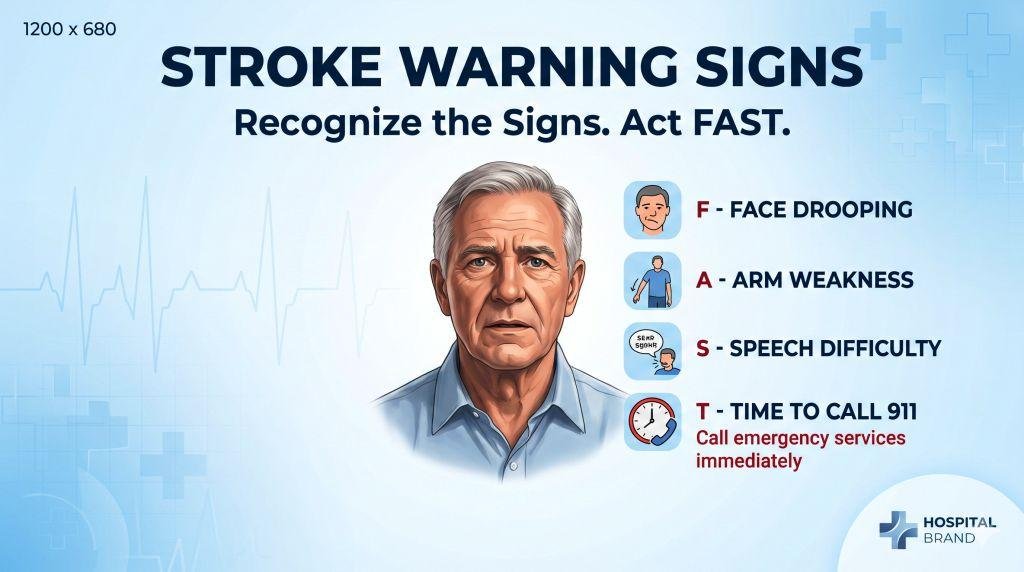
A stroke can happen suddenly, and recognizing the warning signs may save a person’s life. Common stroke symptoms include sudden weakness on one side of the body, difficulty speaking, facial drooping, vision problems, severe dizziness, and an unexplained severe headache.
The most important thing to remember is that a suspected stroke is a medical emergency. Call 911 immediately if you notice possible stroke symptoms, even if they seem mild or disappear after a few minutes. Do not wait to see whether the person feels better.
Stroke risk increases with age, although a stroke can happen to adults of any age. For people over 50, understanding the early warning signs is especially important because conditions such as high blood pressure, diabetes, and heart disease can increase stroke risk.
Some strokes cause obvious symptoms, while others begin with less familiar problems, such as sudden trouble walking, confusion, or changes in vision. Knowing what to look for can help you respond quickly for yourself, a family member, or someone nearby.
In this guide, you’ll learn the most important stroke warning signs, how the FAST method works, what a mini-stroke means, and what steps to take if you suspect someone is having a stroke.
Quick Answer: What Are the Warning Signs of a Stroke?
The most recognizable stroke warning signs can be remembered using the FAST method:
- F – Face: One side of the face droops or feels numb.
- A – Arms: One arm becomes weak or drifts downward when both arms are raised.
- S – Speech: Speech becomes slurred, strange, or difficult to understand.
- T – Time: Call 911 immediately.
Other possible symptoms include sudden vision loss, severe dizziness, difficulty walking, confusion, numbness, or a sudden severe headache.
Never wait for all the symptoms to appear. Even one sudden stroke symptom is enough to call 911.
Suspected stroke? Call 911 now.
Do not drive the person to the hospital yourself. Emergency medical services can begin assessment and coordinate care while transporting the patient.
1. What Is a Stroke?
A stroke happens when blood flow to part of the brain is interrupted or when a blood vessel in the brain ruptures.
Your brain needs a constant supply of oxygen and nutrients delivered through blood. When that supply is disrupted, brain cells can begin to become damaged.
The medical term for a stroke is cerebrovascular accident (CVA).
A stroke can affect different parts of the brain. Depending on the area involved, a person may experience difficulty speaking, walking, remembering, seeing, or moving one side of the body.
Stroke Warning Signs: How to Recognize a Stroke and Act Fast
A stroke can happen suddenly, and recognizing the warning signs may save a person’s life. Common stroke symptoms include sudden weakness on one side of the body, difficulty speaking, facial drooping, vision problems, severe dizziness, and an unexplained severe headache.
The most important thing to remember is that a suspected stroke is a medical emergency. Call 911 immediately if you notice possible stroke symptoms, even if they seem mild or disappear after a few minutes. Do not wait to see whether the person feels better.
Stroke risk increases with age, although a stroke can happen to adults of any age. For people over 50, understanding the early warning signs is especially important because conditions such as high blood pressure, diabetes, and heart disease can increase stroke risk.
Some strokes cause obvious symptoms, while others begin with less familiar problems, such as sudden trouble walking, confusion, or changes in vision. Knowing what to look for can help you respond quickly for yourself, a family member, or someone nearby.
In this guide, you’ll learn the most important stroke warning signs, how the FAST method works, what a mini-stroke means, and what steps to take if you suspect someone is having a stroke.
Quick Answer: What Are the Warning Signs of a Stroke?
The most recognizable stroke warning signs can be remembered using the FAST method:
- F – Face: One side of the face droops or feels numb.
- A – Arms: One arm becomes weak or drifts downward when both arms are raised.
- S – Speech: Speech becomes slurred, strange, or difficult to understand.
- T – Time: Call 911 immediately.
Other possible symptoms include sudden vision loss, severe dizziness, difficulty walking, confusion, numbness, or a sudden severe headache.
Never wait for all the symptoms to appear. Even one sudden stroke symptom is enough to call 911.
Suspected stroke? Call 911 now.
Do not drive the person to the hospital yourself. Emergency medical services can begin assessment and coordinate care while transporting the patient.
1. What Is a Stroke?
A stroke happens when blood flow to part of the brain is interrupted or when a blood vessel in the brain ruptures.
Your brain needs a constant supply of oxygen and nutrients delivered through blood. When that supply is disrupted, brain cells can begin to become damaged.
The medical term for a stroke is cerebrovascular accident (CVA).
A stroke can affect different parts of the brain. Depending on the area involved, a person may experience difficulty speaking, walking, remembering, seeing, or moving one side of the body.
The Three Main Types of Stroke
1. Ischemic Stroke
This is the most common type. It occurs when a blood clot or another blockage prevents blood from reaching part of the brain. It can be associated with narrowed arteries or a clot that travels from elsewhere in the body.
2. Hemorrhagic Stroke
This happens when a blood vessel in or around the brain breaks and causes bleeding. High blood pressure and certain blood vessel abnormalities can contribute to this type of stroke.
3. Transient Ischemic Attack (TIA)
Often called a mini-stroke, a TIA occurs when blood flow to the brain is temporarily blocked. Symptoms may disappear, but a TIA is still a medical emergency and an important warning of future stroke risk.
The distinction matters because treatments are different. Doctors generally use brain imaging to determine whether a person has a blockage or bleeding before choosing treatment.
2. 12 Important Stroke Warning Signs You Should Know
Stroke symptoms usually appear suddenly. They may be obvious, or they may initially look like a minor problem.
The following symptoms deserve immediate attention, particularly when they are new and unexpected.
1. Sudden Facial Drooping
One of the best-known signs of a stroke is an uneven smile.
A person may notice that:
- One side of the mouth looks lower.
- One cheek feels numb.
- Their smile looks different from normal.
- They have difficulty controlling facial muscles.
Ask the person to smile. If one side of the face does not move normally, call 911.
Facial drooping can occur because the stroke affects the parts of the brain responsible for controlling facial muscles.
2. Weakness in One Arm or Leg
Sudden weakness or numbness on one side of the body is another important warning sign.
For example, someone might:
- Drop a coffee cup unexpectedly.
- Struggle to lift one arm.
- Have difficulty holding a phone.
- Drag one leg while walking.
- Feel that one hand is unusually weak.
Ask the person to raise both arms. If one arm drifts downward or cannot be lifted normally, treat it as an emergency.
Stroke-related weakness often affects one side, although symptoms can vary depending on the location of the stroke.
3. Slurred Speech or Difficulty Speaking
Speech changes can be frightening because they sometimes happen without pain.
A person may:
- Slur familiar words.
- Speak unusually slowly.
- Use incorrect words.
- Have trouble forming sentences.
- Understand a question but struggle to answer.
Some people also have difficulty understanding what others are saying.
For example, a normally confident speaker may suddenly be unable to say a simple sentence.
Do not assume the person is tired, confused, or simply having trouble finding words. Sudden speech difficulty requires emergency evaluation.
4. Sudden Vision Problems
A stroke can affect the parts of the brain responsible for processing visual information.
Possible symptoms include:
- Blurred vision.
- Double vision.
- Sudden loss of vision in one eye.
- Missing part of the visual field.
- Difficulty seeing objects clearly.
Some people describe it as a dark area appearing in their vision.
Sudden vision changes should not automatically be blamed on aging, cataracts, or ordinary eye strain.
5. Sudden Dizziness or Loss of Balance
Not every stroke begins with facial drooping or arm weakness.
Some strokes affect the areas of the brain involved in balance and coordination.
A person might:
- Suddenly feel that the room is spinning.
- Have difficulty standing.
- Walk as though they are intoxicated.
- Fall without an obvious reason.
- Struggle to coordinate their movements.
This is particularly important for older adults.
However, dizziness has many possible causes. What makes it concerning is a sudden, unexplained change, especially when accompanied by vision problems, weakness, or speech changes.
6. Sudden Severe Headache
A sudden, extremely severe headache with no known explanation can be a warning sign of a hemorrhagic stroke.
Some people describe it as the worst headache they have ever experienced.
It may occur with:
- Nausea or vomiting.
- Neck discomfort.
- Sensitivity to light.
- Confusion.
- Loss of consciousness.
Not every severe headache is a stroke. However, a sudden, unusually intense headache should be evaluated as an emergency.
7. Sudden Confusion or Disorientation
A person experiencing a stroke may suddenly seem confused or behave differently.
They might:
- Forget where they are.
- Have difficulty understanding simple instructions.
- Struggle to follow a conversation.
- Give unrelated answers.
- Have trouble recognizing familiar information.
For families caring for older adults, it is important to recognize the difference between gradual memory changes and sudden confusion.
A sudden change in mental function should never be dismissed as normal aging.
8. Difficulty Understanding Other People
Sometimes a person can speak clearly but cannot understand what others are saying.
For example, you might ask, “Would you like some water?” and the person may respond with something completely unrelated.
This can happen when a stroke affects language-processing areas of the brain.
If someone suddenly cannot understand familiar words or simple instructions, call 911.
9. Sudden Numbness on One Side
A stroke may cause an unusual loss of sensation.
The person might report:
- Tingling in one hand.
- Numbness in one cheek.
- A strange sensation in one leg.
- Reduced feeling on one side of the body.
Numbness caused by sleeping in an awkward position usually improves after changing position. Stroke-related numbness may appear suddenly and without an obvious explanation.
Do not wait for additional symptoms before seeking emergency help.
10. Trouble Walking or Coordinating Movements
Sudden walking difficulty can be particularly concerning in adults over 50.
A person may have trouble:
- Taking normal steps.
- Turning around.
- Walking in a straight line.
- Coordinating their arms and legs.
- Standing without support.
Some people fall because they suddenly lose coordination.
If walking becomes difficult unexpectedly, especially alongside other neurological symptoms, call 911.
11. Sudden Nausea or Vomiting With Neurological Symptoms
Nausea and vomiting are not specific stroke symptoms on their own.
However, they can occur with certain strokes, particularly those affecting the back part of the brain.
Pay attention when nausea occurs alongside sudden dizziness, severe balance problems, double vision, headache, or weakness.
These symptoms need immediate medical assessment.
12. Sudden Difficulty Swallowing
Some strokes affect the muscles and nerves involved in swallowing.
A person may:
- Cough while drinking water.
- Have difficulty swallowing food.
- Feel that food is getting stuck.
- Have trouble controlling saliva.
- Develop a wet or unusual-sounding voice.
Swallowing difficulty can increase the risk of food or liquid entering the lungs.
If it begins suddenly, especially with other stroke symptoms, call 911. Do not give the person food, water, or medication by mouth while waiting for emergency help.
Important: These symptoms do not need to happen together. One sudden warning sign can be enough to require emergency attention. CDC+2
3. FAST Stroke Symptoms Explained
The FAST method is a simple way to recognize three major stroke symptoms and remember when to get help.
The American Stroke Association also promotes an expanded version called B.E. F.A.S.T., which includes balance and vision changes.
| Letter | Meaning | What to Look For |
|---|---|---|
| B | Balance | Sudden dizziness or loss of coordination |
| E | Eyes | Sudden vision changes |
| F | Face | One side of the face droops |
| A | Arms | One arm becomes weak or numb |
| S | Speech | Slurred or difficult speech |
| T | Time | Call 911 immediately |
FAST vs. B.E. FAST: What’s the Difference?
| Feature | FAST | B.E. FAST |
|---|---|---|
| Balance problems | Not included | Included |
| Eye problems | Not included | Included |
| Facial drooping | Included | Included |
| Arm weakness | Included | Included |
| Speech difficulty | Included | Included |
| Emergency action | Call 911 | Call 911 |
B.E. F.A.S.T. includes two additional symptoms that can help people recognize strokes that might otherwise be missed.
Keep in mind that these are recognition tools, not diagnostic tests. You do not need to complete every step before calling emergency services.
4. Stroke Symptoms in Men and Women
Men and women can experience many of the same stroke symptoms.
These include:
- Facial drooping.
- Arm or leg weakness.
- Speech difficulties.
- Sudden vision problems.
- Dizziness and balance difficulties.
- Sudden confusion.
However, women may also experience additional symptoms that are less commonly associated with stroke awareness, such as general weakness, disorientation, fatigue, nausea, or vomiting.
These less familiar symptoms can sometimes make recognition more difficult.
| Common Symptoms in Both | Additional Symptoms Reported in Women |
|---|---|
| Facial drooping | General weakness |
| Arm weakness | Disorientation |
| Speech problems | Confusion or memory problems |
| Vision changes | Fatigue |
| Balance problems | Nausea or vomiting |
This does not mean that women have a completely different set of stroke warning signs. The familiar B.E. F.A.S.T. symptoms remain important for everyone.
Women should not dismiss sudden unusual symptoms simply because they do not match the classic picture of a stroke. American Stroke Association+1
5. Early Stroke Symptoms in Adults Over 50
Age is an important factor when discussing stroke risk.
As people get older, certain health conditions become more common. High blood pressure, diabetes, heart disease, and abnormal cholesterol levels can all contribute to cardiovascular risk.
For adults over 50, it is particularly useful to recognize sudden changes from their normal health.
For example:
- A person who normally walks comfortably suddenly cannot keep their balance.
- Someone who speaks clearly begins slurring words.
- A family member suddenly struggles to recognize familiar instructions.
- A person experiences unexpected weakness in one arm.
These changes should not be attributed to aging without medical evaluation.
Why Blood Pressure Matters
High blood pressure is one of the most important modifiable stroke risk factors.
It can damage blood vessels over time and increase the risk of both ischemic and hemorrhagic strokes.
If you monitor your blood pressure at home, you may find our guide useful:
Related EverAgeWell article: Blood Pressure Chart for Seniors: What Your Numbers Mean
Remember that high blood pressure often has no noticeable symptoms. Regular measurement is more useful than waiting to feel unwell.
Cholesterol and Stroke Risk
High levels of certain cholesterol particles can contribute to plaque buildup in arteries.
Over time, narrowed arteries can increase the risk of cardiovascular problems, including some types of ischemic stroke.
Learn more in our Cholesterol Levels Chart: What Your Numbers Mean.
Diabetes and Stroke Risk
Diabetes can affect blood vessels throughout the body.
People with diabetes may have an increased risk of stroke, particularly when blood glucose levels, blood pressure, and cholesterol are not well managed.
Our Blood Sugar Chart for Seniors explains common glucose measurements and why individual targets matter.
6. Mini-Stroke (TIA) Warning Signs
A transient ischemic attack, or TIA, is commonly called a mini-stroke.
It happens when blood flow to part of the brain is temporarily interrupted.
The symptoms may look exactly like those of a regular stroke, but they resolve.
Possible TIA symptoms include:
- Temporary facial drooping.
- Brief weakness in an arm or leg.
- Sudden speech difficulty.
- Temporary vision loss.
- Sudden dizziness or balance problems.
- Brief confusion.
How Long Does a Mini-Stroke Last?
TIA symptoms may last only a few minutes, although they can sometimes continue longer.
The important point is that symptoms disappearing does not mean the danger has passed.
A TIA can be a warning that a more serious stroke may occur.
Mini-Stroke vs. Full Stroke
| Feature | TIA (Mini-Stroke) | Stroke |
|---|---|---|
| Blood flow | Temporarily interrupted | Interrupted or bleeding occurs |
| Symptoms | May disappear | May persist |
| Brain injury | No acute infarction by definition | Brain tissue injury occurs |
| Medical attention | Emergency | Emergency |
| Future risk | Can signal increased stroke risk | Depends on type and cause |
Doctors may need brain imaging and other tests to distinguish a TIA from a stroke.
Never wait for a TIA to happen again. Call 911 even when symptoms disappear. CDC+2
7. Stroke vs. Heart Attack: What’s the Difference?
Stroke and heart attack are both serious cardiovascular emergencies, but they affect different organs.
A stroke affects the brain, while a heart attack affects the heart muscle.
| Feature | Stroke | Heart Attack |
|---|---|---|
| Main organ affected | Brain | Heart |
| Common cause | Blocked or ruptured brain blood vessel | Reduced blood flow to heart muscle |
| Common warning sign | Facial drooping | Chest discomfort |
| Other symptoms | Speech difficulty, weakness, vision changes | Shortness of breath, sweating, nausea |
| Emergency response | Call 911 | Call 911 |
Both conditions require immediate emergency medical attention.
Some symptoms, such as nausea, dizziness, and weakness, can occur with either condition. Do not attempt to diagnose the problem at home.
8. What Causes a Stroke?
A stroke is usually caused by a blockage in a blood vessel or bleeding from a damaged blood vessel.
Several health conditions and lifestyle factors can increase the likelihood of these problems.
1. High Blood Pressure
Persistent high blood pressure can damage artery walls and increase the risk of blood vessel blockage or rupture.
2. Diabetes
Diabetes can damage blood vessels and is associated with a higher risk of cardiovascular disease.
3. High Cholesterol
Certain cholesterol particles contribute to plaque buildup inside arteries.
4. Atrial Fibrillation
Atrial fibrillation is an irregular heart rhythm. It can allow blood clots to form in the heart and travel to the brain.
5. Smoking
Smoking damages blood vessels and increases the risk of blood clots and cardiovascular disease.
6. Physical Inactivity
A sedentary lifestyle can contribute to high blood pressure, diabetes, unhealthy cholesterol levels, and excess weight.
7. Excessive Alcohol Consumption
Heavy alcohol consumption can increase blood pressure and contribute to other cardiovascular problems.
8. Family History and Age
Age and family history can influence stroke risk. They cannot be changed, but other risk factors can often be managed.
9. Who Is at Higher Risk of Stroke?
Although strokes can affect people at any age, certain groups may have a higher risk.
| Group | Why Risk May Be Higher |
|---|---|
| Adults over 50 | Stroke risk increases with age |
| People with hypertension | Increased stress and damage to blood vessels |
| People with diabetes | Greater risk of vascular damage |
| People with atrial fibrillation | Increased risk of clot formation |
| Smokers | Damage to blood vessels |
| People with heart disease | Certain heart conditions increase stroke risk |
| People with previous TIA or stroke | Higher risk of another event |
Having one or more risk factors does not mean someone will definitely have a stroke.
However, identifying and managing these conditions can make an important difference.
10. What to Do If Someone Is Having a Stroke
Knowing how to respond can be just as important as recognizing the symptoms.
If you suspect a stroke, follow these steps.

Step 1: Call 911 Immediately
Do not wait for symptoms to improve.
Tell the emergency dispatcher that you suspect a stroke. Describe the symptoms and the person’s current condition.
Step 2: Note When Symptoms Started
Try to remember the exact time symptoms first appeared.
If the person woke up with symptoms, note when they were last known to be normal before sleeping.
This information helps doctors determine which treatments may be appropriate.
Step 3: Keep the Person Safe
Help them sit or lie in a safe position while waiting for emergency responders.
Avoid unnecessary movement, particularly if they have difficulty balancing.
Step 4: Do Not Give Food or Drinks
A stroke can affect swallowing. Giving food, water, or medication could cause choking or aspiration.
Do not give aspirin unless emergency medical professionals specifically instruct you to. Some strokes involve bleeding, and aspirin can make bleeding worse.
Step 5: Watch Their Breathing and Responsiveness
Stay with the person until help arrives.
If they become unresponsive or stop breathing normally, tell the dispatcher immediately and follow their CPR instructions.
Step 6: Prepare Medical Information
If possible, gather information about:
- Current medications.
- Known allergies.
- Existing medical conditions.
- Previous strokes or TIAs.
- Recent surgeries or bleeding problems.
Do not delay the ambulance to collect paperwork.
What You Should NOT Do During a Suspected Stroke
| Avoid Doing This | Why It Matters |
|---|---|
| Waiting for symptoms to disappear | Treatment may be delayed |
| Driving the person yourself | Ambulance staff can begin emergency care |
| Giving food or water | Swallowing may be impaired |
| Giving aspirin without instructions | Some strokes involve brain bleeding |
| Giving extra blood pressure medication | Sudden changes can be harmful |
| Letting the person walk around | They may fall or become injured |
The safest action is to activate emergency medical services immediately. CDC+2
11. What Happens During Stroke Treatment?
Many people wonder what will happen after an ambulance takes someone to the hospital.
The first priority is determining what type of stroke has occurred.
Emergency Evaluation
Doctors and emergency medical teams may:
- Check breathing and circulation.
- Measure blood pressure and blood glucose.
- Perform a neurological examination.
- Ask when the symptoms began.
- Review medical history and medications.
- Order brain imaging.
A CT scan or MRI can help identify bleeding or damage in the brain.
Treatment for Ischemic Stroke
For certain ischemic strokes, doctors may use clot-dissolving medications called thrombolytics.
One example is alteplase. Another is tenecteplase, which is used in eligible patients under appropriate protocols.
These treatments are time-sensitive and are not suitable for everyone.
Some patients may also qualify for a procedure called mechanical thrombectomy. During this procedure, specialists use a catheter-based device to remove a blood clot from a blocked brain artery.
Treatment for Hemorrhagic Stroke
Treatment for a hemorrhagic stroke focuses on controlling bleeding, managing pressure inside the skull, and addressing the damaged blood vessel.
Depending on the situation, treatment may involve medications, surgery, or other specialized procedures.
Recovery and Rehabilitation
Stroke recovery varies considerably.
Some people recover much of their previous function, while others need ongoing assistance.
Rehabilitation may involve:
- Physical therapy to improve movement and balance.
- Occupational therapy to help with everyday activities.
- Speech therapy for communication and swallowing difficulties.
- Cognitive rehabilitation for memory and thinking problems.
- Emotional support and counseling.
The earlier the emergency assessment happens, the sooner doctors can determine which treatments may help. Not every patient has the same treatment window or recovery path. ninds.nih.gov+1
12. Stroke Prevention: Everyday Habits That Help
Not every stroke can be prevented, but managing important risk factors can lower the chances of having one.
For adults over 50, prevention is especially important because several stroke risk factors become more common with age.
1. Monitor Your Blood Pressure
High blood pressure often develops without noticeable symptoms.
Check your blood pressure regularly and follow your healthcare professional’s recommendations.
If you need help understanding your readings, see our Blood Pressure Chart for Seniors.
2. Keep Cholesterol Levels in Check
A healthy cholesterol profile can support better cardiovascular health.
Your healthcare professional may recommend dietary changes, physical activity, and medication depending on your individual risk.
Read our Cholesterol Levels Chart for an explanation of LDL, HDL, and triglycerides.
3. Manage Diabetes
If you have diabetes, follow your treatment plan and monitor your blood glucose as recommended.
Our Blood Sugar Chart for Seniors can help explain common glucose measurements.
4. Eat a Heart-Healthy Diet
A balanced eating pattern may help support healthy blood pressure, cholesterol, and blood glucose levels.
Consider including:
- Leafy green vegetables.
- Fresh fruits.
- Beans and lentils.
- Whole grains.
- Nuts and seeds.
- Fish rich in omega-3 fatty acids.
- Olive oil and other unsaturated fats.
Limit excessive sodium, heavily processed foods, and foods high in added sugars.
5. Stay Physically Active
Regular physical activity supports cardiovascular health.
Walking, swimming, cycling, and appropriate strength exercises can be useful options.
Older adults who have balance problems or chronic health conditions should discuss suitable activities with their healthcare professional.
6. Avoid Smoking
Quitting smoking is one of the most important steps a person can take to protect their blood vessels.
If quitting feels difficult, ask a healthcare professional about counseling and evidence-based smoking cessation treatments.
7. Limit Alcohol
Excessive alcohol consumption can raise blood pressure and contribute to other health problems.
If you drink, discuss a reasonable limit with your healthcare professional.
8. Get Enough Sleep
Consistent sleep supports overall cardiovascular health.
People with loud snoring, interrupted breathing during sleep, or significant daytime sleepiness may benefit from an evaluation for sleep apnea.
9. Take Prescribed Medications
If you have high blood pressure, diabetes, atrial fibrillation, or high cholesterol, take your medications as directed.
Do not stop a prescribed medication simply because you feel healthy.
10. Attend Regular Health Checkups
Regular medical visits can help identify risk factors before they become serious problems.
Ask your healthcare professional about your personal stroke risk, especially if you have a family history of stroke or heart disease.
13. Practical Daily Routine for Better Stroke Prevention
A healthy routine does not need to be complicated or expensive.
Here is an example of how an adult over 50 might organize a typical day.
| Time | Healthy Habit |
|---|---|
| 7:00 AM | Wake up and drink water |
| 7:30 AM | Take a comfortable morning walk |
| 8:30 AM | Eat a balanced breakfast |
| 10:30 AM | Take a short movement break |
| 12:30 PM | Enjoy a vegetable-rich lunch |
| 3:00 PM | Choose fruit or a small handful of nuts |
| 5:30 PM | Do light exercise if appropriate |
| 7:00 PM | Eat a balanced dinner |
| 9:00 PM | Relax and reduce screen time |
| 10:00 PM | Aim for a consistent bedtime |
This is an example, not a medical prescription. People with diabetes, heart disease, mobility limitations, or other health conditions may need a different routine.
Sample Heart-Healthy Meal Ideas
Breakfast
Oatmeal with blueberries, walnuts, and plain yogurt.
Provides fiber and a combination of nutrients from whole grains, fruit, nuts, and dairy.
Lunch
Grilled salmon, brown rice, and steamed vegetables.
Offers protein, fiber, and unsaturated fats.
Dinner
Lentil and vegetable soup with a whole-grain side and fresh salad.
A practical way to include plant protein and fiber.
No single meal prevents a stroke. The goal is to develop an eating pattern that supports cardiovascular health over time.
14. Common Myths About Stroke Warning Signs
Misinformation can cause people to delay emergency treatment. Here are seven common misunderstandings worth correcting.
Myth 1: A Stroke Only Happens to Older Adults
Fact: Stroke risk increases with age, but strokes can happen to younger adults too. Warning signs should be taken seriously at any age.
Myth 2: A Stroke Always Causes Severe Pain
Fact: Many strokes do not cause pain. Facial drooping, weakness, speech difficulty, and vision changes may occur without a painful sensation.
Myth 3: If Symptoms Disappear, Everything Is Fine
Fact: Temporary symptoms may indicate a TIA. A TIA requires emergency medical evaluation even when the person feels normal again.
Myth 4: You Must Have All FAST Symptoms to Be Having a Stroke
Fact: A stroke may cause only one recognizable symptom. You should not wait for several symptoms to appear before calling 911.
Myth 5: A Stroke Always Happens Without Warning
Fact: Some people experience a TIA before a more serious stroke. However, many strokes occur without a noticeable warning event.
Myth 6: Stroke Symptoms Are Always the Same in Men and Women
Fact: Men and women share many common symptoms, but women may also experience additional symptoms such as general weakness, confusion, fatigue, or nausea.
Myth 7: A Healthy Lifestyle Completely Eliminates Stroke Risk
Fact: Healthy habits can reduce certain risk factors, but they cannot eliminate every possible cause of stroke. Age, genetics, and other medical conditions also matter.
15. Who Should Be Especially Careful?
Everyone should know the warning signs, but some people may benefit from additional awareness and preventive care.
Adults Over 50
Stroke risk increases with age. Adults in this age group should pay attention to blood pressure, cholesterol, diabetes, and heart health.
Adults Over 65
Older adults may have several medical conditions and take multiple medications.
Family members and caregivers should understand sudden changes in speech, walking, vision, and coordination.
People With High Blood Pressure
Hypertension is a major stroke risk factor. Regular monitoring and appropriate treatment are important.
People With Atrial Fibrillation
An irregular heart rhythm can increase the risk of blood clots that travel to the brain.
If you have atrial fibrillation, discuss stroke prevention and appropriate treatment with your healthcare professional.
People Who Have Experienced a Previous Stroke or TIA
A previous stroke or TIA can increase the risk of another event.
Follow-up care, prescribed medication, and rehabilitation are important parts of prevention.
People With Diabetes
Diabetes can increase cardiovascular risk, particularly when accompanied by high blood pressure or abnormal cholesterol levels.
16. How to Get Started With Stroke Prevention
If you are concerned about your stroke risk, start with manageable steps.
- Know your numbers: Understand your blood pressure, cholesterol, and blood glucose measurements.
- Review your medications: Ask your doctor whether your current medications are appropriate for your health conditions.
- Learn B.E. F.A.S.T.: Make sure your family members know the signs of a stroke.
- Improve your meals: Include more vegetables, fruits, whole grains, beans, and other heart-supportive foods.
- Move regularly: Find safe activities that fit your fitness level.
- Avoid tobacco: Seek professional support if quitting is difficult.
- Keep emergency information accessible: Make sure family members know how to contact emergency services and where important medical information is kept.
One particularly useful idea is to discuss stroke symptoms during a regular family health conversation. Everyone in the household should know what to do if a family member suddenly develops neurological symptoms.
17. Frequently Asked Questions About Stroke Warning Signs
1. What are the first warning signs of a stroke?
The first warning signs may include sudden facial drooping, weakness in one arm, slurred speech, vision changes, dizziness, or difficulty walking. Symptoms often appear suddenly. Call 911 if you notice any possible stroke symptoms.
2. What are the five main warning signs of a stroke?
Five important warning signs are:
- Facial drooping.
- Arm or leg weakness.
- Speech difficulties.
- Sudden vision problems.
- Sudden loss of balance or coordination.
A severe unexplained headache is another important warning sign.
3. Can you have a stroke without knowing it?
Yes. A silent stroke may occur without obvious symptoms. It can sometimes be discovered through brain imaging performed for another reason. Silent strokes can still cause brain tissue damage and may increase future stroke risk.
4. What does a mini-stroke feel like?
A mini-stroke may cause sudden weakness, numbness, facial drooping, vision changes, dizziness, or speech difficulties. Symptoms may disappear within minutes or hours. Even if you feel completely normal afterward, seek emergency medical attention.
5. Can a stroke happen while sleeping?
Yes. Some people experience a stroke while sleeping and only notice symptoms after waking up. This is sometimes called a wake-up stroke. If you wake up with sudden weakness, speech problems, vision changes, or other possible stroke symptoms, call 911 immediately.
6. What are the warning signs of a stroke in women?
Women can experience facial drooping, arm weakness, speech problems, and vision changes. Additional symptoms may include general weakness, confusion, disorientation, fatigue, nausea, or vomiting.
7. What are the warning signs of a stroke in men?
Common warning signs in men include sudden facial drooping, weakness on one side of the body, difficulty speaking, vision changes, dizziness, loss of balance, and severe unexplained headache.
8. How long do stroke symptoms last?
Stroke symptoms may continue for hours, days, or longer, depending on the type and severity of the stroke. TIA symptoms may disappear within minutes or hours. Never use symptom duration to decide whether emergency care is necessary.
9. Can high blood pressure cause a stroke?
Yes. Long-term high blood pressure can damage blood vessels and increase the risk of ischemic and hemorrhagic strokes. Managing blood pressure is an important part of stroke prevention.
10. Can a person recover completely after a stroke?
Some people recover much of their previous function, while others experience lasting difficulties. Recovery depends on factors such as the stroke’s location, severity, treatment timing, overall health, and rehabilitation.
11. What should you do if stroke symptoms disappear?
Call 911 even if symptoms disappear. Temporary symptoms may indicate a transient ischemic attack, which requires urgent medical evaluation.
12. Can dizziness be an early sign of a stroke?
Yes. Sudden dizziness, particularly when accompanied by difficulty walking, loss of coordination, double vision, or weakness, can indicate a stroke. Dizziness alone has many possible causes, but sudden unexplained symptoms should be taken seriously.
13. Does a stroke always affect one side of the body?
No. One-sided weakness is common, but symptoms depend on which part of the brain is affected. Some strokes primarily cause balance problems, vision changes, speech difficulties, or confusion.
14. What is the difference between a stroke and a brain aneurysm?
A stroke occurs when blood flow to the brain is blocked or a blood vessel ruptures. A brain aneurysm is a weakened, bulging area in a blood vessel. An aneurysm can rupture and cause a hemorrhagic stroke, but not every aneurysm causes a stroke.
15. How can adults over 50 reduce their risk of stroke?
Adults over 50 can reduce certain stroke risk factors by managing blood pressure, controlling diabetes, maintaining healthy cholesterol levels, exercising regularly, avoiding smoking, eating a balanced diet, and following prescribed medical treatments.
18. Final Takeaway: Recognize Stroke Warning Signs Before It’s Too Late
Recognizing stroke warning signs is one of the most important steps in protecting your health and the health of your loved ones.
Sudden facial drooping, arm weakness, speech difficulties, vision changes, dizziness, and unexplained severe headaches should never be ignored.
For adults over 50, managing blood pressure, cholesterol, diabetes, and heart health can help reduce important stroke risk factors.
Remember the B.E. F.A.S.T. method:
- Balance loss.
- Eye changes.
- Face drooping.
- Arm weakness.
- Speech difficulty.
- Time to call 911.
Most importantly, do not wait for symptoms to become severe. A suspected stroke is an emergency, even if the symptoms are mild or disappear.
Knowing the warning signs today could help you protect someone you love tomorrow.
Medical Disclaimer
This article is intended for general educational and informational purposes only. It does not replace professional medical advice, diagnosis, or treatment. Stroke symptoms require immediate emergency evaluation. If you suspect a stroke, call 911 rather than waiting for an appointment or attempting to manage symptoms at home. Always consult a qualified healthcare professional about your individual health and stroke prevention needs.
Written by
Kanhaiya Solanki is a dedicated online researcher, content writer, and blogger passionate about publishing high-quality, research-based articles. His goal is to provide accurate, easy-to-understand, and practical information on health, technology, senior care, and lifestyle topics for readers worldwide.