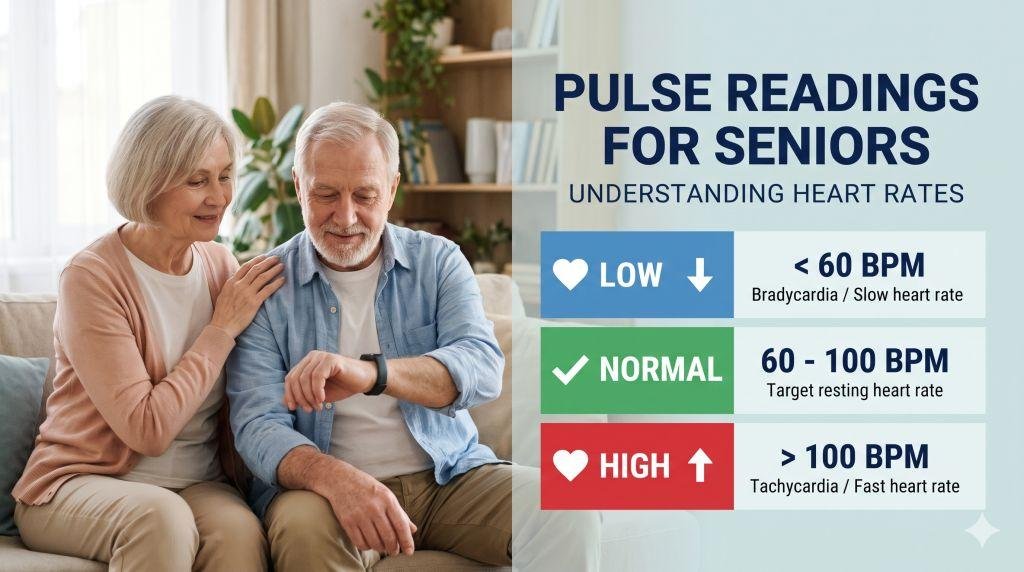
Your pulse tells you how many times your heart beats in one minute. For most adults, including seniors, a normal resting pulse rate is between 60 and 100 beats per minute (bpm). However, the right number for one person may be different from another, depending on fitness, medications, medical conditions, and overall health.
Understanding pulse readings for seniors can be especially helpful after age 50. As people get older, they may develop conditions such as high blood pressure, diabetes, or heart rhythm problems. Some medications used to manage these conditions can also affect heart rate.
The good news is that checking your pulse is simple. You do not need an expensive smartwatch or medical equipment. A watch with a second hand and two fingers can help you measure your resting heart rate at home.
In this guide, we’ll explain normal pulse readings for older adults, provide an easy-to-understand heart rate chart, discuss high and low readings, and explain how to recognize warning signs that deserve medical attention.
Quick Answer: What Is a Normal Pulse Reading for Seniors?
For most adults aged 50 and older, a normal resting heart rate is 60–100 bpm, the same general reference range used for adults of other ages.
Some healthy, physically active seniors may naturally have a resting pulse below 60 bpm. Certain medications can also lower heart rate.
A reading above 100 bpm while resting is considered a fast heart rate, but it does not automatically mean someone has a heart condition.
What matters most is understanding your usual resting heart rate, noticing persistent changes, and paying attention to symptoms such as dizziness, unusual weakness, chest discomfort, or shortness of breath.
What Are Pulse Readings?
A pulse reading is the number of times your heart beats in one minute. It is usually measured in beats per minute, abbreviated as BPM.
Every time your heart contracts, it pushes blood through your arteries. This creates a pressure wave that you can feel as a pulse, particularly at your wrist or neck.
Although people often use the terms pulse rate and heart rate interchangeably, they are slightly different measurements.
- Heart rate: The number of times your heart beats per minute.
- Pulse rate: The number of pulse waves you can feel in your arteries per minute.
In most healthy people, these numbers are the same. However, certain heart rhythm conditions can cause a difference between the actual heartbeat and the pulse you can feel.
Why Are Pulse Readings Important After Age 50?
Your heart works continuously to deliver oxygen and nutrients throughout your body. Checking your pulse provides a simple way to observe how quickly it is beating while you rest or move around.
For older adults, monitoring heart rate may help identify changes worth discussing with a healthcare provider.
For example, someone whose usual resting pulse is 68 BPM may notice that it has remained around 95 BPM for several days. This does not establish a diagnosis, but it is a change worth investigating.
Pulse monitoring can be particularly useful for people who:
- Have high blood pressure or cardiovascular disease.
- Take medications that affect heart rate.
- Have been diagnosed with an irregular heartbeat.
- Are recovering from an illness.
- Want to monitor their response to physical activity.
- Have been advised by a healthcare professional to check their pulse regularly.
It is important to remember that pulse readings are only one part of a person’s overall health assessment. They do not replace blood pressure measurements, medical examinations, or heart rhythm testing.
Normal Pulse Readings for Seniors: Heart Rate Chart
For most adults, including people in their 60s, 70s, and 80s, the commonly accepted normal resting heart rate is 60–100 BPM.
There is no separate official normal resting pulse range for every senior age group. A healthy 65-year-old and a healthy 85-year-old may both have resting heart rates within the same general range.
Normal resting pulse chart for older adults
| Age group | General resting heart rate |
|---|---|
| 50–59 years | 60–100 BPM |
| 60–64 years | 60–100 BPM |
| 65–69 years | 60–100 BPM |
| 70–74 years | 60–100 BPM |
| 75–79 years | 60–100 BPM |
| 80–84 years | 60–100 BPM |
| 85 years and older | 60–100 BPM |
These are general adult reference ranges, not individualized targets or diagnostic cutoffs. Fitness, health conditions, medications, and symptoms can change what is appropriate for an individual.
How to Interpret Different Pulse Readings
| Resting pulse | General interpretation |
|---|---|
| Below 40 BPM | Very slow; medical assessment may be needed |
| 40–59 BPM | Below the usual adult range; may be normal in some people |
| 60–80 BPM | Within the normal adult range |
| 81–100 BPM | Within the normal adult range |
| Above 100 BPM | Faster than the usual resting range |
A pulse of 55 BPM is not automatically dangerous, just as a pulse of 95 BPM is not automatically a sign of disease.
The person’s usual heart rate, medical history, medications, and symptoms are essential to interpreting the result.
For a more detailed visual reference, see our related guide: Heart Rate Chart for Seniors: Normal Resting Pulse Ranges.
Does Age Change Your Normal Heart Rate?
Many people assume that the heart should naturally beat more slowly as someone gets older. However, there is no standard age-based formula that automatically lowers the normal resting heart rate for seniors.
The general adult reference range remains 60–100 BPM.
What can change with age is the heart’s ability to respond to physical activity. Changes in the cardiovascular system, fitness levels, chronic health conditions, and medications may influence how the heart behaves.
Changes in the Heart’s Electrical System
Your heartbeat is controlled by electrical signals that coordinate the heart muscle.
As people age, changes in the heart’s electrical system may increase the likelihood of certain rhythm disorders, including atrial fibrillation.
Atrial fibrillation, often called AFib, is an irregular heart rhythm that can cause the heart to beat too quickly, too slowly, or unpredictably.
Changes in Physical Fitness
Older adults who remain physically active may have lower resting heart rates than people who are less active.
For example, a healthy 70-year-old who walks regularly and exercises may have a resting pulse of 58 BPM.
That number may be normal for that individual, particularly if there are no symptoms and a healthcare professional has no concerns.
Effects of Medications
Medications become an important consideration as people get older.
Beta-blockers, for example, can slow the heart rate. Some calcium channel blockers and other heart medications can also affect pulse readings.
This is one reason seniors should not compare their numbers with those of friends or relatives without considering medication differences.
Resting Heart Rate vs. Active Heart Rate
A resting heart rate and an active heart rate are not expected to be the same.
Your heart beats faster when you walk, climb stairs, exercise, or perform activities that require more oxygen.
| Feature | Resting heart rate | Active heart rate |
|---|---|---|
| When measured | While calm and resting | During physical activity |
| Typical behavior | Relatively stable | Increases with effort |
| Main purpose | Measures resting pulse | Reflects the body’s response to activity |
| Influencing factors | Fitness, health, medication | Exercise intensity, fitness, temperature |
| Measurement | Before activity | During or immediately after activity |
What Is a Target Heart Rate During Exercise?
A target heart rate is a general range used to guide exercise intensity.
The American Heart Association provides an age-based estimate of maximum heart rate using the formula:
\[ 220-\text{age}=\text{estimated maximum heart rate} \]
For example, the estimated maximum for a 70-year-old is 150 BPM.
The AHA generally describes moderate-intensity exercise as approximately 50–70% of estimated maximum heart rate and vigorous exercise as approximately 70–85%.
These are broad estimates, not personal safety limits. Older adults with heart disease or those taking medications that affect heart rate may need a different exercise target.
External resource: American Heart Association – Target Heart Rates Chart.
What Do High and Low Pulse Readings Mean?
An unusually high or low pulse can have several explanations. Sometimes the change is temporary. In other situations, it may be associated with a heart rhythm problem or another medical condition.
Understanding the difference can help seniors know when to repeat a measurement and when to seek medical advice.
1. Low Pulse Rate (Bradycardia)
Bradycardia is the medical term for a slower-than-usual heart rate, generally below 60 BPM in adults.
However, a low pulse does not always indicate a health problem.
Possible explanations include:
- Regular endurance exercise.
- Certain heart medications.
- Sleeping.
- Changes in the heart’s electrical conduction system.
- Some underlying heart conditions.
Example: A physically active 67-year-old has a resting pulse of 54 BPM and feels well. This may be normal for that person.
However, if a senior experiences a slow pulse along with fainting, dizziness, unusual tiredness, or weakness, medical evaluation is important.
2. High Pulse Rate (Tachycardia)
Tachycardia generally refers to a resting heart rate above 100 BPM.
A temporarily elevated pulse can occur for many reasons, including:
- Physical activity.
- Fever.
- Dehydration.
- Emotional stress.
- Pain.
- Certain medications.
- Infection.
- An abnormal heart rhythm.
Example: A 74-year-old checks their pulse immediately after walking upstairs and records 112 BPM. That number alone does not indicate an abnormal resting heart rate.
However, if the pulse remains above 100 BPM after resting, particularly without an obvious explanation, it is worth contacting a healthcare professional.
3. Irregular Pulse
A regular pulse usually feels like evenly spaced beats.
An irregular pulse may feel like:
- Skipped beats.
- Extra beats.
- Fluttering.
- Unexpected pauses.
- An uneven rhythm.
Occasional variations can occur, but a persistent or newly noticed irregular pulse deserves medical attention.
One possible cause is atrial fibrillation. This condition becomes more common with age and is important to identify because it can increase the risk of stroke.
A healthcare professional may recommend an electrocardiogram (ECG or EKG) to evaluate the heart’s electrical activity.
4. Weak or Difficult-to-Feel Pulse
A weak pulse may be difficult to locate or may feel unusually faint.
Possible causes include low blood pressure, reduced circulation, or other cardiovascular problems.
A weak pulse accompanied by cold or clammy skin, confusion, severe weakness, or fainting requires urgent medical attention.
A difficult-to-find wrist pulse by itself does not establish that an artery is blocked.
10 Factors That Affect Pulse Readings in Older Adults
Your heart rate is not a fixed number. It can change throughout the day depending on what you are doing and how your body is feeling.
1. Physical Activity
Walking, gardening, swimming, and climbing stairs increase the heart’s demand for oxygen.
As a result, your pulse naturally rises.
A resting pulse should be measured after sitting quietly rather than immediately after exercise.
2. Dehydration
When the body loses too much fluid, the amount of circulating blood can decrease. The heart may respond by beating faster.
Older adults are particularly vulnerable because thirst sensation may become less noticeable with age.
Read more: Signs Seniors Are Not Drinking Enough Water.
3. Medications
Some common medications can change heart rate.
Examples include:
- Beta-blockers, which generally slow heart rate.
- Certain calcium channel blockers, which may slow heart rate.
- Some thyroid medications, which can increase heart rate if the dose is excessive.
- Certain stimulant medications, which can increase heart rate.
Never change or stop a prescribed medication based on a home pulse reading without speaking with your healthcare provider.
4. Stress and Anxiety
Emotional stress can activate the body’s fight-or-flight response.
This releases hormones that may increase heart rate temporarily.
A stressful appointment, family concern, or even worrying about a health reading can influence the result.
5. Fever and Infection
When your body fights an infection, your heart may beat faster.
A sudden increase in resting pulse accompanied by fever, weakness, or other illness symptoms deserves attention, particularly in older adults.
6. Caffeine and Nicotine
Coffee, energy drinks, and nicotine can affect heart rate in some people.
If you are trying to establish your usual resting pulse, measure it before consuming caffeine and avoid smoking beforehand.
7. Poor Sleep
Sleep problems and sleep disorders can influence cardiovascular health.
A poor night’s sleep may be associated with changes in resting heart rate, although one unusual morning reading is not enough to identify a sleep-related condition.
8. Hot Weather
The heart may work harder in hot weather because the body needs to circulate blood toward the skin to release heat.
Seniors should take particular care during heat waves and avoid strenuous activity during the hottest part of the day.
9. Thyroid Conditions
An overactive thyroid can increase heart rate. An underactive thyroid may sometimes slow it.
If your pulse changes without an obvious explanation, your healthcare provider may consider thyroid testing depending on your symptoms and medical history.
10. Existing Heart Conditions
Conditions such as heart failure, coronary artery disease, and arrhythmias can influence pulse rate.
People with these conditions may need individualized heart rate monitoring rather than relying exclusively on general charts.
How to Check Your Pulse at Home
Checking your pulse manually is inexpensive and straightforward. You only need a watch, clock, or phone timer.
Method 1: Check Your Wrist Pulse
The wrist is usually the easiest place to measure your pulse.
Follow these steps:
- Sit comfortably and relax for at least five minutes.
- Turn one hand palm-side up.
- Place your index and middle fingers on the inside of your wrist, below the base of your thumb.
- Apply gentle pressure until you feel the heartbeat.
- Count the beats for a full 60 seconds.
- Record the result in beats per minute.
If your pulse feels irregular, counting for the entire 60 seconds is especially important.
Method 2: Check Your Neck Pulse
You can also feel your pulse along the side of your neck.
- Place your index and middle fingers gently beside your windpipe.
- Move slightly to one side until you feel the pulse.
- Count the beats for 60 seconds.
Do not press both sides of your neck simultaneously or massage the area while checking your pulse.
Method 3: Use a Smartwatch or Fitness Tracker
Many wearable devices can measure heart rate automatically.
Popular options include smartwatches and fitness trackers with optical heart rate sensors.
They can be convenient for noticing patterns throughout the day, but readings may be inaccurate because of movement, poor skin contact, device limitations, or certain heart rhythm conditions.
If a device reports an unusual result, repeat the measurement manually when possible and discuss persistent abnormalities with your healthcare provider.
How Often Should Seniors Check Their Pulse?
There is no universal requirement for every senior to check their pulse daily.
The appropriate frequency depends on individual health.
- Healthy adults may check occasionally to understand their usual resting heart rate.
- People taking heart medications may need a regular monitoring schedule.
- People with atrial fibrillation or other rhythm conditions may have specific monitoring instructions.
- Anyone experiencing new symptoms should seek appropriate medical assessment rather than relying on repeated home measurements.
Benefits of Monitoring Your Heart Rate
Monitoring your pulse is not a substitute for medical testing, but it can provide useful information about changes in your body.
1. Helps You Understand Your Normal Baseline
Your baseline is your usual resting heart rate.
For example, if your pulse generally stays between 65 and 72 BPM, you may notice when it begins remaining considerably higher or lower.
That information can help during a medical appointment.
2. Makes It Easier to Notice Changes
A sudden change in resting pulse may be associated with illness, dehydration, medication effects, or heart rhythm problems.
Monitoring can help identify a pattern that might otherwise go unnoticed.
3. Supports Medication Monitoring
Some medications directly affect heart rate.
Healthcare professionals may ask patients to record their pulse to help assess medication effects and determine whether further evaluation is necessary.
4. Helps Track Exercise Responses
Observing how your heart rate changes during walking or other activities can help you understand your exercise response.
It may also help you recognize whether an activity feels more difficult than usual.
5. Encourages Better Health Awareness
A simple monitoring habit can encourage people to pay attention to sleep, physical activity, hydration, and other lifestyle factors.
However, a normal pulse does not guarantee that someone has a healthy heart. Blood pressure, cholesterol, blood glucose, and other cardiovascular risk factors matter too.
When Should Seniors Worry About Their Pulse?
An abnormal pulse reading is not always an emergency. The symptoms accompanying it are often just as important as the number itself.
Emergency warning signs
Call 911 immediately if you experience:
- Chest pain or pressure.
- Severe difficulty breathing.
- Fainting or loss of consciousness.
- Severe dizziness accompanied by other concerning symptoms.
- A very fast or very slow heartbeat accompanied by signs of serious illness.
- Sudden confusion, collapse, or other signs of a medical emergency.
Do not drive yourself to the hospital if you may be experiencing a serious cardiac emergency.
When to Contact Your Doctor
Arrange a medical assessment if you notice:
- A resting pulse repeatedly above 100 BPM without an obvious explanation.
- A consistently slow pulse, particularly if it is unusual for you.
- New or persistent irregular heartbeats.
- Unexplained changes in your usual resting pulse.
- Recurrent dizziness or unusual fatigue.
- Palpitations that keep returning.
Your healthcare provider may review medications, check blood pressure, perform an ECG, or recommend blood tests.
An individual with a known heart condition may have different monitoring thresholds.
Common Mistakes When Checking Pulse Readings
Even a simple pulse measurement can be inaccurate if it is performed incorrectly.
1. Measuring Immediately After Exercise
Your pulse naturally increases during physical activity.
Always allow yourself to rest before measuring your resting heart rate.
2. Counting for Too Short a Time
Counting for 10 or 15 seconds and multiplying can introduce errors, particularly when the heartbeat is irregular.
A full 60-second measurement is preferable when accuracy matters.
3. Pressing Too Hard
Applying excessive pressure to the wrist may make the pulse difficult to feel.
Use gentle pressure with two fingers.
4. Comparing Your Number With Someone Else’s
Two healthy people of the same age can have different resting heart rates.
Your personal medical history and usual readings matter more than comparing numbers with friends or relatives.
5. Ignoring Irregular Rhythm
A pulse can fall within the normal numerical range and still have an irregular rhythm.
Pay attention to both the speed and the regularity of the heartbeat.
6. Relying Entirely on a Smartwatch
Wearable devices are helpful for tracking trends, but they are not a replacement for an ECG or professional diagnosis.
7. Changing Medication Without Medical Advice
Never skip a beta-blocker or adjust a prescribed heart medication simply because your pulse appears low.
Contact your healthcare provider for instructions.
Lifestyle Habits That Support Heart Health After 50
A healthy heart depends on more than a single pulse reading. Everyday habits can support cardiovascular health and overall well-being.
1. Stay Physically Active
Walking is a practical starting point for many older adults.
Other options include:
- Swimming.
- Cycling.
- Gentle aerobics.
- Chair exercises.
- Tai Chi.
- Light resistance training.
The CDC recommends that adults aged 65 and older generally aim for at least 150 minutes of moderate-intensity aerobic activity weekly, along with muscle-strengthening and balance activities.
People with existing heart conditions or mobility limitations should discuss appropriate exercise levels with their healthcare professional.
External resource: CDC – Physical Activity for Older Adults.
2. Eat a Heart-Healthy Diet
A balanced eating pattern can help support healthy blood pressure and cholesterol levels.
Consider including:
| Food | Nutritional contribution |
|---|---|
| Salmon | Omega-3 fatty acids |
| Oatmeal | Soluble fiber |
| Spinach | Folate, potassium, and other nutrients |
| Walnuts | Unsaturated fats |
| Beans | Fiber and plant protein |
| Blueberries | Antioxidant compounds |
| Olive oil | Monounsaturated fats |
| Oranges | Vitamin C and potassium |
No individual food can guarantee a normal heart rate. Overall eating patterns matter more than one particular ingredient.
3. Stay Properly Hydrated
Drink fluids regularly throughout the day unless your healthcare provider has recommended a fluid restriction.
Older adults may not always recognize thirst as clearly as younger people.
People with heart failure or kidney disease should follow their individualized fluid recommendations rather than increasing water intake without guidance.
4. Get Enough Sleep
Most adults benefit from approximately seven to nine hours of sleep each night.
Poor sleep and untreated sleep apnea may affect cardiovascular health.
If you regularly snore heavily, wake up gasping, or feel excessively sleepy during the day, discuss these symptoms with a healthcare professional.
5. Manage Stress
Long-lasting stress can influence heart rate and blood pressure.
Helpful activities include:
- Gentle breathing exercises.
- Meditation.
- Walking outdoors.
- Gardening.
- Listening to relaxing music.
- Spending time with family and friends.
6. Avoid Smoking
Smoking increases cardiovascular risk and can affect heart rate.
Quitting at any age can provide meaningful health benefits.
7. Keep Blood Pressure and Cholesterol Under Control
Pulse and blood pressure are different measurements.
A person may have a normal pulse but high blood pressure.
Regular health screenings can help identify problems that cannot be detected by checking the pulse alone.
You can also read our related resource: Blood Pressure Chart for Seniors.
Who Should Monitor Pulse Readings More Carefully?
Although every adult can benefit from understanding their heart rate, certain people may need closer monitoring.
Adults Taking Heart Medications
People taking beta-blockers, certain calcium channel blockers, or medications for abnormal heart rhythms may need to follow specific pulse-monitoring instructions.
Seniors With Atrial Fibrillation
AFib can cause an irregular and sometimes rapid heartbeat.
Regular medical follow-up is important because AFib may increase the risk of blood clots and stroke.
People With Heart Failure
Some people with heart failure are advised to track heart rate, weight, blood pressure, and symptoms.
Follow the monitoring plan provided by the treating healthcare professional.
Adults With Diabetes
Diabetes can increase the risk of cardiovascular disease and may affect the nerves that regulate heart function.
People with diabetes should discuss cardiovascular monitoring as part of their regular care.
Seniors With a Pacemaker
People with pacemakers may have individualized heart rate settings.
They should follow the recommendations of their cardiology team rather than relying on general pulse charts.
Common Myths About Pulse Readings for Seniors
Myth 1: Everyone over 70 should have a pulse below 80 BPM.
Fact: There is no universal requirement for seniors to have a resting pulse below 80. The general adult resting reference range is 60–100 BPM.
Myth 2: A pulse below 60 always means heart disease.
Fact: Some physically active people naturally have resting heart rates below 60 BPM. Medications and individual health conditions also influence the reading.
Myth 3: A pulse of 100 BPM is always dangerous.
Fact: A resting heart rate of 100 BPM is at the upper end of the general adult range. A rate above 100 is considered tachycardia, but the cause and accompanying symptoms matter.
Myth 4: Normal pulse readings mean your heart is completely healthy.
Fact: A normal pulse does not rule out high blood pressure, blocked arteries, or other cardiovascular conditions.
Myth 5: Smartwatches always provide accurate readings.
Fact: Wearable devices can be useful, but their measurements are not always accurate.
Myth 6: Seniors should exercise only if their pulse stays below 100 BPM.
Fact: Heart rate naturally increases during exercise. Appropriate exercise intensity depends on age, fitness, medical history, and medications.
Myth 7: You should stop heart medication if your pulse becomes too low.
Fact: Stopping medication without medical guidance can be dangerous. Contact your prescribing healthcare professional instead.
Frequently Asked Questions About Pulse Readings for Seniors
1. What is a normal pulse rate for a 60-year-old?
A normal resting pulse for most 60-year-olds is 60–100 beats per minute. Fitness, medications, and health conditions can influence an individual’s usual rate.
2. What is a normal pulse rate for a 70-year-old?
Most healthy 70-year-olds have a resting heart rate within the general adult range of 60–100 BPM. A lower reading may also be normal for someone who is physically fit.
3. What is a normal pulse rate for an 80-year-old?
The general adult resting heart rate range of 60–100 BPM also applies to adults aged 80 and older. Symptoms and individual medical history are important when interpreting readings.
4. Is a pulse of 55 dangerous for seniors?
Not necessarily. A pulse of 55 BPM can be normal for some active individuals or people taking heart-rate-lowering medication. However, new slow readings accompanied by dizziness, fainting, or weakness need medical evaluation.
5. Is a resting heart rate of 90 normal for elderly people?
Yes. A resting heart rate of 90 BPM is within the general adult reference range. However, if it is considerably higher than someone’s usual rate or remains elevated without explanation, it is worth discussing with a healthcare professional.
6. What is considered a dangerously low pulse rate in older adults?
There is no single number that determines danger for every person. A very low pulse, particularly around 40 BPM or lower, warrants prompt medical assessment, especially if it is new. Fainting, chest pain, or severe breathing difficulty requires emergency care regardless of the exact reading.
7. What is considered a dangerously high pulse rate for seniors?
A persistent resting heart rate above 100 BPM should be evaluated, particularly if it is unexplained. A rapid heartbeat with chest pain, fainting, or severe shortness of breath requires emergency assistance.
8. Should seniors have a lower resting heart rate?
Not necessarily. Some active seniors have lower resting heart rates, but there is no requirement for everyone to achieve a particular low number. A healthy individual baseline is more useful.
9. Can dehydration increase pulse readings?
Yes. Dehydration can reduce circulating blood volume, causing the heart to beat faster. Older adults should pay attention to fluid intake, especially during hot weather or illness.
10. Can blood pressure medication lower heart rate?
Some blood pressure medications, particularly beta-blockers and certain calcium channel blockers, can lower heart rate. Other blood pressure medicines may have little direct effect on pulse. The effect depends on the medication.
11. Why does my pulse increase when I stand up?
Your heart rate may increase temporarily when you move from sitting or lying down to standing. This helps maintain blood circulation. A persistent or excessive increase accompanied by dizziness deserves medical evaluation.
12. Is an irregular pulse normal in older adults?
An irregular pulse should not automatically be dismissed as a normal part of aging. It may be associated with an arrhythmia such as atrial fibrillation. A new or persistent irregular heartbeat should be assessed by a healthcare professional.
13. What is the best time of day to check your resting pulse?
Morning is a convenient time, preferably before coffee, exercise, or other physical activity. Sit quietly for at least five minutes before measuring.
14. Can walking improve resting heart rate in seniors?
Regular aerobic activity can improve cardiovascular fitness and may lower resting heart rate over time. Walking is a practical option for many older adults, provided the activity is appropriate for their health.
15. Should seniors check their pulse every day?
Not everyone needs daily monitoring. Seniors with heart conditions or medications that affect heart rate may benefit from a regular schedule recommended by their healthcare provider.
Final Takeaway: Understanding Pulse Readings for Seniors
Understanding pulse readings for seniors can help you become more aware of your cardiovascular health as you age.
For most adults over 50, the normal resting heart rate is 60–100 BPM. However, a healthy pulse is not determined by age or a single number alone.
Pay attention to your usual resting heart rate, notice persistent changes, and take symptoms seriously. A lower or higher reading may have several explanations, including physical fitness, medications, dehydration, illness, or an underlying heart condition.
Most importantly, do not try to force your pulse into a particular range. Focus on maintaining healthy daily habits, staying physically active within your abilities, and keeping regular appointments with your healthcare provider.
A simple pulse check can provide useful information, but understanding the bigger picture is what matters most for long-term heart health.
Medical Disclaimer
This article is intended for general educational and informational purposes only. It is not a substitute for professional medical advice, diagnosis, or treatment. Normal pulse ranges can vary depending on individual health, medications, and other factors. Always consult a qualified healthcare professional about unusual heart rate readings, symptoms, or personal treatment decisions. Call 911 for suspected medical emergencies.