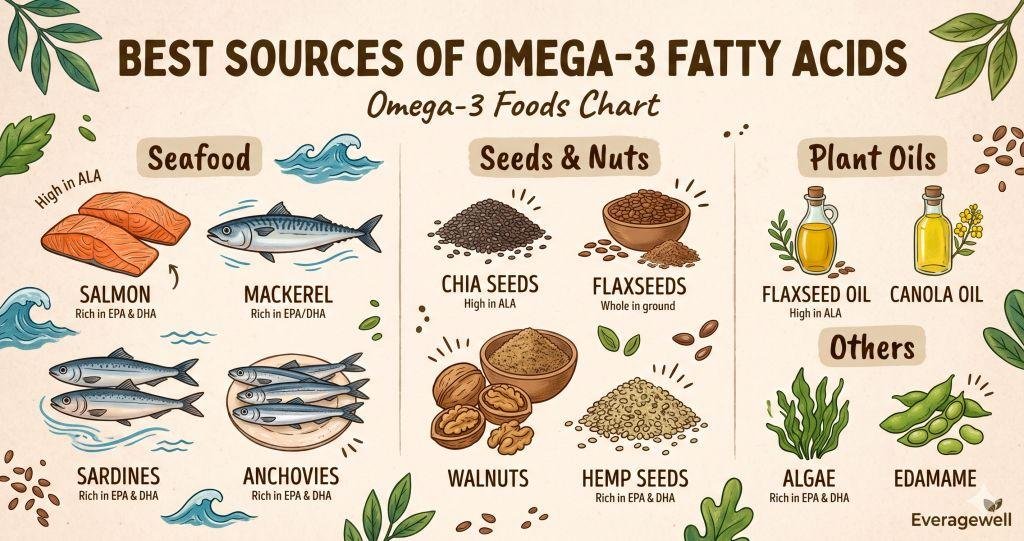
If you are looking for an omega-3 foods chart, the good news is that you have plenty of choices. Fatty fish such as salmon, sardines, herring, and mackerel provide EPA and DHA, while foods such as chia seeds, flaxseed, walnuts, and canola oil provide the plant-based omega-3 fat ALA.
For adults over 50, adding omega-3-rich foods to a balanced eating pattern can be a practical way to improve the overall quality of the diet. Omega-3 fatty acids are involved in the normal function of the heart, blood vessels, brain, eyes, and other tissues.
But not all omega-3 foods provide the same type of omega-3. This distinction is important. Your body can convert ALA from plant foods into EPA and DHA, but the conversion is limited. Eating seafood is therefore a practical way to obtain EPA and DHA directly.
In this guide, you’ll find an easy omega-3 foods chart, the differences between ALA, EPA, and DHA, the best fish and plant sources, practical meal ideas, potential benefits and risks, and tips for choosing omega-3 foods after age 50.
Quick Answer: What Foods Are High in Omega-3?
The best dietary sources include:
- Salmon
- Sardines
- Herring
- Atlantic mackerel
- Rainbow trout
- Canned salmon
- Oysters
- Chia seeds
- Ground flaxseed
- Walnuts
- Canola oil
- Soybean oil
- Some omega-3-fortified eggs and dairy products
Fatty fish generally provide the most EPA and DHA, while seeds, nuts, and plant oils are important sources of ALA.
The American Heart Association recommends eating two servings of fish per week, particularly fatty fish, as part of a heart-healthy dietary pattern.
What Are Omega-3 Fatty Acids?
Omega-3 fatty acids are a group of polyunsaturated fats that play important roles throughout the body.
There are three major omega-3 fatty acids you will commonly see on nutrition information:
- ALA — alpha-linolenic acid
- EPA — eicosapentaenoic acid
- DHA — docosahexaenoic acid
ALA is considered an essential fatty acid because the body cannot make it on its own. It must come from food or another dietary source.
EPA and DHA are found primarily in fish and seafood. Some algae-based foods and supplements also provide them.
Your body can convert some ALA into EPA and DHA, but the conversion is quite limited. That’s one reason fish and seafood can be particularly useful sources of EPA and DHA.
Why Does This Matter?
Imagine two foods:
Food A: walnuts
Food B: salmon
Both provide omega-3 fats, but they provide different forms.
Walnuts are a good source of ALA. Salmon provides EPA and DHA.
Neither is necessarily “better” in every situation. They simply contribute different nutrients to the diet.
For people who don’t eat seafood, plant sources of ALA can still be valuable additions to a healthy eating pattern.
Omega-3 Foods Chart
The following chart gives examples of commonly available omega-3 foods and the main type of omega-3 they provide.
| Food | Typical serving | Main omega-3 | Approximate omega-3 amount* |
|---|---|---|---|
| Flaxseed oil | 1 tablespoon | ALA | 7.26 g |
| Chia seeds | 1 ounce | ALA | 5.06 g |
| English walnuts | 1 ounce | ALA | 2.57 g |
| Whole flaxseed | 1 tablespoon | ALA | 2.35 g |
| Farmed Atlantic salmon, cooked | 3 oz | EPA + DHA | 1.83 g |
| Wild Atlantic salmon, cooked | 3 oz | EPA + DHA | 1.57 g |
| Atlantic herring, cooked | 3 oz | EPA + DHA | 1.71 g |
| Canned sardines | 3 oz | EPA + DHA | 1.19 g |
| Atlantic mackerel, cooked | 3 oz | EPA + DHA | 1.02 g |
| Rainbow trout | 3 oz | EPA + DHA | 0.84 g |
| Canned pink salmon | 3 oz | EPA + DHA | 0.91 g |
| Oysters | 3 oz | EPA + DHA | 0.53 g |
| Sea bass | 3 oz | EPA + DHA | 0.65 g |
| Shrimp | 3 oz | EPA + DHA | 0.24 g |
| Light canned tuna | 3 oz | EPA + DHA | 0.19 g |
| Edamame | ½ cup | ALA | 0.28 g |
| Canola oil | 1 tablespoon | ALA | 1.28 g |
| Soybean oil | 1 tablespoon | ALA | 0.92 g |
*Amounts can vary depending on the specific food, brand, species, preparation, and serving size. Values above are based on the NIH Office of Dietary Supplements food-source table.
This chart illustrates an important point: fatty fish tend to be much richer in EPA and DHA than lean fish, while chia, flaxseed, walnuts, and certain plant oils are particularly rich in ALA.
ALA vs. EPA vs. DHA: What’s the Difference?
Understanding these three names makes an omega-3 foods chart much easier to use.
| Omega-3 | Main food sources | What to know |
|---|---|---|
| ALA | Flaxseed, chia, walnuts, canola oil, soybean oil | Essential omega-3 obtained from food |
| EPA | Fatty fish, seafood, algae-based sources | Long-chain omega-3 |
| DHA | Fatty fish, seafood, algae-based sources | Important structural component of cell membranes |
ALA
ALA is abundant in many plant foods.
Good sources include:
- Flaxseed
- Chia seeds
- Walnuts
- Canola oil
- Soybean oil
- Edamame
ALA is nutritionally important, but the body converts only a small amount of ALA into EPA and DHA.
EPA
EPA is found primarily in seafood.
It is one of the long-chain omega-3 fatty acids that has been studied extensively for cardiovascular health and triglyceride metabolism.
DHA
DHA is another long-chain omega-3.
It is especially abundant in tissues such as the brain and retina and plays structural roles in cell membranes.
10 Best Omega-3 Foods to Add to Your Diet
1. Salmon
Salmon is one of the easiest omega-3 foods for Americans to incorporate into regular meals.
A 3-ounce serving of cooked Atlantic salmon can provide well over 1.5 grams of combined EPA and DHA, although the exact amount varies by type and preparation.
Try salmon:
- Baked with lemon and herbs
- Added to a salad
- Served with roasted vegetables
- Flaked into a whole-grain bowl
- Used in a salmon sandwich
For adults over 50, salmon also provides high-quality protein and several other nutrients.
2. Sardines
Sardines are small, oily fish with an impressive nutritional profile.
They provide EPA and DHA and can also contribute protein, vitamin D, calcium when edible bones are included, and other nutrients.
Canned sardines are particularly convenient because they require little preparation.
Try them on:
- Whole-grain toast
- A green salad
- Crackers with avocado
- Pasta with vegetables
3. Herring
Herring is another naturally omega-3-rich fish.
It can be served fresh, smoked, or canned, although smoked and prepared versions may contain substantial sodium.
If you are watching your blood pressure or sodium intake, check the nutrition label.
You can also read our blood pressure chart for seniors to better understand why sodium and overall dietary patterns matter for cardiovascular health.
4. Atlantic Mackerel
Atlantic mackerel is particularly rich in EPA and DHA.
However, don’t confuse Atlantic mackerel with king mackerel.
The FDA lists Atlantic mackerel as a lower-mercury “Best Choice,” while king mackerel is on the “Choices to Avoid” list because of its high mercury level.
5. Rainbow Trout
Rainbow trout provides EPA and DHA while also offering protein.
It’s a useful alternative if salmon isn’t your favorite fish.
Try baked trout with:
- Roasted vegetables
- Brown rice
- Quinoa
- A simple green salad
6. Canned Salmon
Fresh fish isn’t the only option.
Canned salmon can be affordable, convenient, and easy to keep in the pantry.
Use it to make:
- Salmon patties
- Salmon salad
- Sandwiches
- Grain bowls
- Salads
Canned fish can be especially useful for people who don’t enjoy cooking from scratch.
7. Chia Seeds
Chia seeds are one of the richest common plant sources of ALA.
One ounce provides about 5 grams of ALA according to the NIH Office of Dietary Supplements.
Add chia seeds to:
- Oatmeal
- Yogurt
- Smoothies
- Overnight oats
- Homemade energy bites
They also provide dietary fiber.
8. Ground Flaxseed
Flaxseed is another excellent plant-based omega-3 source.
Ground flaxseed is often easier to incorporate into meals than whole flaxseed.
Try adding a tablespoon to oatmeal, yogurt, smoothies, or whole-grain cereal.
Flaxseed oil is even more concentrated in ALA, but it should generally be used as a finishing oil rather than treated like an everyday cooking oil.
9. Walnuts
Walnuts provide ALA along with protein, fiber, minerals, and unsaturated fats.
A small handful can be an easy snack.
Choose unsalted walnuts when possible, especially if you’re trying to reduce sodium.
10. Canola Oil
Canola oil provides ALA and can be useful for cooking.
It contains considerably less saturated fat than butter, making it one practical option when replacing some saturated fats with unsaturated fats.
Omega-3 Foods for Adults Over 50
Nutrition needs and eating habits often change as people get older.
Some adults over 50 eat less because their appetite changes. Others rely more heavily on convenient foods.
That makes nutrient-dense foods particularly useful.
Omega-3-rich foods can fit into a healthy eating pattern in several ways.
Focus on Food Quality
Rather than asking:
“How can I get the maximum amount of omega-3?”
A better question is:
“How can I build a healthier overall diet that includes omega-3 foods?”
For example, replacing a processed meat sandwich with a salmon or sardine meal can improve the overall nutritional profile of the meal.
Pair Omega-3 Foods With Protein
Adults over 50 also need to pay attention to adequate protein intake.
A meal containing salmon, vegetables, and beans or whole grains can provide several important nutrients at once.
Don’t Forget Fiber
Plant-based omega-3 foods such as chia seeds, flaxseed, and walnuts can also contribute fiber.
For more information, see our fiber intake chart by age.
Potential Health Benefits of Omega-3 Foods
Omega-3 fats have been studied for many aspects of health.
However, it is important to distinguish between eating omega-3-rich foods and taking concentrated omega-3 supplements.
1. May Support Heart Health
Fish and seafood are associated with cardiovascular benefits when they are part of a healthy dietary pattern.
The American Heart Association recommends two servings of fish per week, particularly fatty fish.
The benefit may come from the combination of omega-3 fatty acids, protein, vitamins, minerals, and the fact that fish can replace foods higher in saturated fat.
2. May Help Maintain Healthy Triglyceride Levels
EPA and DHA have been studied extensively in relation to triglycerides.
Very high triglyceride levels sometimes require medical treatment, and prescription omega-3 medications may be used in certain situations.
That is different from simply taking an over-the-counter fish oil supplement.
If you’ve recently had a cholesterol test, our cholesterol levels chart can help explain LDL, HDL, triglycerides, and total cholesterol.
3. Supports Normal Cell Function
Omega-3 fatty acids are components of cell membranes throughout the body.
DHA is particularly concentrated in the brain and retina.
4. May Support Healthy Blood Pressure
Research has examined the relationship between omega-3 intake and blood pressure.
Some evidence suggests relatively high intakes of EPA and DHA may modestly lower blood pressure, although this should not be interpreted as a replacement for prescribed blood-pressure treatment.
5. Provides Nutrients Alongside Omega-3s
One advantage of obtaining omega-3s from food is that the food provides other nutrients too.
For example, salmon provides:
- Protein
- Vitamin B12
- Vitamin D
- Selenium
- EPA
- DHA
That makes whole foods a useful foundation for nutrition.
Omega-3 Foods and Heart Health
Heart health becomes especially important with age because cardiovascular risk generally increases as people get older.
Omega-3 foods can fit into a heart-friendly eating pattern, but they should not be viewed as a magic ingredient.
A heart-supportive diet also includes:
- Vegetables
- Fruits
- Whole grains
- Beans and legumes
- Nuts and seeds
- Fish and seafood
- Unsaturated oils
- Appropriate portions
- Limited processed meats
- Limited excess sodium
- Limited added sugars
The FDA notes that eating fish as part of a healthy dietary pattern may have heart-health benefits, while the American Heart Association recommends two fish servings per week.
Omega-3 Foods and Brain Health
DHA is an important structural component of the brain and retina.
That does not mean eating salmon will automatically improve memory or prevent dementia.
Research into omega-3s and cognitive health is ongoing, and results vary depending on the population, dietary source, health condition, and whether researchers are studying food or supplements.
For older adults, it makes more sense to focus on an overall nutrient-rich dietary pattern rather than expecting one nutrient to protect the brain by itself.
How Much Omega-3 Do You Need?
This is an area where people often get confused.
There is no established recommended daily amount for EPA and DHA for healthy adults.
There is, however, an established adequate intake for ALA:
| Group | ALA recommendation |
|---|---|
| Adult men | 1.6 g/day |
| Adult women | 1.1 g/day |
| Pregnant women | 1.4 g/day |
| Breastfeeding women | 1.3 g/day |
The NIH notes that these recommendations are for ALA, not EPA or DHA.
Instead of trying to calculate your omega-3 intake every day, most people can focus on regularly including omega-3-rich foods.
For seafood, the American Heart Association recommends two servings per week.
Omega-3 Foods vs. Supplements
Food and supplements aren’t interchangeable in every respect.
A salmon fillet provides omega-3 fats along with protein, vitamin D, vitamin B12, selenium, and other nutrients.
A fish-oil capsule primarily provides concentrated omega-3 fatty acids.
When Food May Be the Better Starting Point
For generally healthy people, obtaining nutrients from a varied diet is usually a sensible first approach.
Try:
- Salmon twice a week
- Chia in oatmeal
- Ground flaxseed in yogurt
- Walnuts as a snack
- Canola oil instead of butter in selected recipes
When Supplements May Be Discussed
A healthcare professional may recommend or discuss an omega-3 supplement in particular situations.
This is especially relevant for people with certain medical conditions or very high triglycerides.
Prescription omega-3 products are different from ordinary dietary supplements and may be used under medical supervision.
Don’t assume that taking a high-dose fish oil supplement is automatically healthier.
Mercury: Choosing Fish Safely
One reason people hesitate to eat more fish is mercury.
Mercury is a naturally occurring element that can accumulate in certain fish, particularly larger predatory species.
The solution isn’t necessarily to stop eating fish.
Instead, choose a variety of fish that are lower in mercury.
The FDA/EPA guidance places salmon, sardines, Atlantic mackerel, herring, trout, canned light tuna, and many other species in the “Best Choices” category.
Fish listed by the FDA as choices to avoid because of the highest mercury levels include:
- King mackerel
- Marlin
- Orange roughy
- Shark
- Swordfish
- Tilefish from the Gulf of Mexico
- Bigeye tuna
Variety is useful. You don’t need to eat the same fish every week.
If you catch fish yourself, check local fish advisories because contamination can vary by body of water.
Potential Risks and Drawbacks
Omega-3 foods are generally nutritious, but there are still a few considerations.
Fish Allergies
People with fish or shellfish allergies need to avoid the foods that trigger their reactions.
Mercury Exposure
Choosing certain high-mercury fish too frequently can increase exposure.
Following FDA/EPA fish guidance can help.
Calories From Nuts and Oils
Chia, flaxseed, walnuts, and oils are nutritious, but they are calorie-dense.
If you’re trying to manage weight, portion size still matters.
Our BMI chart for adults can provide general information about BMI categories, although BMI alone does not measure overall health.
Medication Considerations
People taking anticoagulant or antiplatelet medications should talk with their healthcare professional before taking high-dose omega-3 supplements.
Do not stop prescribed medication simply because you begin eating more omega-3-rich foods.
Simple Ways to Eat More Omega-3 Foods
You don’t need a complicated meal plan.
Try these easy swaps:
Breakfast
Add one tablespoon of ground flaxseed to oatmeal.
Midmorning Snack
Have a small handful of unsalted walnuts.
Lunch
Make a salmon salad with leafy greens, beans, tomatoes, and olive or canola oil dressing.
Afternoon
Add chia seeds to plain yogurt.
Dinner
Serve baked salmon or trout with vegetables and a whole grain.
Meatless Option
Use walnuts, chia seeds, flaxseed, and canola or soybean oil regularly if you don’t eat fish.
A Simple One-Day Omega-3 Meal Plan
Here’s what a realistic day might look like.
Breakfast
Oatmeal topped with:
- Chia seeds
- Ground flaxseed
- Blueberries
- Walnuts
Lunch
Large salad with:
- Leafy greens
- Chickpeas
- Tomatoes
- Cucumber
- Canned salmon
- Canola- or olive-oil-based dressing
Snack
Plain Greek yogurt with walnuts.
Dinner
Baked trout with:
- Roasted broccoli
- Brown rice
- Side salad
This type of meal plan provides omega-3s from both seafood and plant foods while also supplying protein, fiber, vitamins, and minerals.
Common Omega-3 Myths
Myth 1: “All omega-3 foods are the same.”
Fact: No. Plant foods such as chia and flaxseed mainly provide ALA, while fatty fish provide EPA and DHA.
Myth 2: “You have to eat salmon to get omega-3s.”
Fact: Salmon is an excellent source, but sardines, herring, mackerel, trout, oysters, walnuts, chia, flaxseed, and certain oils also provide omega-3s.
Myth 3: “More omega-3 is always better.”
Fact: More isn’t automatically better. Extremely high supplemental doses can have risks, and nutrition should be considered in the context of your overall health.
Myth 4: “Plant omega-3s are useless.”
Fact: ALA is an essential fatty acid and an important part of a healthy diet. However, the conversion of ALA into EPA and DHA is limited.
Myth 5: “Fish oil supplements are better than eating fish.”
Fact: Supplements and fish aren’t equivalent. Fish provides omega-3s along with protein and other nutrients. Supplements can have specific uses but aren’t automatically necessary for everyone.
Myth 6: “All tuna is low in mercury.”
Fact: Different tuna species contain different mercury levels. Canned light tuna is a “Best Choice,” while albacore/white tuna is a “Good Choice,” and bigeye tuna is a “Choice to Avoid” under FDA guidance.
Myth 7: “Omega-3 foods can replace heart medications.”
Fact: They cannot. Healthy foods can support an overall heart-healthy lifestyle, but prescribed medications should be taken as directed.
Who Should Be More Careful?
Most adults can include omega-3-rich foods as part of a balanced diet.
However, additional care may be appropriate for:
People Taking Blood-Thinning Medications
Talk with your healthcare professional before starting high-dose omega-3 supplements.
People With Fish or Shellfish Allergies
Choose plant sources such as flaxseed, chia, walnuts, and appropriate plant oils instead.
People With Very High Triglycerides
Don’t attempt to treat very high triglycerides solely with over-the-counter supplements.
A clinician can determine whether prescription treatment, dietary changes, or both are appropriate.
Adults With Multiple Health Conditions
People over 50 may take several medications or have conditions involving the heart, kidneys, liver, blood pressure, or blood sugar.
In those situations, personalized advice is more useful than a generic supplement recommendation.
Pregnant or Breastfeeding Individuals
Fish can provide important nutrients during pregnancy and breastfeeding, but mercury exposure matters.
The FDA recommends choosing fish from lower-mercury categories and provides specific guidance for these groups.
How to Get Started
If your current diet contains very few omega-3 foods, don’t try to change everything at once.
Step 1: Add One Plant Source
Choose one:
- Chia seeds
- Ground flaxseed
- Walnuts
Add it to a meal you already eat.
Step 2: Add Fish Twice a Week
Choose lower-mercury options such as salmon, sardines, trout, Atlantic mackerel, or canned light tuna.
The AHA recommends two servings of fish per week.
Step 3: Use Healthy Oils
Use canola or soybean oil where appropriate instead of relying heavily on butter or other sources of saturated fat.
Step 4: Rotate Your Choices
You don’t have to eat salmon every Tuesday and Thursday.
Try salmon one day and sardines, trout, or another suitable fish later in the week.
Step 5: Think About the Whole Meal
Omega-3 is only one part of a healthy diet.
Pair it with vegetables, beans, whole grains, fruit, and other nutrient-rich foods.
Frequently Asked Questions
1. What is the best food source of omega-3?
Fatty fish such as salmon, sardines, herring, and Atlantic mackerel are among the richest common food sources of EPA and DHA. Chia seeds, flaxseed, and walnuts are excellent plant sources of ALA.
2. Which foods are high in omega-3 but not fish?
Chia seeds, flaxseed, walnuts, canola oil, soybean oil, and some fortified foods provide omega-3s without requiring fish. Most of these foods provide ALA rather than EPA and DHA.
3. What is the best omega-3 food for adults over 50?
There isn’t one best food for everyone. Salmon, sardines, trout, herring, and Atlantic mackerel are practical choices because they provide EPA and DHA along with protein and other nutrients.
4. How many times a week should I eat fish?
The American Heart Association recommends two servings of fish per week, particularly fatty fish.
5. Are walnuts a good source of omega-3?
Yes. Walnuts provide ALA, a plant-based omega-3 fatty acid. One ounce of English walnuts contains about 2.57 grams of ALA according to NIH data.
6. Are chia seeds high in omega-3?
Yes. Chia seeds are particularly rich in ALA. One ounce provides about 5.06 grams of ALA.
7. Is flaxseed better than fish for omega-3?
Not necessarily. Flaxseed is rich in ALA, while fish provides EPA and DHA directly. They contribute different types of omega-3 fatty acids.
8. Does canned salmon contain omega-3?
Yes. Canned salmon can be a useful source of EPA and DHA and can be a convenient alternative to fresh salmon.
9. Is canned tuna high in omega-3?
Canned light tuna contains omega-3s, but generally less EPA and DHA than fatty fish such as salmon, sardines, herring, and mackerel.
10. Can omega-3 foods lower cholesterol?
Omega-3 fatty acids are not primarily used to lower LDL cholesterol. EPA and DHA can affect triglyceride levels, but cholesterol management depends on the complete lipid profile and overall cardiovascular risk.
11. Can omega-3 foods help blood pressure?
Research suggests that higher intake of EPA and DHA may modestly affect blood pressure, but omega-3 foods should not replace prescribed blood-pressure treatment.
12. Are omega-3 supplements necessary?
Not necessarily. Many people can include omega-3-rich foods as part of a healthy diet. Supplements may be appropriate in specific circumstances, but high-dose supplementation should be discussed with a healthcare professional.
13. What is the best vegetarian source of omega-3?
Chia seeds, flaxseed, walnuts, canola oil, and soybean oil are good vegetarian sources of ALA. Algae-based products can provide EPA and DHA for people who avoid fish.
14. Can omega-3 foods help with weight loss?
Omega-3 foods are not a weight-loss treatment. However, foods such as fish, chia seeds, flaxseed, and walnuts can fit into a balanced eating pattern that supports healthy weight management when portions and total calorie intake are appropriate.
15. Which fish should I avoid because of mercury?
The FDA lists king mackerel, marlin, orange roughy, shark, swordfish, Gulf of Mexico tilefish, and bigeye tuna among fish to avoid because they have the highest mercury levels.
Final Takeaway
An omega-3 foods chart can make healthy food choices much easier.
If you eat fish, aim to include a variety of lower-mercury fish, with fatty fish such as salmon, sardines, herring, Atlantic mackerel, and trout being especially useful sources of EPA and DHA. The American Heart Association recommends two servings of fish per week as part of a heart-healthy dietary pattern.
If you don’t eat fish, you still have excellent options. Chia seeds, ground flaxseed, walnuts, canola oil, and soybean oil provide ALA.
For adults over 50, the goal shouldn’t be to chase a particular omega-3 number. Instead, build meals around a variety of nutrient-rich foods and make omega-3 sources a regular part of your routine.
A salmon dinner one night, walnuts with breakfast, and ground flaxseed in oatmeal the next morning can be simple steps toward a more balanced eating pattern.
Medical Disclaimer
This article is provided for general educational and informational purposes only. It does not replace individualized medical advice, diagnosis, or treatment. Nutrition needs vary from person to person, particularly for adults with chronic medical conditions or those taking prescription medications. Speak with a qualified healthcare professional before making major dietary changes or starting high-dose omega-3 supplements.
Written by
Kanhaiya Solanki is a dedicated online researcher, content writer, and blogger passionate about publishing high-quality, research-based articles. His goal is to provide accurate, easy-to-understand, and practical information on health, technology, senior care, and lifestyle topics for readers worldwide.