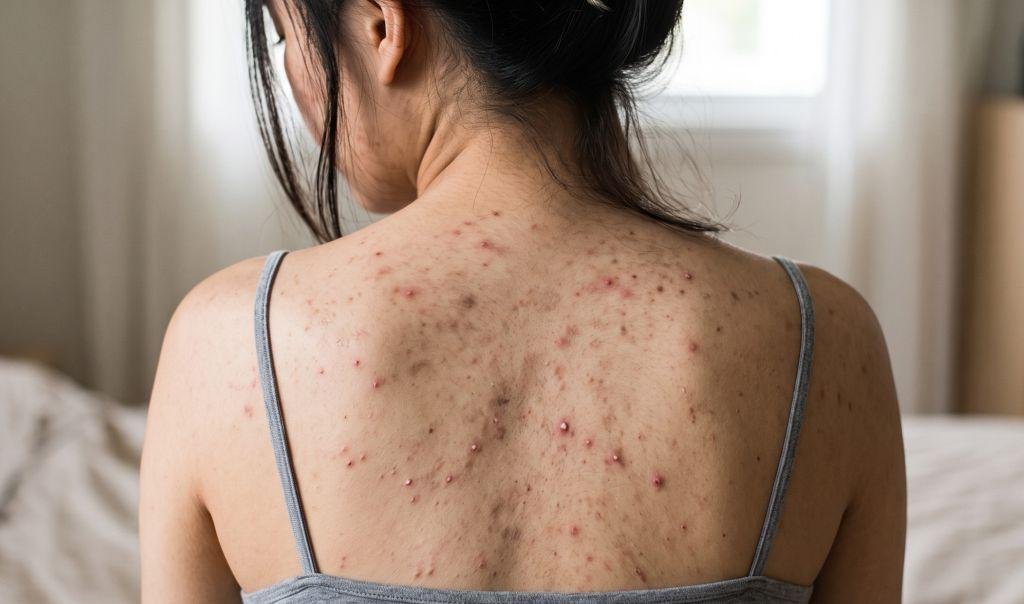
Back acne, often called “bacne,” is a common skin problem that can be frustrating, uncomfortable, and surprisingly difficult to manage.
You may notice small red bumps across your upper back, whiteheads around your shoulders, blackheads near your shoulder blades, or deeper painful pimples that seem to appear out of nowhere.
And because you can’t easily see your back, you may not realize how much acne is there until you feel a rough patch of skin, notice spots on your clothing, or someone points them out.
Back acne is not limited to teenagers. Adults can develop acne on the back, chest, and shoulders too. Hormonal changes, certain medications, sweat, friction, oily skin products, and naturally clogged hair follicles can all play a role.
The good news is that back acne can often be managed with consistent skin care and appropriate treatment. However, severe, painful, or persistent acne may require professional treatment.
This guide explains what causes bacne, how to care for acne-prone back skin, which ingredients may help, what mistakes to avoid, and when it makes sense to see a dermatologist.
Why Does Back Acne Happen?
To understand how to manage back acne, it helps to understand what is happening underneath the skin.
Your skin contains hair follicles connected to oil-producing glands. These glands produce sebum, an oily substance that helps keep the skin from becoming excessively dry.
Acne can develop when excess oil and dead skin cells contribute to blocked follicles. Inflammation and the activity of naturally occurring skin bacteria can then contribute to pimples and other acne lesions.
The back is particularly prone to breakouts because it contains many oil glands.
Several factors can make the problem worse.
Hormonal Changes
Hormones can influence oil production and acne. Although acne is strongly associated with adolescence, hormonal changes can contribute to breakouts during adulthood as well.
For some adults, acne may become more noticeable during periods of hormonal change.
Sweat and Exercise
Sweat itself isn’t necessarily the direct cause of acne, but leaving sweat and damp clothing against your skin for long periods can contribute to irritation.
If you exercise regularly, wearing clean, breathable or sweat-wicking clothing and showering soon after exercising can be helpful. The American Academy of Dermatology recommends changing out of sweaty clothing and showering as soon as possible after workouts.
Friction and Pressure
Something as ordinary as a backpack, tight athletic clothing, or equipment rubbing against your back may irritate acne-prone skin.
This is sometimes referred to as acne mechanica because repeated friction, pressure, and heat can contribute to breakouts.
Mayo Clinic lists friction or pressure from items such as backpacks and other objects as a factor that can worsen acne.
Oily Skin and Hair Products
Hair conditioners, oils, styling products, body lotions, and other products can sometimes transfer onto your back.
If you frequently notice pimples where your hair or products touch your skin, consider whether your routine could be contributing to clogged pores.
Look for products labeled non-comedogenic or oil-free when possible.
Certain Medications
Some medications can contribute to acne in certain people. Mayo Clinic notes that medications containing corticosteroids, testosterone, or lithium can be associated with acne.
Do not stop a prescribed medication on your own. If you think a medication may be affecting your skin, discuss it with the healthcare professional who prescribed it.
What Does Back Acne Look Like?
Back acne doesn’t look exactly the same in everyone.
You might have one type of lesion or several types at the same time.
| Type of breakout | What it may look like |
|---|---|
| Blackheads | Small dark spots in open pores |
| Whiteheads | Small flesh-colored or white bumps |
| Papules | Small, raised, red or tender bumps |
| Pustules | Inflamed bumps containing pus |
| Nodules | Larger, deeper and often painful lumps |
| Cystic lesions | Deep, painful inflammatory lesions |
These are different forms of acne and can require different approaches.
Deep nodules or cystic lesions deserve particular attention because severe acne can increase the risk of permanent scarring.
Can Adults Get Back Acne?
Yes.
Being past your teenage years does not mean you cannot develop acne.
Adult acne may appear on the face, jawline, chest, shoulders, and back. Hormonal changes, genetics, medications, skin products, and other factors can contribute.
For adults in their 40s, 50s, 60s, and beyond, a new skin problem can sometimes be confused with other conditions.
That’s one reason persistent or unusual breakouts should not automatically be assumed to be ordinary acne.
If a new rash, bumps, itching, pain, or skin changes do not behave like your usual acne, a healthcare professional can help determine what you’re dealing with.
How Can You Treat Back Acne at Home?
For mild back acne, a simple routine may be a reasonable place to start.
The goal isn’t to attack your skin with as many products as possible.
In fact, using too many harsh products can leave your skin irritated and uncomfortable.
A better approach is consistency.
1. Wash Your Back Gently
Use a gentle cleanser and avoid aggressively scrubbing the affected area.
It can be tempting to grab a rough loofah or stiff body brush when you feel bumps across your back. However, aggressive scrubbing can irritate acne-prone skin.
The American Academy of Dermatology recommends gentle cleansing and advises avoiding abrasive scrubs, loofahs, back brushes, and similar products when treating back acne.
Think gentle rather than aggressive.
2. Consider a Benzoyl Peroxide Wash
Benzoyl peroxide is one of the commonly used acne-fighting ingredients.
It can reduce acne-causing bacteria and is included in many over-the-counter acne products. The American Academy of Dermatology specifically recommends benzoyl peroxide washes as an option for mild to moderate back acne.
For back acne, the AAD notes that a benzoyl peroxide wash may work better when it remains on the skin for about two to five minutes before being rinsed away.
One practical warning: benzoyl peroxide can bleach fabrics.
That means your favorite dark towel or shirt may develop lighter spots if the product isn’t thoroughly rinsed away.
3. Try Salicylic Acid for Clogged Pores
Salicylic acid is another common acne ingredient.
It helps exfoliate the skin and unclog pores. According to the American Academy of Dermatology, salicylic acid can be particularly useful for whiteheads and blackheads.
If your back has many small clogged pores rather than deep painful lesions, a salicylic-acid-containing cleanser may be worth discussing with a pharmacist or dermatologist.
Start carefully because irritation and dryness can occur with acne treatments.
4. Consider Adapalene When Appropriate
Adapalene is an over-the-counter topical retinoid used to treat acne.
Retinoids help prevent clogged hair follicles and can be particularly useful as part of an acne treatment routine. The AAD notes that adapalene 0.1% gel can be used with benzoyl peroxide for back acne.
However, retinoids aren’t appropriate for everyone.
If you’re pregnant, trying to become pregnant, or unsure whether a retinoid is appropriate for you, talk with a healthcare professional before using one. Treatment choices during pregnancy require particular care.
5. Don’t Pick Your Pimples
This is one of the simplest pieces of advice and one of the hardest to follow.
A pimple on your back can be annoying because you may feel it before you can even see it.
Picking, squeezing, or scratching can increase irritation and may increase the risk of scarring or lingering skin discoloration. Dermatology guidance consistently recommends avoiding the temptation to pick acne.
What Should You Wear If You Have Bacne?
Clothing can make a surprisingly big difference when sweat and friction are part of the problem.
Consider:
- Loose-fitting shirts during exercise
- Breathable fabrics
- Sweat-wicking workout clothing
- Clean clothing after workouts
- Avoiding tight straps that repeatedly rub the same area
- Washing workout clothes after use
If a backpack repeatedly rubs against your acne, consider whether you can reduce the pressure or friction.
The American Academy of Dermatology recommends avoiding things that rub against the back when possible.
Should You Shower After Exercise?
If you’re prone to back acne, showering soon after exercise is a sensible habit.
Sweat, oil, tight clothing, and friction can all occur together during a workout.
You don’t need an elaborate shower routine.
A practical approach is:
- Finish your workout.
- Change out of sweaty clothing.
- Shower when reasonably possible.
- Gently cleanse your skin.
- Pat your skin dry rather than aggressively rubbing it.
- Put on clean clothing.
If you can’t shower immediately, changing out of sweaty clothing is still a useful step. The AAD recommends showering and changing clothes as soon as possible after activities that cause sweating.
Can Diet Cause Back Acne?
This is an area where it’s easy to find overly confident claims online.
People often blame chocolate, dairy, greasy foods, sugar, or one particular food for every acne breakout.
The scientific picture is more complicated.
The American Academy of Dermatology’s updated acne guidance notes that available evidence was insufficient to make recommendations for dietary changes as an acne treatment.
That doesn’t mean your overall diet is unimportant.
Eating a balanced diet supports general health, but it is better not to assume that removing one food will automatically clear your back.
If you notice a consistent personal pattern between a particular food and your symptoms, you can discuss it with a healthcare professional rather than making major dietary restrictions based on internet advice.
Are Home Remedies Good for Back Acne?
Searches for back acne often lead to home remedies involving toothpaste, baking soda, lemon juice, vinegar, essential oils, or harsh scrubbing.
Be careful.
“Natural” does not automatically mean “gentle.”
Your skin can become irritated by substances that were never designed to treat acne.
The American Academy of Dermatology specifically advises against using toothpaste as an acne treatment and recommends relying on proven acne-fighting ingredients instead.
A simple skincare routine is generally easier to maintain and less likely to overwhelm your skin than a long list of kitchen remedies.
What About Moisturizer for Acne-Prone Back Skin?
If acne treatment makes your skin dry, moisturizer may still be useful.
Dryness can make your skin feel tight, rough, itchy, or uncomfortable.
Look for products labeled:
- Oil-free
- Non-comedogenic
- Won’t clog pores
- Fragrance-free, especially if your skin is sensitive
Using an appropriate moisturizer doesn’t mean you’re “feeding” your acne.
The goal is to keep the skin barrier comfortable while treating the underlying acne.
Don’t Forget Sunscreen
If your back is exposed to the sun, protect it.
This becomes particularly important if you have dark marks left behind after acne.
The AAD recommends broad-spectrum, water-resistant sunscreen with SPF 30 or higher and advises choosing non-comedogenic products for acne-prone skin.
If you’re spending time outdoors at a pool, lake, beach, or backyard gathering, remember that the skin on your shoulders and upper back can receive substantial sun exposure.
How Long Does Back Acne Take to Improve?
One of the biggest mistakes people make is changing treatments every few days.
Acne treatment generally requires patience.
The American Academy of Dermatology says that people treating back acne may begin seeing improvement in approximately six to eight weeks, while clearer skin can take several months.
That means you shouldn’t necessarily abandon a reasonable routine after a week because your skin hasn’t changed dramatically.
At the same time, persistent or worsening acne shouldn’t be ignored indefinitely.
If an over-the-counter routine isn’t helping after several weeks, professional advice may be appropriate.
When Should You See a Dermatologist for Back Acne?
Not every case of bacne requires a dermatologist.
But some situations deserve professional attention.
Consider making an appointment if:
- You have deep or painful bumps.
- You have large nodules or cyst-like lesions.
- Your acne is leaving scars.
- Breakouts cover a large portion of your back.
- Your acne continues despite consistent over-the-counter treatment.
- The condition is getting worse.
- You aren’t sure whether the bumps are actually acne.
- The problem is affecting your confidence or daily life.
The AAD recommends professional care for deep, painful back acne, while NHS guidance recommends medical evaluation for moderate or severe acne and nodules or cysts because of the risk of scarring.
What Treatment Might a Dermatologist Recommend?
Treatment depends on the type and severity of acne.
A dermatologist may recommend topical treatments, combinations of medications, or medicines taken by mouth.
Potential treatments can include:
- Topical retinoids
- Benzoyl peroxide
- Salicylic acid
- Azelaic acid
- Prescription topical medications
- Oral antibiotics in appropriate cases
- Hormonal treatments for some patients
- Other prescription therapies for severe acne
The American Academy of Dermatology’s current acne guideline supports several topical therapies, including benzoyl peroxide, topical retinoids, salicylic acid, and azelaic acid, along with selected systemic treatments for appropriate patients.
Treatment is not one-size-fits-all.
Age, medical history, medications, pregnancy status, acne severity, skin sensitivity, and the type of lesions all matter.
Back Acne vs. Folliculitis: Are They the Same?
Not necessarily.
Some bumps on the back may look like acne but have a different cause.
Folliculitis, for example, involves inflammation of hair follicles and can sometimes resemble acne.
If your bumps are extremely itchy, all look very similar, appeared suddenly, or don’t respond to typical acne treatment, it may be worth having them evaluated.
This is particularly important because treating the wrong condition with multiple acne products can increase irritation without addressing the actual problem.
Common Mistakes to Avoid
Scrubbing Too Hard
More scrubbing does not necessarily mean cleaner skin.
Aggressive exfoliation can irritate your back and make an already sensitive area uncomfortable.
Using Too Many Acne Products
Using benzoyl peroxide, salicylic acid, retinoids, exfoliating scrubs, alcohol-based toners, and several other products at once can be overwhelming.
More products aren’t automatically better.
Picking and Squeezing
This can worsen inflammation and increase the possibility of scars or lingering discoloration.
Staying in Sweaty Clothes
After exercising, change into clean clothing as soon as practical.
Ignoring Backpack Friction
If your backpack repeatedly rubs the same area, it may be contributing to the problem.
Using Heavy, Oily Products
Hair oils, body oils, and thick lotions can sometimes contribute to clogged pores.
Consider non-comedogenic alternatives if you’re prone to acne.
Expecting Overnight Results
Acne treatment usually takes time.
Giving a reasonable treatment plan several weeks to work is often more realistic than expecting clear skin within a few days.
A Simple Back Acne Routine
If you want to keep things uncomplicated, start with a basic routine.
Morning or Shower Routine
- Gently cleanse the back.
- If appropriate for your skin, use an acne cleanser containing benzoyl peroxide or salicylic acid.
- Rinse thoroughly.
- Pat dry.
- Apply a lightweight, non-comedogenic moisturizer if needed.
- Use SPF 30 or higher on exposed skin.
After Exercise
- Change out of sweaty clothing.
- Shower as soon as practical.
- Gently cleanse your back.
- Put on clean clothing.
Evening
Depending on the treatment you’re using and professional advice:
- Cleanse gently.
- Apply the appropriate acne treatment.
- Moisturize if needed.
The key is consistency rather than complexity.
Who Should Be More Careful With Acne Treatment?
Some people should speak with a healthcare professional before starting certain acne treatments.
This includes people who:
- Are pregnant or trying to become pregnant
- Have very sensitive skin
- Have eczema or another chronic skin condition
- Take multiple medications
- Have severe or cystic acne
- Develop significant irritation from acne products
- Are unsure whether their skin problem is actually acne
Prescription and nonprescription products can have side effects and interactions.
For that reason, follow product directions and talk with a healthcare professional when you’re unsure.
Frequently Asked Questions About Back Acne
1. What causes back acne?
Back acne develops when hair follicles become clogged with oil and dead skin cells, followed by inflammation and other processes involved in acne. Hormonal changes, genetics, friction, certain medications, and oily products can contribute.
2. How do I get rid of back acne?
Mild back acne may improve with consistent skin care, gentle cleansing, and appropriate over-the-counter acne ingredients such as benzoyl peroxide or salicylic acid. More severe acne may require prescription treatment.
3. Is benzoyl peroxide good for bacne?
Benzoyl peroxide can be useful for mild to moderate back acne. The AAD recommends benzoyl peroxide washes as an over-the-counter option and notes that leaving the wash on the back for about two to five minutes before rinsing may improve its usefulness.
4. Does sweating cause back acne?
Sweating can contribute to conditions that irritate acne-prone skin, especially when combined with tight clothing, friction, and leaving sweaty clothes on for a long time. Showering and changing clothes after exercise can help reduce irritation.
5. Should I scrub my back to remove acne?
No. Aggressive scrubbing can irritate the skin. Dermatologists recommend gentle cleansing rather than abrasive scrubbing, loofahs, or stiff brushes.
6. Can adults over 50 get back acne?
Yes. Acne can affect adults at different ages. Hormonal changes, medications, genetics, and other factors may contribute to adult acne.
However, if a person develops a sudden or unusual skin eruption later in life, it is sensible to have it evaluated rather than automatically assuming it is ordinary acne.
7. Does toothpaste get rid of back acne?
Toothpaste is not a recommended acne treatment. The American Academy of Dermatology advises using established acne-fighting ingredients instead.
8. How long does it take for back acne to improve?
It varies, but you should not expect immediate results. The AAD notes that improvement may begin after about six to eight weeks, with more complete clearing potentially taking several months.
9. Can back acne leave scars?
Yes. Deeper forms of acne, particularly nodules and cystic lesions, can leave permanent scars. Early professional treatment can be important when acne is severe.
10. When should I see a dermatologist for bacne?
Consider seeing a dermatologist if your acne is deep, painful, widespread, persistent, scarring, or not improving with an appropriate over-the-counter routine. A dermatologist can determine whether you have acne and create a treatment plan suited to your skin.
Final Thoughts
Back acne can be frustrating, especially because it’s harder to see and treat than facial acne.
But having bacne doesn’t mean you have poor hygiene, and it doesn’t mean you’ve done something wrong.
Acne is a complex skin condition involving clogged follicles, oil production, inflammation, and other factors. Genetics, hormones, medications, friction, and skin products can all influence what happens on your back.
A practical approach is to keep your routine simple.
Cleanse gently. Avoid aggressive scrubbing. Shower after sweating. Wear clean, breathable clothing. Reduce unnecessary friction. Choose non-comedogenic products when possible. And give an appropriate treatment enough time to work.
If your back acne is painful, deep, persistent, or leaving scars, don’t keep experimenting with home remedies indefinitely. A dermatologist can help determine the cause and recommend treatment based on the type and severity of your acne.
For adults, especially those who develop a new or unusual breakout later in life, getting an accurate diagnosis can also be valuable because not every bump on the back is acne.
Health disclaimer: This article is for general educational purposes and is not a substitute for individualized medical advice, diagnosis, or treatment. If you have severe, painful, rapidly changing, or persistent skin symptoms, speak with a qualified healthcare professional or dermatologist.
Also Read:
What Is Acne? Causes, Symptoms, Treatment, and Prevention
5 Places Body Acne Can Appear: Causes, Treatment and Prevention
What Is Acid Sphingomyelinase Deficiency (ASMD)?
Written by:
Kanhaiya Solanki is a dedicated online researcher, content writer, and blogger passionate about publishing high-quality, research-based articles. His goal is to provide accurate, easy-to-understand, and practical information on health, technology, senior care, and lifestyle topics for readers worldwide.