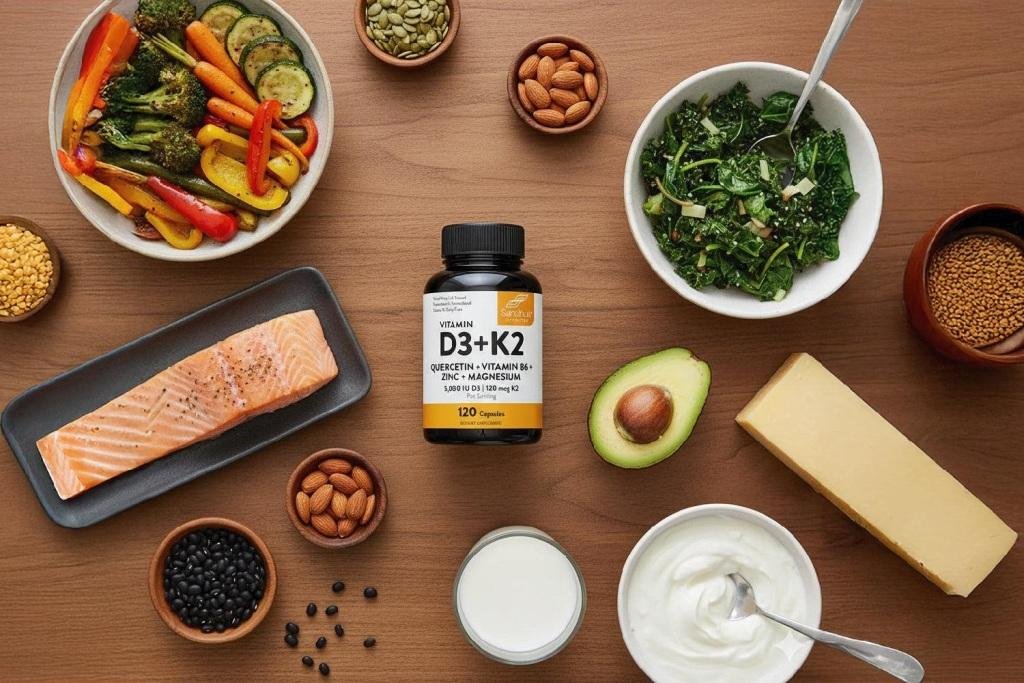
Vitamin D3 with K2 is a popular nutritional supplement combination designed to support bone health and normal calcium metabolism. Vitamin D3 helps the body absorb calcium, while vitamin K2 helps activate proteins involved in calcium regulation and bone metabolism.
Because both nutrients play important roles in the body, some people believe taking them together offers additional health benefits, particularly for adults over 50 who want to maintain strong bones as they age.
However, there is an important distinction between how these vitamins work biologically and what clinical research has actually proven. Although vitamin D3 and vitamin K2 have complementary functions, there is not enough strong evidence to conclude that everyone needs to take them together or that the combination prevents heart disease, artery calcification, or bone fractures.
So, is vitamin D3 with K2 worth taking? How much do you need? Can you get these nutrients from food? And are there any risks for older adults?
This guide explains how the two vitamins work, their potential benefits, recommended vitamin D intake, food sources, supplement safety, and practical considerations for adults over 50.
Quick Answer: Is Vitamin D3 with K2 Good for You?
Vitamin D3 with K2 may be useful for people who need vitamin D supplementation and have a reason to consider their vitamin K intake. However, combining the two is not necessary for everyone.
- Vitamin D3: Helps the body absorb calcium and supports normal bone and muscle function.
- Vitamin K2: Helps activate proteins involved in normal blood clotting and bone metabolism.
- Together: They have complementary biological functions, but additional benefits from taking both supplements together have not been firmly established.
- For adults over 50: Maintaining adequate vitamin D, calcium, protein, and physical activity is important for healthy aging.
- Safety: People taking warfarin or certain other medications should consult their healthcare professional before using vitamin K supplements.
The best approach is to assess your nutritional needs rather than automatically choosing a high-dose combination supplement.
1. What Is Vitamin D3 with K2?
Vitamin D3 with K2 is a dietary supplement that combines two fat-soluble vitamins.
Vitamin D3, also called cholecalciferol, is a form of vitamin D that helps regulate calcium and phosphorus levels in the body.
Vitamin K2, a form of vitamin K, is involved in activating certain proteins that participate in blood clotting and bone metabolism.
Although they perform different jobs, researchers are interested in how these nutrients may work together.
What Is Vitamin D3?
Vitamin D3 helps your body absorb calcium from the digestive system. Calcium is essential for maintaining strong bones and teeth.
It also contributes to normal muscle function, nerve signaling, and immune system activity.
Your body can produce vitamin D when your skin is exposed to sunlight. You can also obtain it from certain foods, fortified products, and supplements.
Vitamin D deficiency can contribute to weakened bones. Severe deficiency in adults can lead to osteomalacia, a condition in which bones become softer than normal.
What Is Vitamin K2?
Vitamin K2 belongs to the vitamin K family.
It is commonly found in fermented foods and certain animal-based foods. Two frequently discussed forms are:
- MK-4: Found in certain animal foods, including eggs and meat.
- MK-7: Found in fermented foods, particularly natto, a traditional Japanese soybean food.
Vitamin K helps activate proteins such as osteocalcin, which is involved in bone metabolism.
It also participates in activating matrix Gla protein, which researchers study for its role in regulating calcium in soft tissues.
However, the biological role of these proteins does not mean K2 supplements have been proven to prevent artery calcification.
2. Vitamin D3 vs. Vitamin K2: What’s the Difference?
Although vitamin D3 and K2 are often sold together, they are not interchangeable.
| Feature | Vitamin D3 | Vitamin K2 |
|---|---|---|
| Main role | Helps calcium absorption | Activates vitamin K-dependent proteins |
| Nutrient type | Fat-soluble vitamin | Fat-soluble vitamin |
| Bone connection | Supports calcium availability | Helps activate osteocalcin |
| Food sources | Fatty fish, egg yolks, fortified milk | Natto, cheese, eggs, some meats |
| Common supplement form | Cholecalciferol | MK-4 or MK-7 |
| Deficiency concerns | Bone weakening and osteomalacia | Rare, but can affect blood clotting |
| Medication concerns | Certain diuretics and other medications | Particularly important with warfarin |
Both vitamins are important, but a person does not automatically need supplements containing both.
Why Does Vitamin D3 Get More Attention?
Vitamin D deficiency and inadequate vitamin D intake are recognized nutritional concerns.
Vitamin D is particularly important for calcium absorption. Without enough vitamin D, the body cannot use dietary calcium as efficiently.
Adults who spend limited time outdoors, have certain digestive conditions, or have difficulty absorbing fat may be more likely to have inadequate vitamin D levels.
Why Is Vitamin K2 Popular in Supplements?
K2 has become popular because of its relationship with proteins involved in bone and calcium metabolism.
Some supplement manufacturers describe K2 as a nutrient that directs calcium toward bones and away from arteries.
Although this explanation is based on biological mechanisms, it can oversimplify the evidence. Researchers have not established that taking K2 supplements reliably prevents calcium buildup in human arteries.
3. How Do Vitamin D3 and K2 Work Together?
The interest in combining vitamin D3 and K2 comes from their different roles in calcium metabolism.
Vitamin D helps the digestive system absorb calcium from food. Vitamin K helps activate proteins involved in normal bone metabolism and other processes.
Think of them as two nutrients that contribute to different parts of the same larger system.
Vitamin D3 Helps With Calcium Absorption
When you consume calcium-rich foods, vitamin D helps your digestive system absorb that calcium.
This is important because calcium is continuously used to maintain bones and support normal muscle and nerve function.
Without adequate vitamin D, calcium absorption can become less efficient.
Vitamin K Helps Activate Osteocalcin
Osteocalcin is a protein produced by bone-forming cells.
Vitamin K is needed to activate this protein through a process called carboxylation.
Activated osteocalcin participates in normal bone metabolism.
What Does Research Say About Taking Them Together?
Some clinical studies have investigated whether combining vitamin D and vitamin K improves bone mineral density.
A 2020 meta-analysis of eight randomized controlled trials reported improvements in certain bone-related measurements with combined supplementation.
However, the studies differed in their participants, doses, vitamin K forms, and treatment periods.
This means the findings should not be interpreted as proof that every healthy adult benefits from taking D3 and K2 together.
The NIH Office of Dietary Supplements also notes that evidence for vitamin K supplementation and osteoporosis outcomes remains mixed.
More research is needed to determine who may benefit, which doses are appropriate, and whether supplementation reduces fractures.
4. Potential Benefits of Vitamin D3 with K2
Vitamin D3 and K2 have several important functions in the body. However, it is helpful to separate established nutrient functions from possible benefits of taking the combination as a supplement.
1. Supports Normal Bone Health
Vitamin D helps the body absorb calcium, while vitamin K participates in activating osteocalcin.
Both nutrients are involved in maintaining normal bone metabolism.
This is particularly relevant after age 50 because bone density can gradually decline with age.
Postmenopausal women and older adults may have additional reasons to discuss bone health with their healthcare professionals.
What the evidence says: Adequate vitamin D and calcium are important for bone health. Whether adding K2 supplements provides additional protection against fractures remains uncertain.
2. Helps Maintain Normal Calcium Metabolism
Calcium is essential for several body functions, including muscle contraction, nerve signaling, and bone structure.
Vitamin D contributes to calcium absorption, while vitamin K-dependent proteins participate in calcium-related processes.
Maintaining adequate levels of these nutrients helps support normal body function.
However, taking more vitamins does not necessarily improve calcium regulation.
3. Supports Normal Muscle Function
Vitamin D plays a role in normal muscle function.
Inadequate vitamin D can contribute to muscle weakness, which may become particularly concerning in older adults.
Maintaining muscle strength is important for everyday activities such as walking, climbing stairs, getting out of a chair, and maintaining balance.
Vitamin K2 has not been established as a treatment for age-related muscle weakness.
4. May Support Bone Metabolism in Older Adults
As people age, maintaining bone strength becomes increasingly important.
Vitamin D and K participate in different biological processes associated with bone metabolism.
Some research suggests that combined supplementation may influence bone-related measurements.
However, there is not enough consistent evidence to recommend D3 with K2 as a universal bone-strengthening supplement.
5. Supports Normal Blood Clotting
Vitamin K is essential for producing several proteins involved in normal blood clotting.
Vitamin K2 contributes to the body’s overall vitamin K supply.
People should remember that vitamin K supplements can interfere with certain anticoagulant medications, particularly warfarin.
This makes professional guidance especially important for older adults who take multiple medications.
6. May Be Relevant to Cardiovascular Research
Researchers are studying vitamin K2 because certain vitamin K-dependent proteins are involved in processes related to calcium regulation in blood vessels.
This has created interest in whether K2 supplementation could influence arterial calcification.
However, the evidence is not sufficient to establish that vitamin D3 with K2 prevents heart attacks, strokes, or cardiovascular disease.
For cardiovascular health, established habits such as regular physical activity, healthy eating, blood pressure management, and appropriate cholesterol treatment remain more important.
7. Helps Address Vitamin D Intake Gaps
Some adults do not obtain enough vitamin D through food and sunlight exposure.
Older adults, people with limited outdoor activity, and individuals with certain medical conditions may be more likely to have inadequate vitamin D intake.
When supplementation is appropriate, vitamin D3 can help meet nutritional needs.
K2 is not automatically required alongside it.
5. Vitamin D3 and K2 Dosage: How Much Do You Need?
There is no single recommended daily dose for a combined vitamin D3 and K2 supplement that applies to everyone.
Vitamin D has established recommended dietary allowances, while vitamin K recommendations are based on total vitamin K intake rather than a separate K2 requirement.
Recommended Vitamin D Intake by Age
According to the National Institutes of Health, recommended vitamin D intake varies by age.
| Age Group | Recommended Daily Vitamin D |
|---|---|
| Adults 19–50 | 600 IU |
| Adults 51–70 | 600 IU |
| Adults over 70 | 800 IU |
These recommendations include vitamin D from food, beverages, and supplements.
For reference:
- 1 microgram (mcg) of vitamin D equals 40 IU.
- 600 IU equals 15 mcg.
- 800 IU equals 20 mcg.
What Is the Upper Limit for Vitamin D?
For adults, the tolerable upper intake level is generally 4,000 IU (100 mcg) per day from all sources.
This is a safety limit, not a recommended daily target.
A healthcare professional may occasionally recommend a different short-term dose to correct a documented deficiency, with appropriate monitoring.
Taking high doses for long periods without medical supervision can cause vitamin D toxicity.
What About Vitamin K2 Dosage?
Unlike vitamin D, there is no separate established recommended daily allowance for vitamin K2.
The NIH provides adequate intake recommendations for total vitamin K:
| Group | Daily Vitamin K Intake |
|---|---|
| Adult men | 120 mcg |
| Adult women | 90 mcg |
These amounts include vitamin K from food and supplements.
They should not be interpreted as recommended K2 supplement doses.
Should You Take D3 and K2 Every Day?
Not necessarily.
Some people may need regular vitamin D supplementation, while others can meet their needs through food and other sources.
Whether K2 supplementation is appropriate depends on dietary intake, health conditions, medications, and individual circumstances.
A doctor or registered dietitian can help determine what is necessary.
6. Best Food Sources of Vitamins D3 and K2
Supplements are not the only way to obtain these nutrients.
A balanced eating pattern can provide vitamin D and vitamin K along with protein, calcium, and other important nutrients.
Foods Rich in Vitamin D3
| Food | Approximate Vitamin D |
|---|---|
| Cooked rainbow trout, 3 oz | 645 IU |
| Cooked salmon, 3 oz | 570 IU |
| Fortified milk, 1 cup | 120 IU |
| Fortified orange juice, 1 cup | 100 IU |
| Egg yolk, 1 large | 40 IU |
| Canned light tuna, 3 oz | 40 IU |
Amounts vary by product, preparation, and brand. Fortification levels can differ.
Other options include fortified cereals and certain UV-exposed mushrooms, although mushrooms generally provide vitamin D2 rather than D3.
Foods That Provide Vitamin K2
Vitamin K2 is found in several fermented and animal-based foods.
| Food | Vitamin K2 Information |
|---|---|
| Natto | Particularly rich in MK-7 |
| Certain aged cheeses | Can provide MK-8 and MK-9 |
| Egg yolks | Provide smaller amounts |
| Chicken | Contains some vitamin K2 |
| Meat | Contains varying amounts |
| Certain fermented foods | May contain different vitamin K forms |
The amount of K2 in foods varies considerably.
Natto is one of the richest recognized food sources of MK-7, but it is not a common food in many American households.
Foods That Provide Vitamin K1
It is also important to remember that vitamin K1 contributes to total vitamin K intake.
Good sources include:
- Spinach
- Kale
- Broccoli
- Collard greens
- Brussels sprouts
- Lettuce
- Cabbage
These foods are nutritious and can contribute to normal blood clotting and bone health.
People taking warfarin should maintain consistent vitamin K intake rather than suddenly eliminating or substantially increasing leafy greens.
7. Potential Side Effects and Risks
Vitamin D3 with K2 is not automatically safe simply because both ingredients are vitamins.
The amount consumed, medical history, and medication use all matter.
1. Excess Vitamin D
Taking too much vitamin D can cause hypercalcemia, meaning the calcium level in the blood becomes abnormally high.
Possible symptoms include:
- Nausea
- Vomiting
- Constipation
- Muscle weakness
- Increased thirst
- Frequent urination
- Loss of appetite
- Kidney problems
Severe vitamin D toxicity can cause serious complications.
2. Kidney Stone Concerns
Excessive vitamin D can increase calcium levels in the body.
In some circumstances, this can contribute to excessive calcium in the urine and increase the risk of kidney-related complications.
People with a history of kidney stones should discuss their vitamin D and calcium intake with a healthcare professional.
3. Medication Interactions
Vitamin K supplements can interfere with warfarin, a medication used to prevent blood clots.
Sudden changes in vitamin K intake can affect how warfarin works.
People taking warfarin should never start or stop a D3 and K2 supplement without speaking with their anticoagulation clinic or prescribing clinician.
4. Digestive Discomfort
Some people experience mild digestive symptoms after taking supplements.
Possible complaints include:
- Nausea
- Stomach discomfort
- Constipation
- Diarrhea
These effects may be related to the supplement formulation or other ingredients rather than the vitamins themselves.
5. Excessive Calcium Supplementation
Vitamin D increases calcium absorption.
Taking high amounts of vitamin D alongside unnecessary calcium supplements may increase the risk of elevated blood calcium in susceptible individuals.
More calcium is not always better.
Adults should consider their total calcium intake from food and supplements before adding another product.
6. Unnecessary High-Dose Supplementation
A common mistake is assuming that a higher supplement dose produces better results.
This is particularly concerning with vitamin D because excessive long-term intake can be harmful.
Choose a dose based on nutritional needs and professional guidance rather than marketing claims.
8. Is Vitamin D3 with K2 Important After Age 50?
Adults over 50 have good reasons to pay attention to vitamin D, calcium, and overall bone health.
As people get older, changes in diet, physical activity, sunlight exposure, and health conditions can affect nutritional status.
However, taking a combined supplement is not a requirement simply because someone reaches age 50.
Bone Density Becomes More Important
Bone density can decline with age.
Women may experience more rapid bone loss around and after menopause because estrogen levels decrease.
Men can also experience age-related bone loss.
Adequate calcium, vitamin D, protein, and regular weight-bearing exercise all contribute to maintaining bone health.
Muscle Strength Matters
Muscle weakness can affect mobility and independence.
Vitamin D contributes to normal muscle function, while protein and resistance exercise help maintain muscle mass.
Simple activities such as walking, chair exercises, and resistance-band workouts can be useful additions to a healthy aging routine.
Medication Use Requires Attention
Many adults over 50 take medications for blood pressure, heart conditions, diabetes, or other health concerns.
Some medications can affect vitamin D or calcium metabolism.
For example, thiazide diuretics can increase the risk of high blood calcium when combined with vitamin D supplements, particularly in susceptible people.
A medication review is a sensible step before beginning a new supplement.
9. How to Choose a Vitamin D3 and K2 Supplement
If a healthcare professional recommends supplementation, selecting a suitable product is important.
Here are several practical considerations.
Check the Vitamin D3 Amount
Look at the Supplement Facts panel.
Make sure you understand whether the listed amount is in IU or mcg.
Remember that 1 mcg equals 40 IU.
Avoid choosing a high-dose product simply because it contains more vitamin D.
Understand the K2 Form
The two common forms are:
- MK-4
- MK-7
They have different characteristics and are used in different supplement formulations.
Do not assume one form is automatically better for everyone.
Look for Independent Quality Testing
Choose products from manufacturers that provide clear ingredient information and quality-control practices.
Independent certification programs such as USP or NSF can provide additional information about product quality.
Certification does not mean that a supplement is effective for preventing a disease.
Check Other Ingredients
Some combination products also contain calcium, magnesium, or other vitamins.
Read the label carefully to avoid unintentionally taking multiple products containing the same nutrient.
Avoid Unsupported Health Claims
Be cautious of products claiming to:
- Clean arteries
- Reverse osteoporosis
- Prevent heart attacks
- Eliminate calcium deposits
- Cure vitamin deficiencies without testing
Dietary supplements should not be marketed as replacements for prescribed medical treatment.
10. Common Myths About Vitamin D3 with K2
Myth 1: Everyone Taking Vitamin D Must Also Take K2
Fact: Vitamin D and vitamin K have different functions, but there is no universal recommendation that everyone taking vitamin D must also take K2.
Myth 2: Vitamin K2 Prevents All Calcium Buildup in Arteries
Fact: K2-dependent proteins are involved in processes related to calcium regulation, but supplements have not been proven to prevent cardiovascular disease or reliably stop arterial calcification.
Myth 3: More Vitamin D Means Stronger Bones
Fact: Vitamin D is essential, but excessive supplementation can be harmful. Meeting your nutritional needs is more important than taking the highest possible dose.
Myth 4: Vitamin D3 with K2 Can Replace Calcium
Fact: Calcium is a separate essential mineral. Vitamin D helps absorb it, and vitamin K participates in bone metabolism. Neither vitamin replaces the need for adequate calcium intake.
Myth 5: You Cannot Get Enough Vitamin D From Food
Fact: Some foods provide vitamin D, including fatty fish and fortified milk. However, it can be difficult for some people to meet their needs through food alone.
Myth 6: Vitamin K2 Is the Same as Vitamin K1
Fact: Both belong to the vitamin K family, but they have different food sources and chemical forms. Both contribute to vitamin K nutrition.
Myth 7: Natural Supplements Have No Side Effects
Fact: Natural products can still interact with medications or cause problems when taken in excessive amounts.
11. Who Should Be More Careful?
Although many adults can meet their vitamin needs through food, some groups should seek professional advice before using a combined supplement.
Adults Over 50
Older adults may have changing nutritional needs and may take several prescription medications.
A healthcare professional can help determine whether vitamin D supplementation is appropriate.
People Taking Warfarin
This is one of the most important safety considerations.
Vitamin K supplements can reduce the effectiveness of warfarin if vitamin K intake changes unexpectedly.
Do not begin a K2 supplement without guidance from your prescribing clinician.
People With Kidney Disease
Kidney disease can affect how the body manages calcium, phosphorus, and vitamin D.
Supplement decisions may require blood tests and individualized monitoring.
People With High Blood Calcium
People with hypercalcemia or certain conditions that affect calcium regulation should not begin high-dose vitamin D without medical supervision.
People Taking Certain Blood Pressure Medications
Thiazide diuretics can reduce calcium excretion through the kidneys.
When combined with vitamin D supplementation, they may increase the risk of elevated blood calcium in susceptible people.
People Taking Certain Other Medications
Some medications can affect vitamin D absorption or metabolism.
Examples include certain corticosteroids, anti-seizure medications, and weight-loss medications such as orlistat.
Ask a pharmacist or clinician to review your medication list.
12. How to Get Started Safely
If you are considering vitamin D3 with K2, a few simple steps can help you make an informed decision.
Step 1: Review Your Current Diet
Consider how often you eat vitamin D-rich foods.
Examples include salmon, trout, fortified milk, fortified orange juice, and eggs.
Also include foods that provide vitamin K, such as leafy greens and fermented foods.
Step 2: Review Your Existing Supplements
Check whether your multivitamin, calcium supplement, or other products already contain vitamin D or vitamin K.
Adding another supplement without checking the total amount can lead to unnecessary intake.
Step 3: Discuss Whether Testing Is Appropriate
A healthcare professional may recommend a 25-hydroxyvitamin D blood test when there is a medical reason to assess vitamin D status.
Routine testing is not necessary for every healthy adult.
Step 4: Review Your Medications
Make sure your clinician knows about prescription medications, over-the-counter products, and supplements you currently use.
This is particularly important if you take warfarin.
Step 5: Focus on Overall Bone Health
Supplements are only one part of maintaining strong bones.
Other useful habits include:
- Eating calcium-rich foods.
- Getting adequate protein.
- Walking regularly.
- Including appropriate resistance exercises.
- Avoiding smoking.
- Limiting excessive alcohol consumption.
- Discussing osteoporosis screening when appropriate.
Step 6: Follow Up When Needed
If you are taking vitamin D to correct a deficiency, your clinician may recommend follow-up testing depending on your situation.
Avoid increasing the dose on your own simply because you do not notice an immediate difference.
13. Frequently Asked Questions About Vitamin D3 with K2
1. What are the benefits of taking vitamin D3 with K2?
Vitamin D3 helps calcium absorption, while vitamin K2 activates proteins involved in bone metabolism. They have complementary functions, but additional benefits from taking them together are not conclusively established.
2. Should I take vitamin D3 with K2 every day?
Not everyone needs both supplements daily. Your vitamin D requirements, diet, medications, and health conditions should guide the decision.
3. Is vitamin D3 with K2 good for adults over 50?
It may be appropriate for certain adults over 50, particularly those who need vitamin D supplementation. However, age alone does not mean you need a combined D3 and K2 product.
4. What is the best time to take vitamin D3 with K2?
There is no universally established best time. Because both vitamins are fat-soluble, taking a supplement with a meal containing some fat may help absorption.
5. Can I take vitamin D3 with K2 without food?
You can take many formulations without food, but absorption may be better when taken with a meal containing fat. Follow the product instructions and your healthcare professional’s advice.
6. Does vitamin K2 help calcium go into bones?
Vitamin K helps activate osteocalcin, a protein involved in bone metabolism. However, the popular claim that K2 directly sends calcium into bones and keeps it out of arteries is an oversimplification.
7. Can vitamin D3 with K2 help prevent osteoporosis?
Adequate vitamin D and calcium are important for bone health. Evidence is not sufficient to establish that adding K2 supplements prevents osteoporosis or fractures in everyone.
8. Can vitamin D3 and K2 improve heart health?
There is ongoing research into vitamin K-dependent proteins and cardiovascular health. However, combined supplementation has not been proven to prevent heart attacks, strokes, or arterial calcification.
9. Can I take vitamin D3 with K2 and calcium together?
Some people may need all three nutrients, but the appropriate amounts depend on dietary intake, medical conditions, and medication use. Excessive supplementation can cause problems.
10. Is MK-7 better than MK-4?
MK-7 and MK-4 are different forms of vitamin K2. They differ in their chemical properties and how long they remain in circulation. Current evidence does not establish one as universally better for every person.
11. Can vitamin D3 with K2 cause kidney stones?
Excessive vitamin D can increase calcium absorption and may contribute to elevated calcium levels or urinary calcium. People with a history of kidney stones should seek individualized advice before taking high-dose supplements.
12. Is vitamin D3 with K2 safe with blood thinners?
Not necessarily. Vitamin K can interfere with warfarin. Anyone taking warfarin should consult their prescribing clinician before using K2 supplements. Do not change prescribed treatment independently.
13. Can I get vitamin D3 and K2 from food?
Yes. Fatty fish, fortified milk, and eggs provide vitamin D. Natto, certain cheeses, eggs, and some meats provide vitamin K2. Leafy greens are excellent sources of vitamin K1.
14. Does vitamin D3 with K2 help with tiredness?
Correcting a vitamin D deficiency may help address symptoms associated with that deficiency. However, tiredness has many possible causes, and there is no strong evidence that the D3-K2 combination is a general energy booster.
15. Do I need a blood test before taking vitamin D3 with K2?
Not every healthy adult needs vitamin D testing. However, testing may be appropriate if you have symptoms, risk factors, certain medical conditions, or a reason to take higher-dose supplementation.
Final Takeaway: Is Vitamin D3 with K2 Worth Considering?
Vitamin D3 and K2 are two important fat-soluble vitamins that contribute to different aspects of normal body function.
Vitamin D3 helps the body absorb calcium and supports bone and muscle health. Vitamin K2 helps activate proteins involved in bone metabolism and blood clotting.
For adults over 50, maintaining adequate vitamin D, calcium, protein, and regular physical activity is an important part of healthy aging.
However, taking both vitamins together is not automatically necessary, and current evidence does not establish that the combination prevents heart disease or fractures.
Before purchasing a supplement, consider your diet, existing medications, health conditions, and vitamin D needs.
A well-planned eating pattern and appropriate medical guidance are generally better starting points than choosing a supplement simply because it contains more ingredients.
Medical Disclaimer
This article is for general educational and informational purposes only. It is not intended to diagnose, treat, cure, or prevent any disease and does not replace individualized medical advice. Always consult a qualified healthcare professional before starting, stopping, or changing a dietary supplement, particularly if you take prescription medications or have an existing medical condition.
Related EverAgeWell reading:
- Eye Healthy Foods Chart
- Vitamin C Foods Chart
- Omega-3 Foods Chart
- Fiber Intake Chart by Age
- Calcium Intake Chart by Age
Written by
Kanhaiya Solanki is a dedicated online researcher, content writer, and blogger passionate about publishing high-quality, research-based articles. His goal is to provide accurate, easy-to-understand, and practical information on health, technology, senior care, and lifestyle topics for readers worldwide.