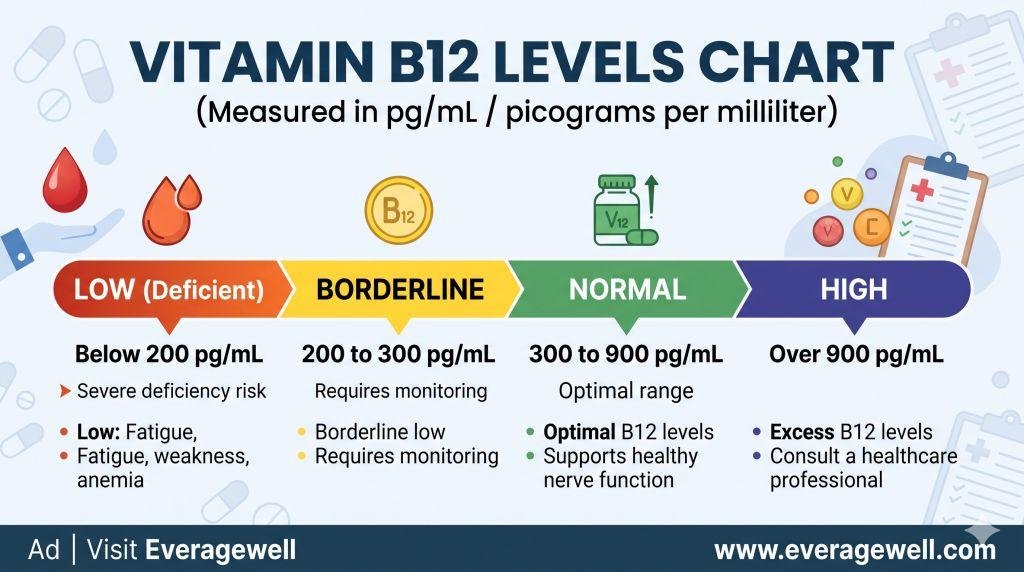
If you recently received a vitamin B12 blood test, you may be wondering whether your number is normal, too low, or unusually high. A vitamin B12 levels chart can make the result easier to understand, but there is an important catch: laboratories use different reference ranges, and a B12 blood level alone does not always tell the complete story.
For many laboratories, a vitamin B12 level below about 200–250 pg/mL is considered subnormal. However, some laboratory reference ranges classify levels differently. MedlinePlus, for example, lists a reference range of about 299–1,054 pg/mL, while the NIH notes that values below 200–250 pg/mL are generally considered subnormal.
This matters particularly for adults over 50. Vitamin B12 absorption can become less efficient with age, and certain medications, digestive conditions, and dietary patterns can also increase the risk of low B12.
This guide explains what different B12 levels may mean, what symptoms can occur when levels are low, why your doctor may order additional tests, and how to get enough vitamin B12 from food or supplements.
Quick Answer: What Is a Normal Vitamin B12 Level?
There is no single B12 number that applies to every person or every laboratory.
As a general guide:
| Vitamin B12 blood level | General interpretation |
|---|---|
| Below 200 pg/mL | Often considered low and suggestive of deficiency |
| 200–250 pg/mL | May be considered low or borderline depending on the laboratory |
| 250–300 pg/mL | Borderline in some testing situations; additional testing may be useful |
| 300–400 pg/mL | Often considered adequate, but symptoms and laboratory reference ranges still matter |
| 400–900 pg/mL | Commonly within many laboratory reference ranges |
| 900–1,000+ pg/mL | May still fall within some laboratory ranges; interpretation depends on the lab and individual circumstances |
| Above the laboratory’s reference range | Should be interpreted with your healthcare professional rather than automatically considered harmful |
The NIH Office of Dietary Supplements says serum or plasma B12 levels below approximately 200–250 pg/mL are generally considered subnormal. When the B12 result is in an uncertain range, doctors may use another test called methylmalonic acid (MMA) to help determine whether a deficiency is actually present.
Important: Always compare your result with the reference range printed on your own laboratory report. Different laboratories use different testing methods and reference ranges.
What Is Vitamin B12?
Vitamin B12, also called cobalamin, is a water-soluble vitamin that your body needs for several important functions.
It helps maintain healthy nerve cells, supports normal red blood cell formation, and is involved in making DNA.
B12 is naturally found mainly in animal foods, including:
- Fish
- Meat
- Poultry
- Eggs
- Milk
- Yogurt
- Cheese
- Shellfish
Some plant-based foods, such as certain breakfast cereals and nutritional yeast products, are fortified with vitamin B12.
For people who eat little or no animal food, fortified foods or supplements can become especially important.
If you are interested in improving your overall nutrition after 50, see our guide to Top 10 Foods You Must Eat After 50.
Vitamin B12 Levels Chart
The easiest way to understand a B12 blood test is to look at your number alongside your laboratory’s reference range.
Vitamin B12 Blood Test Chart in pg/mL
| B12 level | What it may indicate | What to consider |
|---|---|---|
| <200 pg/mL | Low | B12 deficiency is possible and should be evaluated |
| 200–250 pg/mL | Low/borderline | Interpretation depends on symptoms and laboratory range |
| 250–300 pg/mL | Borderline | Additional testing may sometimes help |
| 300–400 pg/mL | Generally adequate for many people | Consider symptoms and lab reference range |
| 400–900 pg/mL | Commonly adequate | Usually interpreted as satisfactory when consistent with the lab range |
| 900–1,000+ pg/mL | Higher level | May still be normal for some laboratories |
| Above laboratory range | High | Discuss persistent unexplained elevation with a healthcare professional |
These categories are general educational ranges, not diagnostic rules. The NIH notes that B12 cutoffs vary according to the laboratory and testing method.
MedlinePlus also emphasizes that laboratory reference ranges can differ and that a result outside a reference range does not automatically mean that a person has a health problem.
What If Your Result Is in pmol/L?
Some laboratories report vitamin B12 in picomoles per liter (pmol/L) rather than pg/mL.
A commonly used conversion is:
1 pg/mL ≈ 0.738 pmol/L
So approximately:
| B12 level in pg/mL | Approximate pmol/L |
|---|---|
| 150 pg/mL | 111 pmol/L |
| 200 pg/mL | 148 pmol/L |
| 250 pg/mL | 185 pmol/L |
| 300 pg/mL | 221 pmol/L |
| 400 pg/mL | 295 pmol/L |
| 500 pg/mL | 369 pmol/L |
| 700 pg/mL | 516 pmol/L |
| 900 pg/mL | 664 pmol/L |
| 1,000 pg/mL | 738 pmol/L |
These are conversions rather than separate diagnostic categories.
What Does a Low B12 Level Mean?
A low vitamin B12 level may indicate that your body does not have enough B12 available.
A level below about 200 pg/mL is commonly considered subnormal, although the exact cutoff varies.
Low B12 can affect blood cells and the nervous system.
Possible symptoms include:
- Fatigue
- Weakness
- Numbness or tingling
- Balance problems
- Changes in sensation
- Anemia
- A sore or inflamed tongue
- Palpitations
- Certain neurological changes
Symptoms may develop gradually, and some people with low or marginal B12 levels may have few obvious symptoms at first.
That is one reason a blood test can be useful when a person has unexplained fatigue, neurological symptoms, anemia, or risk factors for deficiency.
What Is a Borderline B12 Level?
A borderline result is one of the trickier situations.
Suppose your test shows 245 pg/mL.
That is not dramatically low, but it may be below the range considered adequate by some laboratories.
The NIH notes that when serum B12 falls between approximately 150 and 399 pg/mL, measuring methylmalonic acid may help confirm whether a true deficiency exists.
Your doctor may consider:
- Your symptoms
- Your medical history
- Your diet
- Medications
- Kidney function
- Other blood tests
- Your laboratory’s reference range
- Additional B12-related testing
A borderline number should therefore be interpreted in context rather than treated as an automatic diagnosis.
What Does a Normal B12 Level Mean?
A B12 result within your laboratory’s reference range is generally reassuring.
However, “normal” does not always mean that B12 is definitely unrelated to your symptoms.
Laboratory testing is only one part of a medical evaluation. MedlinePlus explains that people can sometimes have health problems even when a laboratory result falls within a reference range.
If you have persistent numbness, balance changes, unusual fatigue, anemia, or other concerning symptoms, talk with your healthcare professional even if your B12 result appears normal.
Can Vitamin B12 Be Too High?
Vitamin B12 is different from many nutrients because the body generally eliminates excess amounts through urine, and the NIH has not established a tolerable upper intake level for B12 because it has a low potential for toxicity.
Still, an unexpectedly high blood B12 level deserves context.
A high result can occur after taking B12 supplements or receiving B12 injections. If you are not taking supplements and your B12 remains unusually elevated, your healthcare professional may decide whether additional evaluation is appropriate.
The important distinction is this:
A high B12 blood level does not automatically mean you have consumed too much vitamin B12.
It may simply reflect supplementation or another factor that needs to be considered alongside your overall health.
Vitamin B12 Symptoms to Watch For
B12 deficiency can develop slowly, so symptoms may be easy to overlook.
1. Unusual Fatigue
B12 is important for normal red blood cell formation. A deficiency can contribute to anemia, which may cause tiredness and weakness.
2. Numbness or Tingling
Changes in nerve function can cause a pins-and-needles sensation, particularly in the hands or feet.
3. Balance Problems
Some people with B12 deficiency develop changes in balance or coordination.
For an older adult, unexplained balance changes deserve attention because many different conditions can cause them.
4. Weakness
General weakness can occur with B12 deficiency, particularly when anemia is present.
5. Changes in the Tongue
B12 deficiency can be associated with glossitis, meaning inflammation of the tongue.
6. Anemia
Vitamin B12 is involved in healthy red blood cell production. Deficiency can result in a type of anemia called megaloblastic anemia.
7. Neurological Changes
B12 deficiency can affect the nervous system. Some neurological symptoms can occur even when anemia is not the most obvious feature.
8. Cognitive or Mental Changes
Confusion and other cognitive changes have been associated with B12 deficiency.
However, these symptoms have many possible causes. A person should not assume that fatigue, memory problems, or numbness automatically mean low B12.
Why Vitamin B12 Levels Drop
There are several possible reasons.
Not Getting Enough B12
People who eat very little meat, fish, eggs, milk, or other B12-containing foods may have difficulty getting enough.
Strict vegan diets require particular attention because natural plant foods do not contain meaningful amounts of B12 unless they are fortified.
Reduced Absorption
You can consume enough B12 and still become deficient if your digestive system does not absorb it properly.
B12 from food must first be released from food proteins and then bind with a stomach protein called intrinsic factor before it can be absorbed effectively.
Pernicious Anemia
Pernicious anemia is an autoimmune condition that interferes with intrinsic factor production.
This can make B12 absorption difficult.
Stomach or Intestinal Surgery
Certain gastrointestinal surgeries can interfere with the body’s ability to absorb B12.
Digestive Disorders
Conditions affecting the stomach or small intestine, including certain cases of celiac disease or Crohn’s disease, may interfere with B12 absorption.
Vitamin B12 and Age
Adults over 50 deserve particular attention to B12.
The issue is not simply that everyone over 50 becomes B12 deficient.
Rather, the body’s ability to absorb B12 naturally present in food can become less efficient in some older adults because stomach acid production may decrease.
That is why the NIH recommends that people over 50 obtain most of their B12 from fortified foods or supplements, which are generally easier to absorb than food-bound B12.
If you’re over 50 and trying to improve your overall nutrient intake, our How Much Protein Do Seniors Really Need? guide can also help you build more balanced meals.
Medications That May Affect B12
Certain medications can interfere with B12 absorption.
Two important examples are:
Metformin
Metformin is commonly used to manage type 2 diabetes and may reduce vitamin B12 absorption and blood levels over time.
Acid-Reducing Medicines
Long-term use of certain acid-reducing medicines can interfere with the release of B12 from food.
Examples include some proton pump inhibitors and H2-receptor antagonists.
This does not mean you should stop a prescribed medicine.
If you take these medications regularly and have concerns about B12, discuss testing with your healthcare professional.
Vitamin B12 Food Sources
Food is an excellent place to start for people who can absorb B12 normally.
Vitamin B12 Foods Chart
| Food | Approximate B12 per serving |
|---|---|
| Beef liver, 3 oz | 70.7 mcg |
| Clams, 3 oz | 17 mcg |
| Oysters, 3 oz | 14.9 mcg |
| Fortified nutritional yeast, ¼ cup | 8.3–24 mcg |
| Cooked salmon, 3 oz | 2.6 mcg |
| Canned light tuna, 3 oz | 2.5 mcg |
| Ground beef, 3 oz | 2.4 mcg |
| 2% milk, 1 cup | 1.3 mcg |
| Plain fat-free yogurt, 6 oz | 1.0 mcg |
| Fortified breakfast cereal | Varies |
| Cheddar cheese, 1½ oz | 0.5 mcg |
| One large cooked egg | 0.5 mcg |
Food amounts can vary by brand, preparation, and serving size. The NIH provides detailed food-source information and notes that fortified products should be checked for their actual B12 content.
Easy B12-Rich Meal Ideas
Breakfast: Eggs, whole-grain toast, and milk or yogurt.
Lunch: Tuna salad with vegetables and whole-grain bread.
Dinner: Baked salmon with roasted vegetables and a whole grain.
Vegetarian option: Eggs or dairy combined with a B12-fortified food.
Vegan option: A reliable B12-fortified food or B12 supplement may be necessary because unfortified plant foods do not naturally provide B12.
For more practical food ideas, see Top 10 Foods You Must Eat After 50.
How Much Vitamin B12 Do Adults Need?
For most adults, the recommended dietary allowance is 2.4 micrograms (mcg) per day. The recommendation increases to 2.6 mcg during pregnancy and 2.8 mcg during breastfeeding.
This daily intake recommendation is different from a blood-level target.
In other words:
2.4 mcg per day is an intake recommendation, not a target B12 blood level.
This distinction is important because some people may consume adequate B12 but have difficulty absorbing it.
B12 Blood Test vs. MMA Test
A standard serum B12 test measures the amount of B12 circulating in your blood.
An MMA test looks at methylmalonic acid, a substance that can increase when the body’s B12 status is inadequate.
The NIH describes MMA as one of the most sensitive markers for vitamin B12 status.
MMA can be particularly useful when the B12 result is not clearly low but deficiency is still suspected.
However, MMA is not perfect. Kidney problems can also raise MMA levels, and MMA tends to increase with age.
The UK’s NICE guidance similarly recommends using laboratory reference ranges and considering MMA testing when B12 results are indeterminate and symptoms or signs suggest deficiency.
Vitamin B12 Supplements
Vitamin B12 supplements are available in several forms and doses.
Common forms include:
- Cyanocobalamin
- Methylcobalamin
- Adenosylcobalamin
- Hydroxocobalamin
The NIH notes that there is no clear evidence that one supplemental form is universally better absorbed than another.
Some B12-only supplements contain much more than the daily requirement.
That may sound surprising when the RDA is only 2.4 mcg, but absorption of large oral doses is relatively low, which is one reason some supplements contain hundreds or even 1,000 mcg.
Treatment of confirmed deficiency can involve oral B12 or injections depending on the cause and severity. People with absorption problems such as pernicious anemia may require a specific treatment plan.
Don’t choose a treatment dose simply by looking at a vitamin B12 levels chart.
Common Mistakes When Reading a B12 Test
Mistake 1: Assuming One Number Fits Everyone
Laboratories use different reference ranges.
Always look at the range printed on your report.
Mistake 2: Treating 200 pg/mL as a Universal Cutoff
The NIH uses approximately 200–250 pg/mL as a general subnormal range, but diagnosis depends on the clinical situation and laboratory method.
Mistake 3: Ignoring Symptoms
A laboratory result should be considered alongside symptoms and medical history.
Mistake 4: Assuming Normal B12 Rules Out Every Problem
Other conditions can cause fatigue, numbness, weakness, and balance problems.
Mistake 5: Taking Large Doses Without Understanding Why
B12 supplements are generally considered low-risk, but supplementation should not replace an evaluation of why your level is low.
Mistake 6: Stopping Medication
If you suspect a medication is affecting B12, talk with your healthcare professional rather than stopping it yourself.
Real-Life Examples
Example 1: B12 of 175 pg/mL
A 67-year-old has a B12 level of 175 pg/mL and reports numbness in both feet.
This result is below the range commonly considered subnormal. The combination of the laboratory result and symptoms deserves medical evaluation.
Example 2: B12 of 245 pg/mL
A 59-year-old has a B12 level of 245 pg/mL but feels well.
This could be considered borderline depending on the laboratory. A healthcare professional may consider the person’s diet, medications, symptoms, and possibly additional testing.
Example 3: B12 of 520 pg/mL
A 72-year-old has a B12 level of 520 pg/mL with no concerning symptoms.
That result would commonly be considered adequate, although the laboratory’s own reference range remains the appropriate standard.
Example 4: B12 of 1,100 pg/mL
A person taking a daily B12 supplement has a level of 1,100 pg/mL.
The elevated result may simply reflect supplementation. The healthcare professional can determine whether the dose and test result need further consideration.
Common Vitamin B12 Myths
Myth: A B12 level below 300 always means deficiency.
Fact: Not necessarily. A result between 200 and 300 pg/mL may require additional context or testing rather than an automatic diagnosis.
Myth: If you eat meat, you cannot become B12 deficient.
Fact: Diet is only one factor. Absorption problems, pernicious anemia, digestive disorders, surgery, and certain medications can contribute to deficiency.
Myth: Everyone over 50 is B12 deficient.
Fact: Aging can increase the risk of reduced absorption, but being over 50 does not automatically mean you have a deficiency.
Myth: Plant foods naturally contain plenty of B12.
Fact: Unfortified plant foods generally do not naturally contain B12. Fortified foods can provide it.
Myth: A high-dose B12 supplement is always necessary.
Fact: The appropriate amount depends on your diet, blood levels, absorption, and reason for supplementation.
Myth: A normal B12 number means your symptoms must be unrelated to nutrition.
Fact: Symptoms such as fatigue and numbness can have many causes, and one blood test does not evaluate every possible nutritional or medical problem.
Who Should Pay Special Attention to Vitamin B12?
Certain people have a higher reason to discuss B12 with their healthcare professional.
Adults Over 50
Reduced absorption of food-bound B12 becomes more relevant with age.
People Taking Metformin
Long-term metformin use may reduce B12 absorption.
People Taking Acid-Reducing Medicines
Some long-term acid-suppressing medications can affect B12 absorption from food.
Vegetarians and Vegans
Those who consume little or no animal food need a dependable source of B12 from fortified foods or supplements.
People With Digestive Conditions
Certain gastrointestinal disorders can interfere with B12 absorption.
People Who Have Had Certain Stomach or Intestinal Surgeries
Some procedures can make B12 absorption more difficult.
People With Neurological Symptoms
Persistent numbness, tingling, weakness, balance problems, or other neurological changes should be evaluated rather than attributed automatically to aging.
How to Get Started
If you’re concerned about your vitamin B12 level, keep things simple.
Step 1: Find Your Actual Test Result
Look at the B12 number and the reference range printed on your laboratory report.
Step 2: Check the Units
Determine whether your result is reported in pg/mL or pmol/L.
Step 3: Review Your Symptoms
Make a note of symptoms such as fatigue, numbness, tingling, weakness, balance problems, or changes in your tongue.
Step 4: Review Your Diet
Consider whether you regularly eat B12-containing foods or fortified foods.
Step 5: Review Your Medications
Make a list of prescription and over-the-counter medicines you take regularly.
Step 6: Discuss Borderline Results
If your level is low or borderline, ask your healthcare professional whether additional testing, such as MMA, is appropriate.
Step 7: Treat the Cause, Not Just the Number
If B12 is low because of poor intake, the solution may differ from a deficiency caused by an absorption problem.
That distinction is especially important for older adults.
Frequently Asked Questions About Vitamin B12 Levels
1. What is a normal vitamin B12 level?
There is no universal normal range. Many laboratories use ranges that are roughly a few hundred to around 1,000 pg/mL, while the NIH considers values below about 200–250 pg/mL generally subnormal. Your own laboratory’s reference range should be used first.
2. Is a B12 level of 200 low?
It can be. A level of 200 pg/mL is at or near the lower end of commonly used cutoffs and may warrant further evaluation, particularly if symptoms or risk factors are present.
3. Is 300 pg/mL a good B12 level?
A level of 300 pg/mL may be adequate according to some laboratory ranges but borderline according to others. Symptoms and additional testing may be important when the clinical picture is unclear.
4. Is 400 pg/mL a good B12 level?
For many people, 400 pg/mL falls comfortably within commonly used laboratory reference ranges. Your own laboratory’s range and your health situation still matter.
5. Is 500 pg/mL a good B12 level?
Generally, 500 pg/mL would be considered a satisfactory result by many laboratories, assuming it falls within your report’s reference range.
6. What is a dangerously low B12 level?
There is no single number that defines a “dangerously low” B12 level for every person. Very low levels, particularly when accompanied by neurological symptoms or anemia, require prompt medical evaluation.
7. Can low B12 cause tingling in the feet?
Yes. Vitamin B12 deficiency can affect nerve function and may cause numbness or tingling in the hands or feet.
8. Can vitamin B12 deficiency cause fatigue?
Yes. B12 deficiency can contribute to anemia and associated tiredness or weakness. However, fatigue has many possible causes.
9. Should adults over 50 take vitamin B12?
Not necessarily everyone needs a supplement, but adults over 50 should pay attention to B12 because absorption of naturally occurring food-bound B12 can become less efficient. Fortified foods and supplements may be useful sources.
10. Can you have B12 deficiency with a normal blood count?
Yes. Neurological effects can occur with B12 deficiency, and anemia is not necessarily the only sign. If symptoms or risk factors are present, your healthcare professional may consider B12 testing.
11. What foods are highest in vitamin B12?
Some of the richest sources include beef liver, clams, oysters, fortified nutritional yeast, salmon, tuna, and beef. Milk, yogurt, eggs, cheese, and fortified cereals also provide B12.
12. Can vitamin B12 be too high?
A high blood B12 result can occur with supplementation or injections. If it is unexpectedly elevated and persistent, your healthcare professional can determine whether further evaluation is appropriate.
13. Is 1,000 mcg of vitamin B12 too much?
B12 supplements commonly contain doses much higher than the daily RDA because the body absorbs only a small percentage of large oral doses. The NIH reports that B12 has a low potential for toxicity, but treatment doses should be chosen according to the individual’s needs.
14. What test confirms vitamin B12 deficiency?
A serum B12 test is commonly used first. When the result is uncertain, a methylmalonic acid test may help determine whether a functional B12 deficiency is present.
15. Should I worry about a B12 level of 250?
Not necessarily, but it should not be ignored if you have symptoms or risk factors. A level around 250 pg/mL can be considered borderline depending on the laboratory and clinical situation.
Final Takeaway
A vitamin B12 levels chart is useful for understanding your blood test, but the number should never be interpreted in isolation.
As a general rule, B12 levels below about 200–250 pg/mL are often considered subnormal, while results in the borderline range may require additional testing such as methylmalonic acid.
For adults over 50, paying attention to B12 is particularly worthwhile because absorption from food can become less efficient with age. Eating B12-rich foods, choosing fortified foods when appropriate, and discussing supplements or testing with a healthcare professional can help maintain adequate B12 status.
Most importantly, use the reference range on your own lab report rather than relying on a single number found online. Your symptoms, medications, diet, medical history, and other laboratory results all help determine what your B12 result actually means.
Medical Disclaimer
This article is provided for general educational and informational purposes only. It is not a substitute for individualized medical advice, diagnosis, or treatment. Vitamin B12 results should be interpreted using your laboratory’s reference range and your personal health history. If you have a low or borderline B12 result, persistent neurological symptoms, anemia, or other health concerns, speak with a qualified healthcare professional.
Trusted Sources
- NIH Office of Dietary Supplements — Vitamin B12 — B12 requirements, food sources, absorption, supplements, and deficiency information.
- NIH Office of Dietary Supplements — Vitamin B12 for Health Professionals — laboratory interpretation, MMA testing, deficiency, and treatment information.
- MedlinePlus — Vitamin B12 Level — B12 blood testing and laboratory reference-range information.
- MedlinePlus — Understanding Your Lab Results — explanation of laboratory reference ranges and why they can differ.
- NICE — Vitamin B12 Deficiency: Diagnosis and Management — guidance on interpreting B12 testing and when additional MMA testing may be considered.
Written by
Kanhaiya Solanki is a dedicated online researcher, content writer, and blogger passionate about publishing high-quality, research-based articles. His goal is to provide accurate, easy-to-understand, and practical information on health, technology, senior care, and lifestyle topics for readers worldwide.