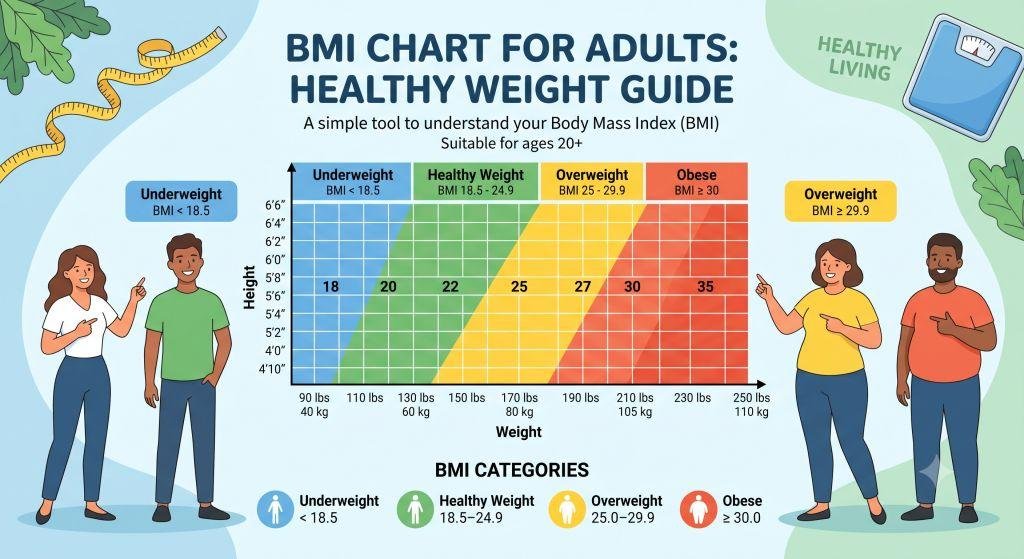
If you are trying to understand whether your weight falls into a healthy range, a BMI chart for adults is a useful place to start. Body mass index, or BMI, compares your weight with your height and places the result into a general weight category.
For adults age 20 and older, the standard BMI categories are underweight, healthy weight, overweight, and obesity. According to the CDC, a BMI from 18.5 to less than 25 is considered the healthy-weight range, 25 to less than 30 is overweight, and 30 or higher falls into the obesity category.
But BMI is not a complete picture of health. It does not directly measure body fat, muscle mass, or where fat is stored. This becomes particularly important after age 50, when changes in muscle and body composition can make a simple height-and-weight calculation less informative.
This guide explains how to read an adult BMI chart, calculate your BMI, understand what the numbers mean, and look beyond BMI when evaluating your health.
Quick Answer: What Is a Healthy BMI for Adults?
For most adults age 20 and older, the standard BMI categories are:
| BMI | Adult Weight Category |
|---|---|
| Below 18.5 | Underweight |
| 18.5–24.9 | Healthy weight |
| 25.0–29.9 | Overweight |
| 30.0–34.9 | Class 1 obesity |
| 35.0–39.9 | Class 2 obesity |
| 40 or higher | Class 3 obesity |
These are the standard adult categories used by the CDC. BMI is a screening measure, not a diagnosis of disease.
For someone over 50, the number should be considered alongside waist size, muscle mass, blood pressure, blood sugar, cholesterol, physical activity, medical history, and overall well-being.
What Is BMI?
BMI stands for body mass index.
It is a number calculated from your height and weight. The purpose is to provide a quick screening measure of whether your weight is relatively low, within the standard healthy range, above the healthy range, or in an obesity category.
The formula does not directly measure body fat. That distinction is important.
For example, two people can have exactly the same BMI but have very different amounts of muscle and body fat.
BMI is popular because it is inexpensive, simple, and easy to calculate. Healthcare professionals may use it as one part of a broader assessment rather than relying on it alone. The CDC recommends considering BMI alongside medical history, health behaviors, physical examination findings, and laboratory results.
Who Can Use an Adult BMI Chart?
The standard adult BMI categories apply to people 20 years and older.
Children and teenagers are evaluated differently because their bodies are still growing. Their BMI is interpreted using age- and sex-specific growth charts rather than the adult categories.
BMI Chart for Adults
Here is the standard adult BMI chart used in the United States:
| BMI Range | Category | What It Generally Indicates |
|---|---|---|
| Less than 18.5 | Underweight | Weight is below the standard healthy range |
| 18.5–24.9 | Healthy weight | Weight falls within the standard healthy range |
| 25.0–29.9 | Overweight | Weight is above the standard healthy range |
| 30.0–34.9 | Class 1 obesity | Obesity category |
| 35.0–39.9 | Class 2 obesity | Higher obesity category |
| 40 or higher | Class 3 obesity | Severe obesity category |
The CDC uses these categories for adults regardless of age, sex, or race. However, that does not mean BMI has the same meaning for every individual.
A person’s health risk may also depend on where body fat is located, physical fitness, muscle mass, genetics, existing medical conditions, and other factors.
What Each BMI Range Means
BMI Below 18.5: Underweight
A BMI below 18.5 is classified as underweight for adults.
Being underweight is not automatically a sign of illness. Some naturally thin people are healthy. However, unexplained weight loss or a persistently low body weight can sometimes signal inadequate nutrition, muscle loss, digestive problems, chronic illness, or another health concern.
This can be particularly important for older adults.
If an adult over 50 is losing weight without trying, especially if the change is significant or accompanied by weakness, appetite changes, or other symptoms, it is worth discussing with a healthcare professional.
BMI 18.5–24.9: Healthy Weight
A BMI from 18.5 through 24.9 falls within the standard healthy-weight category.
This range is often used as a general reference point, but it should not be interpreted as a guarantee of good health.
Someone with a BMI of 22 can still have high blood pressure, high cholesterol, diabetes, poor cardiovascular fitness, or excess abdominal fat.
Likewise, a person slightly outside this range may have good overall health.
BMI 25.0–29.9: Overweight
A BMI between 25 and 29.9 falls into the overweight category.
Being in this range does not automatically mean that someone needs to lose weight.
Healthcare professionals may consider additional factors such as waist circumference, blood pressure, blood glucose, cholesterol, physical activity, family history, and existing medical conditions.
The context matters.
BMI 30 or Higher: Obesity
A BMI of 30 or higher falls into the obesity category.
The CDC divides obesity into three classes:
- Class 1: BMI 30.0–34.9
- Class 2: BMI 35.0–39.9
- Class 3: BMI 40 or higher
Higher BMI levels are associated with increased risk for several chronic health conditions, including type 2 diabetes, cardiovascular disease, high blood pressure, and other health problems.
BMI alone, however, cannot determine an individual’s complete health risk.
How to Calculate Your BMI
The adult BMI formula is straightforward.
Using Pounds and Inches
If you live in the United States, you can use:
BMI = weight in pounds ÷ height in inches² × 703
For example, imagine a person who weighs 180 pounds and is 5 feet 10 inches tall.
Five feet 10 inches equals 70 inches.
The calculation is:
180 ÷ (70 × 70) × 703 = approximately 25.8
A BMI of about 25.8 falls into the overweight category according to the standard adult BMI chart.
The CDC provides the same formula and an online adult calculator.
Using Kilograms and Meters
With metric measurements:
BMI = weight in kilograms ÷ height in meters²
For example:
Weight: 82 kg
Height: 1.75 m
BMI = 82 ÷ (1.75 × 1.75)
BMI = approximately 26.8
Again, this falls within the standard overweight category.
BMI Examples for Common Heights
The amount a person can weigh at a particular BMI depends on height.
Here are approximate examples:
| Height | Weight at BMI 18.5 | Weight at BMI 24.9 | Weight at BMI 30 |
|---|---|---|---|
| 5’0″ | 95 lb | 127 lb | 153 lb |
| 5’2″ | 101 lb | 136 lb | 164 lb |
| 5’4″ | 108 lb | 145 lb | 175 lb |
| 5’6″ | 115 lb | 155 lb | 186 lb |
| 5’8″ | 122 lb | 164 lb | 197 lb |
| 5’10” | 129 lb | 174 lb | 209 lb |
| 6’0″ | 136 lb | 184 lb | 221 lb |
| 6’2″ | 144 lb | 195 lb | 233 lb |
These numbers are mathematical examples based on the standard BMI thresholds, not individualized weight recommendations.
Your healthiest weight may depend on factors that BMI does not capture.
Does BMI Change With Age?
The standard adult BMI categories do not automatically change just because you turn 50, 60, or 70.
For adults 20 and older, the CDC uses the same basic BMI categories regardless of age.
However, aging changes body composition.
As people get older, they may gradually lose muscle and bone mass while gaining body fat. This means two people with the same BMI may have very different body compositions.
NIDDK notes that older adults may have different healthy-weight considerations and that BMI should be considered along with waist size and other measures.
So if you are 65, for example, you should not automatically assume that a higher BMI is healthy simply because you are older. At the same time, aggressively trying to reach a younger-adult BMI may not always be appropriate.
The goal should be individualized health rather than chasing a particular number.
Why BMI Can Be Misleading After 50
BMI is useful, but it has important limitations.
1. BMI Does Not Measure Muscle
Muscle is denser than fat.
A physically strong person who exercises regularly may have a relatively high BMI because of muscle mass.
That does not necessarily mean they have excessive body fat.
2. BMI Does Not Show Where Fat Is Stored
Two people can have the same BMI but very different waist measurements.
Abdominal fat can be particularly relevant to metabolic health.
NIDDK recommends considering waist size in addition to BMI because where body fat is stored can affect health risk.
3. Aging Changes Body Composition
Muscle loss can occur with aging, particularly when physical activity and strength training decline.
A person’s scale weight may stay relatively stable while their proportion of muscle and fat changes.
That is one reason the bathroom scale should not be the only measurement you follow.
4. BMI Does Not Measure Fitness
A BMI number cannot tell whether you can comfortably climb stairs, carry groceries, walk a mile, or perform everyday activities.
Physical function is especially meaningful as we age.
5. BMI Does Not Diagnose Disease
A BMI category does not tell you whether you have diabetes, heart disease, or another medical condition.
Those conditions require appropriate medical evaluation and testing.
BMI vs. Waist Size
For adults over 50, waist circumference can provide useful additional information.
Fat stored around the abdomen is associated with increased health risks.
NIDDK identifies waist measurements of 35 inches or more for women and 40 inches or more for men as levels associated with increased risk for obesity-related health problems.
This does not mean that everyone above these measurements has a disease or that everyone below them is healthy.
Instead, waist size can be used alongside BMI and other health information.
A More Complete Weight Check
Instead of asking only:
“What is my BMI?”
consider asking:
- What is my BMI?
- What is my waist circumference?
- Is my weight stable?
- Am I losing muscle?
- Is my blood pressure healthy?
- What are my blood glucose levels?
- What are my cholesterol levels?
- How physically active am I?
- How strong and mobile do I feel?
- Do I have any medical conditions?
- Am I eating enough nutritious food?
This broader approach can be particularly useful after 50.
For example, you can also review our Blood Pressure Chart for Seniors and Normal Blood Pressure Chart when looking at overall cardiovascular health.
For readers monitoring blood sugar, our Blood Glucose Level Chart can help explain common glucose ranges.
And if cholesterol is part of your health check, see our Cholesterol Levels Chart.
BMI and Other Health Measurements
BMI is more useful when viewed as one piece of a larger health picture.
| Measurement | What It Can Tell You |
|---|---|
| BMI | Weight relative to height |
| Waist circumference | Approximate abdominal fat distribution |
| Blood pressure | Pressure against artery walls |
| Blood glucose | Information about blood sugar regulation |
| Cholesterol | Information about blood lipids |
| Physical activity | Fitness and functional capacity |
| Strength | Muscle function |
| Weight trend | Whether weight is stable, increasing, or decreasing |
| Medical history | Existing health risks and conditions |
The CDC specifically recommends considering BMI with medical history, health behaviors, physical examination findings, muscle mass, blood pressure, glucose, and cholesterol.
This is particularly relevant for adults who are trying to stay healthy rather than simply reach a number on a scale.
Healthy Weight Habits After 50
There is no need to approach weight management with extreme diets.
For many adults over 50, maintaining muscle, staying active, eating nutrient-dense foods, and avoiding gradual unwanted weight gain may be more useful than pursuing rapid weight loss.
Prioritize Protein-Rich Foods
Protein helps support muscle maintenance.
Practical choices include:
- Eggs
- Fish
- Chicken
- Greek yogurt
- Cottage cheese
- Beans
- Lentils
- Tofu
- Lean meats
Protein needs vary from person to person, particularly for people with kidney disease or other medical conditions, so individualized guidance may be appropriate.
Eat More High-Fiber Foods
Fiber-rich foods can make meals more satisfying while supporting digestive health.
Good choices include:
- Oatmeal
- Beans
- Lentils
- Vegetables
- Berries
- Apples
- Pears
- Whole grains
- Nuts and seeds
Include Regular Physical Activity
Walking is an accessible option for many adults.
Strength training is also important because maintaining muscle becomes increasingly valuable with age.
NIDDK recommends at least 150 minutes of moderate-intensity aerobic activity per week for adults, along with muscle-strengthening activity on at least two days per week, when appropriate for the individual.
If you have been inactive for a long time or have a chronic condition, talk with your healthcare professional about an appropriate starting level.
Watch Liquid Calories
Soda, sweetened coffee drinks, energy drinks, and some alcoholic beverages can contribute substantial calories without making you feel as full as a balanced meal.
Water and unsweetened beverages can often be simpler choices.
Avoid Crash Diets
Extreme diets may produce rapid changes on the scale, but they can be difficult to maintain.
For older adults, overly aggressive calorie restriction may also make it harder to consume enough protein and other nutrients.
A sustainable approach is usually more practical.
A Simple Day of Healthy Eating After 50
Here is an example of how someone might build a balanced day.
Breakfast
Oatmeal topped with berries and walnuts, along with plain Greek yogurt.
Lunch
Grilled chicken or beans with a large vegetable salad, whole-grain bread, and fruit.
Afternoon
An apple with a small handful of nuts.
Dinner
Baked salmon, roasted vegetables, and a moderate serving of brown rice or another whole grain.
Activity
A brisk walk during the day, plus appropriate strength exercises several times per week.
This is only an example, not a prescribed diet. Individual calorie and nutrient needs vary.
Common BMI Mistakes
Mistake 1: Treating BMI as a diagnosis
BMI is a screening measure.
It cannot diagnose obesity-related disease by itself.
Mistake 2: Ignoring waist size
A BMI within the standard range does not necessarily mean a person has little abdominal fat.
Mistake 3: Focusing only on weight loss
For adults over 50, preserving muscle and strength can be just as important as reducing body weight.
Mistake 4: Comparing your BMI with someone else’s
Two people with the same BMI can have different muscle mass, waist size, health conditions, fitness levels, and nutritional needs.
Mistake 5: Trying to reach an exact number
There is no single BMI that guarantees good health.
Think of the chart as a screening tool rather than a personal health score.
Mistake 6: Ignoring unexplained weight loss
Unintentional weight loss can be important, particularly in older adults.
If weight is falling without a deliberate change in eating or activity, discuss it with a healthcare professional.
BMI Myths and Facts
Myth: A BMI of 24 means you are automatically healthy.
Fact: A BMI in the healthy range is reassuring in one respect, but it does not rule out high blood pressure, diabetes, high cholesterol, low fitness, or other health concerns.
Myth: Everyone over 60 should have a higher BMI.
Fact: Adult BMI categories do not automatically change with age. However, older adults may have different body-composition and nutritional considerations that should be discussed individually.
Myth: BMI tells you exactly how much body fat you have.
Fact: BMI is calculated from height and weight. It does not directly measure body fat.
Myth: A muscular person with a high BMI is necessarily unhealthy.
Fact: BMI can classify some muscular people as overweight or obese even when they have relatively low body fat. This is one reason additional measurements matter.
Myth: Losing as much weight as possible is always healthier.
Fact: Excessive weight loss is not necessarily beneficial. For older adults, adequate nutrition, strength, mobility, and muscle preservation are important considerations.
Myth: You only need to check your BMI once.
Fact: A single BMI number is less informative than a longer-term picture. Tracking weight trends, waist size, physical activity, and other health measurements can provide more useful information.Who Should Be More Careful With BMI?
Adults Over 50
Older adults may experience changes in muscle, bone, appetite, activity levels, and body-fat distribution.
That makes a broader assessment especially useful.
Older Adults With Unintentional Weight Loss
Unexpected weight loss should not simply be dismissed as part of aging.
A healthcare professional can help determine whether nutrition, medications, dental problems, digestive issues, or another medical concern may be involved.
People With Chronic Conditions
People with diabetes, heart disease, kidney disease, high blood pressure, or other chronic conditions may have specific weight-management needs.
Very Muscular Adults
Athletes and people with substantial muscle mass may have a higher BMI without having excessive body fat.
People With Significant Abdominal Fat
Waist circumference can provide additional information because BMI does not show where body fat is located.
How to Get Started
If you have not checked your BMI recently, you can begin with a few simple steps.
1. Measure Your Height Accurately
Remove your shoes and measure your height as accurately as possible.
2. Check Your Weight
Use a reliable scale and, if possible, weigh yourself under similar conditions when tracking changes over time.
3. Calculate Your BMI
Use the adult BMI formula or the CDC Adult BMI Calculator.
4. Measure Your Waist
This gives you another useful piece of information that BMI cannot provide.
5. Look at Your Overall Health
Consider blood pressure, glucose, cholesterol, physical activity, strength, sleep, diet, and existing medical conditions.
6. Avoid Extreme Changes
If you want to lose weight, focus on sustainable changes rather than severe calorie restriction.
7. Talk With a Healthcare Professional When Needed
Professional guidance is particularly important if you have significant unexplained weight changes, chronic disease, or questions about medications and nutrition.
Frequently Asked Questions
1. What is a normal BMI for adults?
For adults 20 and older, a BMI from 18.5 to 24.9 is classified as healthy weight under the standard CDC categories.
2. What is a good BMI for a 50-year-old?
The standard adult BMI categories still apply at age 50. However, BMI should not be considered alone. Waist size, muscle mass, fitness, blood pressure, glucose, cholesterol, and medical history also matter.
3. Is BMI different for men and women?
The standard adult BMI categories are the same for men and women. However, BMI does not account for differences in body composition, so it should be interpreted in context.
4. Does BMI change with age?
The standard adult BMI thresholds do not automatically change as you get older. However, body composition changes with aging, which can affect how useful BMI is for an individual.
5. Is a BMI of 25 considered overweight?
Yes. A BMI from 25.0 to 29.9 falls into the adult overweight category under the standard CDC classification.
6. Is a BMI of 30 considered obese?
Yes. A BMI of 30 or higher falls into the obesity category. A BMI of 30.0 to 34.9 is classified as Class 1 obesity.
7. Is BMI accurate for older adults?
BMI can still be useful as a screening measure, but it has limitations. Older adults can lose muscle and gain body fat without major changes in BMI. Waist size and other health measures can provide additional information.
8. What is the best BMI for seniors?
There is no single BMI that is best for every older adult. Individual health, muscle mass, nutrition, medical conditions, and functional ability should be considered.
NIDDK notes that some experts recommend a somewhat higher BMI range for certain older adults, but this should not be interpreted as a universal target for every senior.
9. Can you have a healthy BMI and still have too much belly fat?
Yes. BMI does not show where body fat is stored. Someone can have a BMI within the standard healthy range while carrying excess abdominal fat.
10. Can muscle make your BMI higher?
Yes. Because BMI is based only on height and weight, it cannot distinguish muscle from fat. A muscular person may have a higher BMI without having excessive body fat.
11. Should I lose weight if my BMI is over 25?
Not necessarily without considering your overall health. A healthcare professional may consider BMI together with waist size, blood pressure, blood glucose, cholesterol, medical history, and other risk factors.
12. Is a low BMI always healthy?
No. A low BMI can sometimes be associated with inadequate nutrition or loss of muscle and bone, particularly in older adults. Unexpected weight loss deserves attention.
13. How often should I check my BMI?
There is no universal requirement to calculate BMI every week or month. For many people, periodically reviewing weight trends and other health measurements is more useful than repeatedly checking one number.
14. What is more important than BMI after 50?
There is not one measurement that replaces BMI. A more complete picture includes waist circumference, blood pressure, blood glucose, cholesterol, physical activity, muscle strength, nutrition, medical history, and overall function.
15. Where can I calculate my BMI?
The CDC provides a free adult BMI calculator for people age 20 and older.
Final Takeaway
A BMI chart for adults can be a helpful first step for understanding how your weight compares with your height. For adults 20 and older, the standard healthy-weight BMI range is 18.5 to 24.9, while 25 or higher falls into the overweight or obesity categories depending on the number.
But BMI is not the whole story.
This is especially important after age 50, when muscle mass, body-fat distribution, activity levels, and nutritional needs can change. A better approach is to look at BMI alongside waist size, blood pressure, blood glucose, cholesterol, strength, physical activity, and your overall health.
The goal should not be to chase a perfect number on a chart. It should be to maintain a healthy, functional body and make sustainable choices that support your health as you age.
Medical Disclaimer
This article is for general educational and informational purposes only. It is not intended to diagnose, treat, or prevent any medical condition and does not replace individualized medical advice. If you have significant or unexplained weight changes, chronic health conditions, or questions about your personal BMI or weight goals, speak with a qualified healthcare professional.
Recommended EverageWell Reading
- How Protein Can Help You Lose Weight After 50
- Fastest Way to Shrink Visceral Fat Safely After 50
- How Many Eggs Should a Senior Eat Per Day?
- Sleep Problems After 50: Causes and Solutions
- 10 Health Benefits of Raspberries
Written by
Kanhaiya Solanki is a dedicated online researcher, content writer, and blogger passionate about publishing high-quality, research-based articles. His goal is to provide accurate, easy-to-understand, and practical information on health, technology, senior care, and lifestyle topics for readers worldwide.