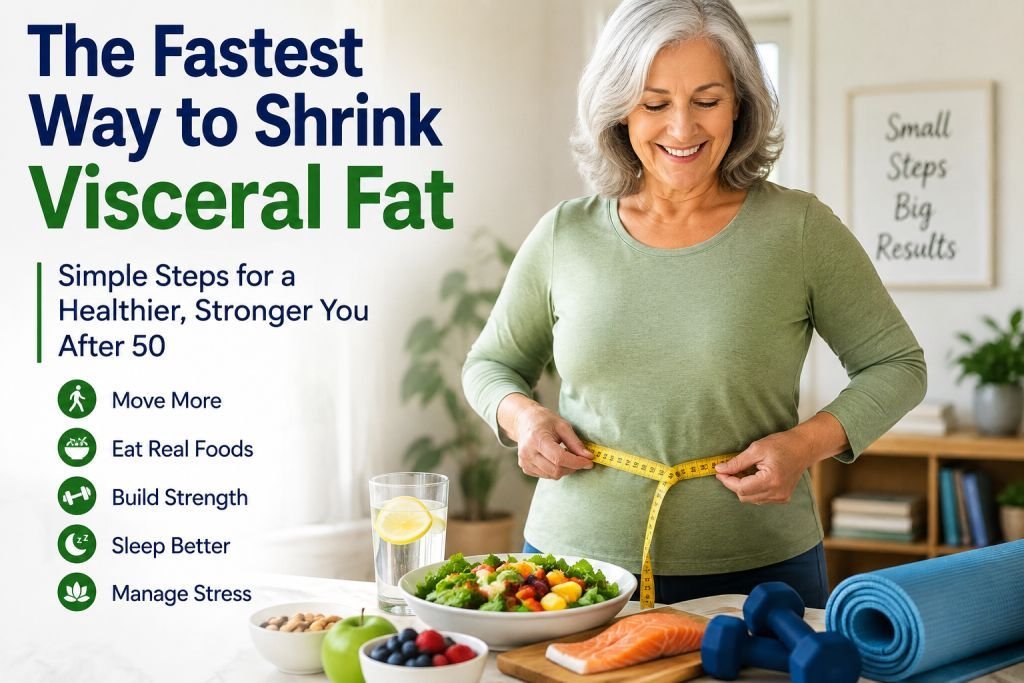
If you’re looking for the fastest way to shrink visceral fat, the answer isn’t a detox drink, fat-burning supplement, or hundreds of crunches. The most reliable approach is a combination of regular aerobic activity, strength training, a nutrient-dense eating pattern, adequate sleep, and gradual weight management.
Visceral fat is the fat stored deep inside the abdomen around organs such as the liver and intestines. Unlike the fat you can pinch under your skin, you can’t easily see or measure visceral fat directly at home. But a growing waistline can be an important clue that you’re carrying more abdominal fat.
For adults over 50, reducing excess visceral fat can be especially worthwhile because body composition tends to change with age. Maintaining muscle while reducing excess body fat becomes more important than simply watching the number on the bathroom scale. The National Institute on Aging recommends combining nutritious eating with regular physical activity as we age.
The good news is that you don’t need a perfect diet or an extreme workout routine. Small, consistent changes can add up. This guide explains what visceral fat is, which habits can help reduce it, what doesn’t work, and how to create a realistic plan after 50.
Quick Answer: What Is the Fastest Way to Shrink Visceral Fat?
The most effective practical strategy is to combine a modest calorie-controlled, nutrient-dense eating pattern with aerobic exercise and strength training.
A good starting point is:
- Walk briskly or perform another moderate aerobic activity most days.
- Aim for at least 150 minutes of moderate activity per week.
- Strength-train at least 2 days per week, adjusting the exercises to your abilities.
- Eat more vegetables, fruits, beans, whole grains, nuts, seeds, and lean protein.
- Reduce sugary drinks, highly processed foods, and excessive portions.
- Get adequate sleep and maintain a regular sleep schedule.
- Limit alcohol.
- Don’t rely on ab exercises to burn belly fat.
- Track your waist measurement and overall health—not just your weight.
Research suggests that aerobic exercise, resistance training, combined training, and high-intensity interval training can all help reduce visceral adipose tissue.
For many adults over 50, however, consistency matters more than choosing the theoretically “fastest” workout.
What Is Visceral Fat?
Visceral fat is a type of body fat stored inside the abdominal cavity. It surrounds internal organs rather than sitting directly beneath the skin.
That’s different from subcutaneous fat, which is the softer fat you can usually pinch around your stomach, hips, thighs, or arms.
You need some body fat for normal health. The problem is having an excessive amount, particularly around the abdomen.
Visceral fat is metabolically active. It can release substances involved in inflammation and metabolism, which is one reason excess visceral fat is associated with health problems such as type 2 diabetes, cardiovascular disease, and fatty liver disease.
Can You See Visceral Fat?
Not directly.
A person can have a relatively normal-looking body and still carry excess visceral fat. Likewise, a larger waist doesn’t tell you exactly how much visceral fat you have.
For everyday tracking, waist circumference can be useful because changes in waist size can provide an indication of changes in abdominal fat.
If you’re concerned about your waist size, blood sugar, cholesterol, blood pressure, or overall metabolic health, your healthcare professional can help interpret those measurements together.
Why Visceral Fat Matters After 50
Getting older doesn’t automatically mean you’ll develop excess visceral fat.
However, aging is often accompanied by changes in activity levels, muscle mass, appetite, sleep, hormones, and body composition. The National Institute on Aging notes that metabolism and body composition can change with age, making healthy eating and physical activity important parts of healthy weight management.
For someone in their 50s, 60s, or 70s, the goal shouldn’t simply be “lose as much weight as possible.”
A better goal is:
Reduce excess fat while protecting muscle, strength, mobility, and nutritional status.
That distinction matters.
Losing weight extremely quickly through severe calorie restriction may also mean losing valuable lean tissue. That’s particularly undesirable as you get older.
Visceral Fat vs. Subcutaneous Fat
| Feature | Visceral Fat | Subcutaneous Fat |
|---|---|---|
| Location | Deep inside the abdomen | Directly beneath the skin |
| Can you pinch it? | No | Usually yes |
| Surrounds organs? | Yes | No |
| Associated with metabolic health risks? | Strongly associated | Generally less metabolically harmful |
| Can exercise help reduce it? | Yes | Yes |
| Can you spot-reduce it? | No | No |
| Best overall strategy | Healthy diet + activity + weight management | Overall fat loss and healthy lifestyle |
The important point is that you cannot choose exactly where your body loses fat first.
Genetics, age, sex, hormones, activity, and overall energy balance all influence where fat is stored and where it comes off.
The 10 Most Effective Ways to Reduce Visceral Fat
1. Create a Sustainable Calorie Deficit
If you have excess body fat, one of the fundamental requirements for losing it is using more energy than you consume over time.
You don’t need to starve yourself.
In fact, extreme dieting can make it harder to maintain muscle and can be difficult to sustain.
Instead, look for small changes that reduce your overall calorie intake without leaving you constantly hungry.
For example:
- Replace soda with water or unsweetened beverages.
- Reduce oversized restaurant portions.
- Eat vegetables or salad before calorie-dense foods.
- Choose fruit instead of sugary desserts more often.
- Measure calorie-dense foods such as oils, nuts, and dressings.
- Include protein at meals.
The goal is a pattern you can maintain for months—not a seven-day crash diet.
2. Walk Briskly and Consistently
Walking is one of the most underrated tools for reducing excess abdominal fat.
It’s accessible, inexpensive, and relatively easy to adjust to your fitness level.
The CDC recommends adults get at least 150 minutes of moderate-intensity aerobic activity per week, along with muscle-strengthening activities on at least two days. Adults 65 and older should also include activities that improve balance.
You could divide that into:
- 30-minute brisk walks, 5 days per week
- Three 10-minute walks throughout the day
- A morning walk plus a shorter walk after dinner
- Walking errands when practical
If you’re currently inactive, start smaller.
Ten minutes of walking is better than deciding you need an hour and doing nothing because an hour feels overwhelming.
3. Add Strength Training
Cardio isn’t the only piece of the puzzle.
Strength training can help preserve and build muscle, which becomes particularly important as you age.
Try exercises such as:
- Chair squats
- Wall push-ups
- Resistance-band rows
- Step-ups
- Light dumbbell presses
- Hip hinges
- Calf raises
You don’t necessarily need a gym.
Resistance bands, dumbbells, machines, or body-weight exercises can all be useful.
A systematic review of 84 randomized controlled trials found that aerobic exercise, resistance training, combined aerobic and resistance training, and HIIT were all beneficial for reducing visceral adipose tissue in people with overweight or obesity.
4. Combine Cardio and Strength Training
If your health and fitness level allow it, combining aerobic and resistance exercise may be particularly useful.
One randomized controlled trial involving older adults with obesity found that combined aerobic and resistance exercise during weight loss produced greater reductions in visceral fat than either aerobic or resistance exercise alone.
That doesn’t mean you need exhausting workouts.
A practical weekly schedule could look like:
| Day | Activity |
|---|---|
| Monday | 30-minute brisk walk + strength |
| Tuesday | 30-minute walk |
| Wednesday | 30-minute walk + strength |
| Thursday | Easy walk or active recovery |
| Friday | 30-minute brisk walk |
| Saturday | Strength + light walking |
| Sunday | Easy walk/rest |
Adjust the duration and intensity according to your fitness and medical situation.
5. Reduce Sugary Drinks
One of the simplest dietary changes is reducing liquid calories.
Regular soda, sweetened tea, energy drinks, flavored coffee drinks, and other sugar-sweetened beverages can add substantial calories without making you feel as full as a whole-food meal.
Try:
- Water
- Sparkling water without added sugar
- Unsweetened tea
- Coffee without large amounts of added sugar
- Water flavored with lemon, lime, cucumber, or berries
You don’t have to completely eliminate every food you enjoy.
The goal is to make high-sugar beverages an occasional choice rather than a daily habit.
6. Eat More Protein and Fiber-Rich Foods
A meal built around protein and fiber is often more satisfying than one dominated by refined carbohydrates.
Good protein choices include:
- Eggs
- Greek yogurt
- Cottage cheese
- Fish
- Chicken
- Turkey
- Tofu
- Tempeh
- Beans
- Lentils
Fiber-rich foods include:
- Oatmeal
- Beans
- Lentils
- Berries
- Apples
- Vegetables
- Whole grains
- Nuts and seeds
For adults over 50, this approach can also help support nutritional quality while you’re trying to manage calories.
7. Choose a Mostly Whole-Food Eating Pattern
There isn’t one magical “visceral fat diet.”
Instead, focus on an overall eating pattern built around minimally processed foods.
A Mediterranean-style pattern is one reasonable example. It emphasizes vegetables, fruits, whole grains, beans, nuts, seeds, olive oil, and other minimally processed foods, with moderate amounts of fish, poultry, eggs, and dairy.
You don’t have to follow a diet perfectly.
Think of your plate as:
½ vegetables and fruit
¼ protein
¼ whole grains or other high-fiber carbohydrates
Then add a reasonable amount of healthy fat.
8. Get Enough Sleep
Sleep may not sound like a fat-loss strategy, but it is part of the bigger picture.
Poor sleep can make healthy eating and regular exercise more difficult. Sleep also interacts with appetite, energy, mood, and daily activity.
Harvard Health recommends adults generally aim for seven to nine hours of sleep, while noting that inadequate sleep can be associated with visceral fat accumulation.
For better sleep:
- Keep a regular bedtime.
- Wake up around the same time each day.
- Keep your bedroom comfortable and dark.
- Avoid heavy meals close to bedtime.
- Limit alcohol, especially near bedtime.
- Exercise regularly.
If you regularly snore loudly, wake up gasping, or feel extremely tired despite enough time in bed, talk with a healthcare professional.
9. Manage Chronic Stress
You don’t have to eliminate stress.
That’s unrealistic.
Instead, find ways to lower your daily stress load and improve your ability to recover from it.
Helpful options may include:
- Walking outdoors
- Deep breathing
- Meditation
- Gardening
- Reading
- Spending time with friends
- Gentle yoga
- Hobbies
- Relaxing music
Chronic stress can affect sleep, eating behavior, and other factors involved in weight management. Harvard Health also notes that stress-related processes can influence abdominal fat and inflammation.
10. Be Patient With the Process
This might be the least exciting advice, but it’s important.
You cannot safely force your body to remove visceral fat overnight.
A plan that works for six months is more valuable than a plan that produces dramatic changes for ten days and then becomes impossible to maintain.
Focus on trends:
- Is your waist gradually decreasing?
- Are you becoming stronger?
- Are you walking more?
- Is your diet improving?
- Are your blood pressure or blood sugar numbers improving?
- Do you feel more energetic?
Those are meaningful signs of progress.
Best Foods for Reducing Belly Fat
No individual food specifically “burns” visceral fat.
However, some foods can make a healthy calorie-controlled diet easier.
Vegetables
Try:
- Broccoli
- Spinach
- Peppers
- Carrots
- Cauliflower
- Green beans
- Tomatoes
- Brussels sprouts
Fruit
Whole fruit provides fiber and nutrients.
Good choices include:
- Berries
- Apples
- Oranges
- Pears
- Kiwi
- Peaches
Fruit doesn’t need to be feared simply because it contains naturally occurring sugar.
Beans and Lentils
Beans and lentils provide a combination of plant protein, fiber, vitamins, and minerals.
Try adding them to:
- Soups
- Salads
- Chili
- Grain bowls
- Tacos
Whole Grains
Consider:
- Oatmeal
- Brown rice
- Barley
- Quinoa
- Whole-grain bread
- Whole-grain pasta
Healthy Fats
Reasonable portions of:
- Avocado
- Nuts
- Seeds
- Olive oil
- Natural nut butter
can fit into a healthy eating pattern.
Remember that healthy fats are still calorie-dense, so portions matter if weight loss is your goal.
Foods and Drinks to Limit
You don’t necessarily need a permanent “forbidden foods” list.
Instead, limit foods that make it easy to consume lots of calories without much nutritional value.
These may include:
- Sugary soda
- Candy
- Cookies
- Pastries
- Highly processed snack foods
- Large portions of fried foods
- Sugar-heavy breakfast cereals
- Sweetened coffee beverages
- Excessive alcohol
- Large portions of refined carbohydrates
The goal isn’t perfection.
If you normally drink two sodas every day, switching to one and eventually replacing most of them with water is meaningful progress.
Exercise Plan for Adults Over 50
If you’re new to exercise, don’t begin with an intense workout because you want fast results.
Start with what you can perform safely and consistently.
Beginner Week
Monday: 20-minute brisk walk
Tuesday: 15-minute strength workout
Wednesday: 20-minute walk
Thursday: Rest or gentle mobility work
Friday: 25-minute walk
Saturday: 15-minute strength workout
Sunday: Easy walk or rest
Over several weeks, gradually increase the duration.
Eventually, work toward the CDC’s recommended 150 minutes of moderate aerobic activity each week, plus muscle-strengthening activity at least two days weekly.
Why Strength Training Matters
Adults over 50 have another reason to care about strength training: maintaining muscle.
When you’re losing weight, you want the weight you lose to come primarily from excess fat rather than valuable lean tissue.
Strength training sends your body a signal to maintain muscle.
It can also support:
- Strength
- Balance
- Everyday mobility
- Bone health
- Independence
NIDDK recommends muscle-strengthening activities at least two days per week for older adults and suggests gradually increasing the challenge.
If you have joint problems, balance difficulties, osteoporosis, heart disease, or another medical condition, ask your healthcare professional what type of exercise is appropriate.
Sleep, Stress, and Visceral Fat
Fat loss isn’t controlled by food alone.
Your daily routine matters.
Imagine two people eating relatively similar diets.
One sleeps seven to eight hours, walks every day, strength trains twice weekly, and has a consistent schedule.
The other sleeps poorly, rarely moves, drinks alcohol frequently, and spends most of the day sitting.
Their results may be very different even if their meals look similar on paper.
That’s why the fastest way to shrink visceral fat isn’t one trick—it is getting several controllable habits working together.
Common Mistakes
Doing Hundreds of Crunches
Abdominal exercises can strengthen your core, but they don’t selectively burn visceral fat.
You can’t tell your body, “Burn the fat from my stomach first.”
Harvard Health specifically notes that spot exercises such as sit-ups can strengthen abdominal muscles but won’t remove visceral fat specifically.
Eating Almost Nothing
Severe calorie restriction isn’t necessary for most people and can make it difficult to meet nutritional needs.
Buying Fat-Burning Supplements
Be skeptical of products promising rapid belly-fat loss.
A supplement isn’t a substitute for an appropriate eating pattern, physical activity, sleep, and medical care.
Exercising Hard Seven Days a Week
More isn’t always better.
Recovery matters, particularly as you get older.
Only Watching the Scale
Your weight can fluctuate because of water, food, sodium, bowel contents, and other factors.
Your waist measurement, strength, fitness, and health markers can provide additional information.
A Simple One-Day Routine
Here’s an example of what a realistic day might look like.
Breakfast
Oatmeal topped with berries, walnuts, and plain Greek yogurt.
Mid-Morning
A brisk 10–15 minute walk.
Lunch
Grilled chicken or beans with a large vegetable salad, whole-grain bread, and a piece of fruit.
Afternoon
Water, unsweetened tea, or coffee without excessive added sugar.
Evening Exercise
A 20–30 minute walk or a short strength-training session.
Dinner
Salmon, tofu, chicken, or beans with roasted vegetables and a moderate serving of brown rice or another whole grain.
Before Bed
A consistent wind-down routine and enough time in bed to get adequate sleep.
This isn’t a prescription or mandatory menu. It’s simply an example of how several small habits can fit together.
Common Myths About Visceral Fat
Myth: You Can Burn Belly Fat With One Exercise
Fact: No exercise selectively removes visceral fat. A combination of aerobic activity, strength training, and healthy weight management is more effective.
Myth: You Need a Detox to Remove Visceral Fat
Fact: Your body already has organs that process and eliminate waste. There is no special detox drink proven to rapidly remove visceral fat.
Myth: Carbs Automatically Cause Belly Fat
Fact: Carbohydrates are not inherently fattening. The type and amount matter. Whole grains, beans, fruits, and vegetables can be part of a healthy eating pattern.
Myth: You Have to Stop Eating After 6 PM
Fact: There is nothing magical about 6 PM. Your overall dietary pattern and calorie intake matter more than an arbitrary clock time.
Myth: Losing Weight Quickly Is Always Better
Fact: Rapid weight loss isn’t automatically better, particularly for older adults who need to protect muscle and maintain adequate nutrition.
Myth: A Flat Stomach Means No Visceral Fat
Fact: Appearance alone cannot tell you exactly how much visceral fat you have.
Myth: If You’re Thin, You Can’t Have Metabolic Problems
Fact: Body weight alone doesn’t tell the whole story. Waist size, blood pressure, blood sugar, cholesterol, family history, and other factors also matter.
Who Should Be More Careful?
Adults over 50 should avoid extreme dieting or suddenly starting intense exercise without considering their individual health.
Talk with a healthcare professional before making major changes if you have:
- Heart disease
- Diabetes
- Kidney disease
- Significant high blood pressure
- Osteoporosis
- Major joint problems
- A history of falls
- Significant obesity
- An eating disorder or history of disordered eating
- Unexplained weight loss
People taking medications for diabetes, blood pressure, or other chronic conditions may also need individualized guidance when making substantial dietary or exercise changes.
If you’re unintentionally losing weight, losing muscle, experiencing persistent fatigue, or having other unexplained symptoms, don’t assume visceral fat is the problem. Get evaluated.
How to Get Started
You don’t need to overhaul your entire lifestyle tomorrow.
Try this five-step approach.
Step 1: Measure Your Waist
Measure your waist consistently using the same technique.
Don’t suck in your stomach.
Use the measurement as a trend rather than obsessing over day-to-day changes.
Step 2: Walk Every Day
Start with whatever duration feels realistic.
Even short walking sessions can help you build toward the recommended weekly activity level.
Step 3: Strength Train Twice a Week
Start with simple exercises that work major muscle groups.
Focus on good form rather than lifting heavy weights.
Step 4: Change Your Drinks
Make water or other unsweetened beverages your default.
This can be one of the easiest ways to reduce unnecessary calories.
Step 5: Build Better Meals
At most meals, include:
Protein + vegetables/fruit + high-fiber carbohydrate + healthy fat
You don’t need to follow a perfect diet.
You need a repeatable one.
Frequently Asked Questions
1. What is the fastest way to shrink visceral fat?
The most effective approach is a combination of regular aerobic activity, strength training, a nutritious calorie-controlled eating pattern, adequate sleep, and sustainable weight management. There is no proven overnight method for eliminating visceral fat.
2. Does walking reduce visceral fat?
Yes, regular walking can contribute to reductions in abdominal and visceral fat, particularly when it helps increase overall physical activity and supports healthy weight management. Walking is also a practical starting point for many adults over 50.
3. How long does it take to reduce visceral fat?
It varies considerably. Age, genetics, starting body composition, diet, activity level, sleep, and overall health all influence the rate of change. Focus on consistent progress over weeks and months rather than expecting results in a few days.
4. Can you lose visceral fat without losing weight?
Yes. Exercise can sometimes reduce visceral fat and improve body composition even when the scale changes little. Harvard Health notes that aerobic exercise may reduce visceral fat even without substantial weight loss.
5. Are crunches good for visceral fat?
Crunches can strengthen your abdominal muscles, but they don’t specifically burn visceral fat. Whole-body physical activity and overall fat loss are more relevant.
6. What foods burn visceral fat?
No single food burns visceral fat. Foods such as vegetables, fruit, beans, whole grains, lean proteins, nuts, and seeds can support a healthy eating pattern that makes fat loss easier.
7. Does drinking water reduce belly fat?
Water doesn’t directly melt visceral fat. However, replacing sugary drinks with water can reduce calorie intake, which may support weight management.
8. Is visceral fat worse than belly fat under the skin?
Visceral fat is generally considered more metabolically harmful than subcutaneous fat because it is associated with inflammation and metabolic health problems.
9. Does strength training reduce visceral fat?
Yes. Research indicates that resistance training can help reduce visceral adipose tissue, and combining resistance and aerobic exercise may be particularly effective.
10. Is intermittent fasting the fastest way to lose visceral fat?
Intermittent fasting can help some people reduce calorie intake and lose weight, but it isn’t necessarily superior for everyone. The most important factor is whether the eating pattern is nutritionally adequate and sustainable.
11. Does alcohol cause belly fat?
Regular excessive alcohol consumption can make weight management more difficult because alcoholic drinks contribute calories and may affect eating and sleep habits. Reducing alcohol can therefore be a useful part of a visceral-fat reduction strategy.
12. Can you lose visceral fat after age 60?
Yes. Older adults can improve body composition and health through appropriate nutrition and physical activity. However, maintaining muscle and avoiding unnecessary nutritional restriction become particularly important with age.
13. What is the best exercise for visceral fat after 50?
There isn’t one universally best exercise. Brisk walking and other aerobic activities are excellent options, while strength training helps preserve muscle. For many people, combining the two is a strong approach.
14. Does sleeping more reduce visceral fat?
Getting adequate sleep may support healthy weight management and metabolic health. Poor sleep can make appetite, energy, and lifestyle habits harder to manage. Aim for a consistent sleep schedule and adequate sleep rather than simply sleeping as long as possible.
15. How can I tell if my visceral fat is decreasing?
You can’t directly measure visceral fat accurately at home without specialized methods. However, a decreasing waist circumference, improving fitness, and favorable changes in health markers can provide useful clues. Your healthcare professional can assess your overall metabolic health more accurately.
Final Takeaway
The fastest way to shrink visceral fat isn’t a special food, supplement, exercise machine, or detox program.
It’s a consistent combination of moving more, strength training, eating mostly nutrient-dense foods, controlling portions, sleeping adequately, and maintaining a healthy weight.
For adults over 50, don’t make the mistake of focusing exclusively on getting smaller. Protecting muscle, strength, balance, and nutritional health matters just as much.
Start with something simple: take a brisk walk today, make your next meal protein- and vegetable-rich, replace a sugary drink with water, and build from there.
Those ordinary habits may not sound dramatic—but done consistently, they’re far more useful than chasing a quick fix.
Medical Disclaimer
This article is intended for general educational and informational purposes only. It is not a substitute for individualized medical advice, diagnosis, or treatment. If you have a chronic medical condition, take prescription medications, are experiencing unexplained weight changes, or plan to make significant changes to your diet or exercise routine, speak with a qualified healthcare professional.
Sources used for health guidance: NIH/NIA, NIDDK, CDC, Harvard Health, and peer-reviewed research.
Also Read –
Salmon Benefits: Powerful Reasons to Eat More Salmon
Blueberries: 25 Powerful Health Benefits for a Healthier Life
30 Super Foods for a Healthier You: Eat Better Every Day
Written by
Kanhaiya Solanki is a dedicated online researcher, content writer, and blogger passionate about publishing high-quality, research-based articles. His goal is to provide accurate, easy-to-understand, and practical information on health, technology, senior care, and lifestyle topics for readers worldwide.CategoriesHealth & Wellness