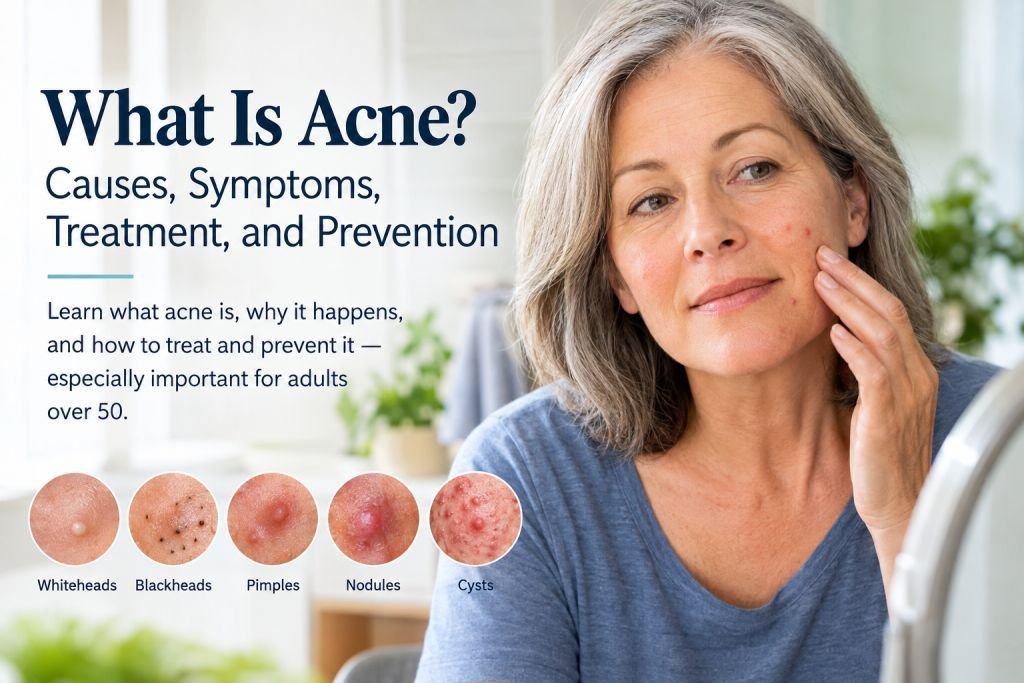
Acne is a common skin condition that happens when hair follicles become clogged with oil, dead skin cells, and other substances. It can cause blackheads, whiteheads, pimples, red bumps, and, in more severe cases, deep painful nodules or cysts.
Although acne is usually associated with teenagers, it can affect adults at almost any age. Some people continue to have acne after adolescence, while others develop it for the first time during adulthood. Adult acne can be particularly frustrating because skin often becomes drier and more sensitive with age.
For adults over 50, a new breakout deserves a little more attention. Acne can still occur, but a sudden acne-like rash may sometimes be related to medications, hormonal changes, skin-care products, or another skin condition. Not every red bump is acne.
This guide explains what acne is, why it happens, what different types look like, how acne is treated, what adults over 50 should know, and when it makes sense to see a dermatologist.
Quick Answer: What Is Acne?
Acne is a skin condition caused by clogged and inflamed hair follicles. Excess oil, dead skin cells, bacteria, and inflammation can work together to produce blackheads, whiteheads, pimples, nodules, and cysts.
Acne is:
- Not contagious
- Not caused by being “dirty”
- Not limited to teenagers
- Often treatable
- Sometimes associated with hormonal changes, medications, skin products, or stress
- Capable of causing permanent scars if severe or repeatedly picked
For adults over 50, especially someone who suddenly develops severe or unusual acne-like bumps, professional evaluation can help determine whether the problem is actually acne.
What Is Acne?
Acne is an inflammatory skin condition involving the hair follicles and oil-producing glands connected to them.
Your skin naturally produces an oily substance called sebum. Sebum helps keep the skin and hair from becoming excessively dry. Problems can arise when too much oil combines with dead skin cells and blocks a hair follicle.
That blockage can produce a whitehead or blackhead. If inflammation develops, the area may become red, swollen, and tender.
More severe inflammation can occur deeper inside the skin, producing painful nodules or cyst-like lesions.
Acne most commonly affects the face, forehead, chest, upper back, and shoulders because these areas contain many oil-producing glands.
The condition is extremely common, but its severity varies considerably from person to person.
How Acne Develops
Acne generally develops through several connected processes rather than one single cause.
1. The skin produces oil
Oil-producing glands release sebum into hair follicles.
Sebum is normal and necessary for healthy skin. The problem occurs when oil production becomes excessive or combines with other substances in a way that promotes blockage.
2. Dead skin cells accumulate
Skin naturally sheds dead cells.
Sometimes these cells mix with sebum and collect inside a follicle. This can create a plug.
3. The follicle becomes clogged
A clogged follicle can appear as a whitehead or blackhead.
A blackhead is not simply dirt. The material inside an open clogged follicle can darken when exposed to air.
4. Inflammation develops
Once a follicle becomes inflamed, it may turn into a red bump or pimple.
Inflammation deeper within the follicle can produce larger, more painful lesions.
5. Severe inflammation can damage the skin
Deep or persistent acne can damage surrounding skin tissue.
This is one reason early treatment can be useful, particularly when acne is painful or repeatedly leaves marks.
What Causes Acne?
There is no single cause of acne.
Four major factors are involved:
- Excess oil production
- Clogged hair follicles
- Changes involving microorganisms in the follicle
- Inflammation
Hormones can influence oil production, which helps explain why acne often appears during puberty and why some adults experience hormonal breakouts.
Other factors can contribute as well.
Hormonal Changes
Hormones called androgens can stimulate oil-producing glands.
Hormonal changes may occur during puberty, pregnancy, perimenopause, menopause, and other periods of hormonal fluctuation.
Adult acne is particularly recognized in women around menopause, although men can also experience adult acne.
Family History
Genetics can influence a person’s tendency to develop acne.
If close family members experienced significant acne, you may have a greater likelihood of developing it yourself.
Certain Medications
Some medications can cause or worsen acne-like eruptions.
Examples reported in medical literature include certain corticosteroids, testosterone-related medicines, lithium, and some other drugs.
If you notice a new rash after starting a medication, do not stop the medication on your own. Instead, ask the prescribing clinician whether the medicine could be contributing to the problem.
Skin and Hair Products
Some oily skin-care or hair-care products can contribute to clogged pores.
Look for terms such as:
- Oil-free
- Non-comedogenic
- Won’t clog pores
- Non-acnegenic
This can be particularly useful if breakouts appear around the forehead, hairline, or areas where products contact the skin.
Stress
Stress does not necessarily cause acne by itself, but research and dermatology guidance indicate that stress can worsen existing acne in some people.
Stress can also affect sleep, eating habits, skin-care routines, and other behaviors that may indirectly affect the skin.
Different Types of Acne
Not every acne lesion looks the same.
| Type | What It Usually Looks Like | Common Characteristics |
|---|---|---|
| Whiteheads | Small white or flesh-colored bumps | Closed clogged pores |
| Blackheads | Small dark spots | Open clogged pores |
| Papules | Small red bumps | Inflamed and often tender |
| Pustules | Red bumps with a white or yellow center | Contain pus |
| Nodules | Large, firm bumps under the skin | Often painful and deep |
| Cyst-like lesions | Deep, painful, swollen bumps | Can increase risk of scarring |
The type of acne matters because different treatments work better for different kinds of breakouts.
Where Does Acne Usually Appear?
Acne commonly develops in areas with many oil-producing glands.
These include:
- Face
- Forehead
- Chin
- Jawline
- Chest
- Upper back
- Shoulders
The location can sometimes provide clues about possible triggers.
For example, repeated bumps along the hairline may be related to hair products, while breakouts where tight equipment repeatedly rubs against the skin may be related to friction.
Why Adults Over 50 Can Still Get Acne
Many people assume acne should disappear completely after the teenage years.
That is not necessarily true.
Some adults continue to experience acne into their 30s and 40s, and some people develop acne for the first time during adulthood.
For women, hormonal changes around perimenopause and menopause can contribute to adult acne.
Adults over 50 may also be using more medications and skin-care products than they did when they were younger. That makes it important to consider whether a new rash could have another explanation.
A New Breakout Is Worth Looking At Carefully
If you are 55 or 65 and suddenly develop several red bumps, don’t automatically assume you have ordinary teenage-style acne.
A dermatologist may need to distinguish acne from conditions such as folliculitis, perioral dermatitis, rosacea, or an acne-like medication reaction.
A sudden and severe acne-like eruption in an older adult deserves medical attention, particularly if it is unusual for that person.
Acne vs. Other Skin Conditions
One of the most important things to understand is that not every pimple-like bump is acne.
| Condition | Possible Appearance | Why Diagnosis Matters |
|---|---|---|
| Acne | Blackheads, whiteheads, pimples, nodules | Often responds to acne treatments |
| Folliculitis | Small inflamed bumps around hair follicles | May require different treatment |
| Rosacea | Facial redness and acne-like bumps | Acne products may irritate the skin |
| Perioral dermatitis | Small bumps around the mouth or facial area | Requires a different approach |
| Medication-related eruption | Sudden acne-like rash | Treating the underlying cause may be important |
This distinction becomes especially useful when acne appears suddenly later in life.
Common Acne Triggers
Several everyday factors can make breakouts more likely or more noticeable.
1. Heavy or Oily Skin Products
Thick creams, oils, pomades, and some cosmetics may contribute to clogged pores.
Choose products labeled non-comedogenic when possible.
2. Friction and Pressure
Repeated rubbing or pressure can contribute to acne-like breakouts.
Possible examples include tight straps, helmets, collars, sports equipment, or repeated contact with certain objects.
3. Picking or Squeezing
It can be tempting to squeeze a pimple when you see it in the mirror.
However, manipulating an inflamed lesion can irritate the skin and increase the risk of discoloration or scarring.
4. Overwashing
Washing your face repeatedly or aggressively scrubbing acne does not necessarily make it disappear faster.
In fact, excessive irritation can make skin more uncomfortable and may worsen breakouts.
5. Stress
Periods of high stress may coincide with acne flare-ups in some people.
Managing stress won’t guarantee clear skin, but adequate sleep, regular physical activity, and healthy routines are worthwhile for overall health.
Does Diet Cause Acne?
Diet and acne is an area where it is easy to find overly simple advice online.
Current evidence does not support the idea that one particular food automatically causes acne in everyone.
Some research suggests that higher-glycemic foods may be associated with acne in certain people, but researchers continue to study the relationship.
A balanced diet is a sensible approach rather than eliminating large numbers of foods without a clear reason.
For adults over 50, that means emphasizing a varied eating pattern containing:
- Vegetables
- Fruits
- Beans and lentils
- Whole grains
- Fish
- Lean protein
- Nuts and seeds
- Adequate fluids
If you notice that a particular food consistently seems to coincide with breakouts, discuss the pattern with a healthcare professional rather than making major dietary restrictions on your own.
How Is Acne Treated?
Acne treatment depends on the type and severity of the condition.
Mild acne may sometimes respond to over-the-counter products, while moderate or severe acne may require prescription treatment.
Benzoyl Peroxide
Benzoyl peroxide can reduce acne-causing bacteria and inflammation.
It is commonly available without a prescription.
Some people experience dryness, irritation, or burning, particularly when they use too much or start too aggressively.
Salicylic Acid
Salicylic acid helps exfoliate the skin and unclog pores.
It can be particularly useful for blackheads and whiteheads.
Adapalene
Adapalene is a topical retinoid that helps prevent clogged pores and can reduce acne.
It is available without a prescription in the United States.
Because retinoid products can irritate the skin, adults with sensitive or dry skin may need to introduce them gradually and follow product directions carefully.
Azelaic Acid
Azelaic acid can help with acne and inflammation and may also help reduce the appearance of dark spots left after some breakouts.
Prescription Treatments
A dermatologist may prescribe stronger or combination treatments when over-the-counter products aren’t enough.
Depending on the situation, treatment may involve topical retinoids, benzoyl peroxide, prescription antibiotics, hormonal approaches for appropriate patients, or other prescription medications.
For moderate-to-severe acne, treatment should be individualized.
Skin-Care Habits That Can Help
A complicated 10-step routine is not necessary for most people.
A simple routine can be easier to maintain.
Morning
- Wash with a gentle cleanser.
- Apply an acne treatment if appropriate.
- Use a non-comedogenic moisturizer if your skin feels dry.
- Apply broad-spectrum sunscreen.
Evening
- Gently cleanse the skin.
- Apply the recommended acne treatment.
- Use moisturizer if needed.
Avoid constantly changing products.
Many acne treatments take several weeks before noticeable improvement occurs. Giving a treatment enough time to work can be more useful than switching products every few days.
Acne Mistakes to Avoid
Scrubbing Your Face Hard
Scrubbing harder does not mean cleaning pores better.
Acne is not caused by dirty skin, and harsh scrubbing can irritate the skin.
Using Toothpaste on Pimples
Toothpaste is designed for teeth, not acne.
It can irritate facial skin and is not considered an appropriate acne treatment.
Popping Deep Pimples
Deep lesions are especially tempting to squeeze, but doing so can increase inflammation and the possibility of scarring.
Starting Several Strong Products at Once
Using benzoyl peroxide, acids, retinoids, scrubs, and other treatments simultaneously can leave your skin irritated.
Start carefully and introduce products gradually when appropriate.
Stopping Treatment Too Quickly
Many acne treatments require several weeks to show meaningful improvement.
If a product is causing severe irritation, however, don’t simply push through it. Ask a healthcare professional or pharmacist how to adjust your routine.
Potential Complications of Acne
Acne is usually not dangerous, but it can cause several problems.
Acne Scars
Deep inflammation can damage the skin and leave permanent scars.
The risk is higher with severe or untreated acne.
Dark or Light Marks
After inflammation disappears, some people develop darker or lighter areas of skin.
These changes can persist for months.
Emotional Distress
Visible acne can affect confidence and social comfort.
This is not simply a cosmetic issue. Persistent or severe acne can affect quality of life.
If acne is making you avoid people, activities, photographs, or social situations, mention this to your healthcare provider.
Benefits of Treating Acne
Treating acne isn’t simply about having clearer-looking skin.
Appropriate treatment can help:
- Reduce new breakouts
- Reduce inflammation
- Lower the chance of severe acne
- Reduce the risk of some acne scars
- Improve comfort when lesions are painful
- Improve confidence and quality of life
The goal is not necessarily perfect skin.
For many people, the practical goal is fewer breakouts, less inflammation, and prevention of permanent skin damage.
When Should Adults Over 50 See a Doctor?
Consider making an appointment with a primary care clinician or dermatologist if:
- Acne suddenly appears for the first time later in life
- Breakouts are severe or painful
- Deep nodules are developing
- Acne is leaving scars
- Over-the-counter treatment isn’t helping
- The rash is spreading quickly
- The bumps look unusual
- You recently started a medication and then developed an acne-like rash
- You aren’t sure whether the condition is actually acne
A dermatologist can often diagnose acne simply by examining the skin, but additional evaluation may be appropriate when the appearance or history is unusual.
A Practical Daily Acne Routine for Adults 50+
Skin tends to become drier and more sensitive with age, so aggressive acne treatment may be especially uncomfortable for some older adults.
A practical routine might look like this:
Step 1: Keep cleansing gentle
Use a mild cleanser rather than harsh soap or abrasive scrubs.
Step 2: Choose one primary acne treatment
Depending on the type of acne, an appropriate ingredient might include salicylic acid, benzoyl peroxide, adapalene, or azelaic acid.
If you have significant skin sensitivity, ask a dermatologist or pharmacist which option makes the most sense.
Step 3: Moisturize
Acne-prone skin can still become dry.
A non-comedogenic moisturizer can help support the skin barrier.
Step 4: Protect your skin from the sun
Use sunscreen appropriate for your skin type.
Sun protection is particularly important when using some acne treatments that can increase sensitivity to sunlight.
Step 5: Be patient
Give an appropriate treatment enough time to work.
If you have no improvement after several weeks, or if your acne is getting worse, professional guidance may be more useful than continuously adding new products.
Real-Life Examples
Example 1: A 52-Year-Old Woman With Jawline Breakouts
A woman in her early 50s notices recurring pimples around her chin and jawline.
She has not changed her diet, but the breakouts seem to come and go.
Because hormonal changes can contribute to adult acne, particularly around menopause, she discusses the pattern with her healthcare provider.
The important point is not to assume that every jawline breakout has the same cause. A proper history and skin examination can help determine the next step.
Example 2: A 67-Year-Old Man With Sudden Red Bumps
A 67-year-old man develops many small red bumps on his face and chest several weeks after starting a new medication.
Rather than assuming the bumps are ordinary acne, he contacts his doctor.
The timing of the eruption makes a medication-related reaction worth considering.
He should not stop an important prescription on his own, but his clinician can determine whether the medication or another condition may be involved.
Example 3: Mild Blackheads in a 58-Year-Old
A 58-year-old has a few blackheads around the nose and forehead but otherwise has healthy skin.
A gentle cleanser, non-comedogenic products, and an appropriate over-the-counter acne treatment may be reasonable options.
If the skin becomes very dry or irritated, the person can reduce irritation and seek professional advice rather than adding more products.
Common Acne Myths
Myth: Acne only affects teenagers.
Fact: Acne can occur in adults and can sometimes continue or begin later in life.
Myth: Acne means your skin is dirty.
Fact: Acne is not caused simply by poor hygiene. Excessive washing and scrubbing may irritate the skin.
Myth: You should pop every pimple.
Fact: Picking and squeezing can increase irritation and may contribute to scarring.
Myth: Chocolate always causes acne.
Fact: There is not enough evidence to say that chocolate automatically causes acne in everyone. Diet-acne relationships are more complicated.
Myth: More acne medicine works faster.
Fact: Using excessive amounts of acne products can irritate the skin. More product does not necessarily mean faster improvement.
Myth: Older adults cannot get acne.
Fact: Acne can occur at different ages, although a new acne-like eruption later in life deserves careful consideration.
Myth: Every red bump is acne.
Fact: Several skin conditions can look similar to acne, including folliculitis and rosacea.
Who Should Be More Careful?
Adults Over 50
Older adults should be particularly cautious about assuming that a new rash is ordinary acne.
Sudden or unusual acne-like eruptions should be evaluated when they are persistent, severe, or associated with a medication change.
People With Sensitive Skin
Acne ingredients can cause dryness, redness, peeling, or irritation.
A simpler routine may be better than combining several strong products.
People Taking Multiple Medications
If a new rash develops after starting or changing medication, mention it to your healthcare provider.
Never discontinue an important prescription without medical guidance.
People With Severe Acne
Large, painful, deep lesions are more likely to cause scarring and often require professional treatment.
How to Get Started
If you think you have acne, begin with a simple approach.
1. Identify what you are actually seeing
Are they blackheads, whiteheads, small pimples, or deep painful bumps?
If you’re uncertain, a dermatologist can help.
2. Simplify your skin care
Use a gentle cleanser and avoid harsh scrubs.
3. Check your products
Look for oil-free or non-comedogenic skin-care and cosmetic products.
4. Avoid picking
Let lesions heal rather than repeatedly touching or squeezing them.
5. Give treatment time
Most acne treatments don’t produce dramatic results overnight.
6. Watch for unusual changes
If acne suddenly appears after age 50, becomes severe, or develops after a medication change, consider professional evaluation.
7. Treat the whole picture
Adequate sleep, regular physical activity, balanced nutrition, stress management, and appropriate skin care all support overall health.
They shouldn’t be viewed as substitutes for medical treatment when treatment is needed.
Frequently Asked Questions About Acne
1. What is acne in simple terms?
Acne is a condition in which hair follicles become clogged and inflamed, producing blackheads, whiteheads, pimples, or deeper bumps.
It commonly affects areas with many oil-producing glands.
2. Can adults over 50 get acne?
Yes. Adults can develop acne even after age 50.
Hormonal changes, medications, skin-care products, and other factors may contribute. A new acne-like rash later in life should sometimes be checked to make sure it is actually acne.
3. Is acne contagious?
No. Acne is not contagious.
You cannot catch acne from another person through ordinary skin contact.
4. Is acne caused by dirty skin?
No.
Acne develops from processes involving oil, clogged follicles, inflammation, and other biological factors. Aggressive washing can actually irritate the skin.
5. What causes acne in adults?
Adult acne can have several contributing factors.
Hormonal changes, genetics, certain medications, stress, and some skin or hair products can play a role.
6. Can stress make acne worse?
Yes, stress may worsen existing acne in some people.
Stress management is therefore useful, although reducing stress alone may not eliminate acne.
7. Does sugar cause acne?
Not necessarily, but diet may influence acne in some people.
Research has examined relationships between high-glycemic eating patterns and acne, but there is no single diet proven to prevent acne for everyone.
8. Should I pop a pimple?
Generally, no.
Popping or squeezing can increase irritation and may raise the risk of scarring or lingering skin discoloration.
9. What is the best acne treatment?
There is no single best treatment for everyone.
The right treatment depends on the type and severity of acne, your age, skin sensitivity, other medical conditions, medications, and other factors.
10. Does toothpaste get rid of acne?
No. Toothpaste is not an appropriate acne treatment.
It can irritate the skin and may make the area more uncomfortable.
11. How long does acne treatment take to work?
Many acne treatments require several weeks before noticeable improvement.
Changing products too quickly can make it difficult to determine what is helping and may increase irritation.
12. Can acne leave scars?
Yes.
Severe or deep acne can damage the skin and leave permanent scars. Dark or light marks can also remain after an acne lesion heals.
13. When should I see a dermatologist for acne?
See a dermatologist if acne is severe, painful, persistent, scarring, unusual, or not improving with appropriate self-care.
A dermatologist can also determine whether a condition that looks like acne is actually something else.
14. Can medication cause acne?
Yes, some medications can cause acne or acne-like eruptions.
If you notice a new rash after starting medication, talk with the prescribing clinician rather than stopping the medicine yourself.
15. Can acne suddenly appear after age 50?
Yes, but sudden new acne after 50 deserves a closer look.
It may be ordinary adult acne, but medication-related eruptions and other skin conditions can sometimes look similar. A healthcare professional can help identify the cause.
Final Takeaway
So, what is acne? It is a common inflammatory skin condition involving clogged and irritated hair follicles. It can cause everything from blackheads and whiteheads to painful deep nodules.
Although acne is most common during adolescence, it does not necessarily disappear with age. Adults can develop or continue to experience acne well into midlife and later adulthood.
For adults over 50, the most useful approach is to avoid assuming every new skin bump is acne. Pay attention to when it started, where it appears, what products or medications have changed, and whether the condition is becoming painful or leaving marks.
A gentle skin-care routine and an appropriate acne treatment can help many people. When breakouts are severe, sudden, persistent, or unusual, a dermatologist can help determine the cause and choose a treatment that fits your skin and overall health.
Medical Disclaimer
This article is provided for general educational and informational purposes only. It is not a substitute for individualized medical advice, diagnosis, or treatment. If you have severe, sudden, persistent, painful, or unusual skin changes—or if you are concerned that a medication may be causing a rash—talk with a qualified healthcare professional or dermatologist.
Also Read:
Written by:
Kanhaiya Solanki is a dedicated online researcher, content writer, and blogger passionate about publishing high-quality, research-based articles. His goal is to provide accurate, easy-to-understand, and practical information on health, technology, senior care, and lifestyle topics for readers worldwide.