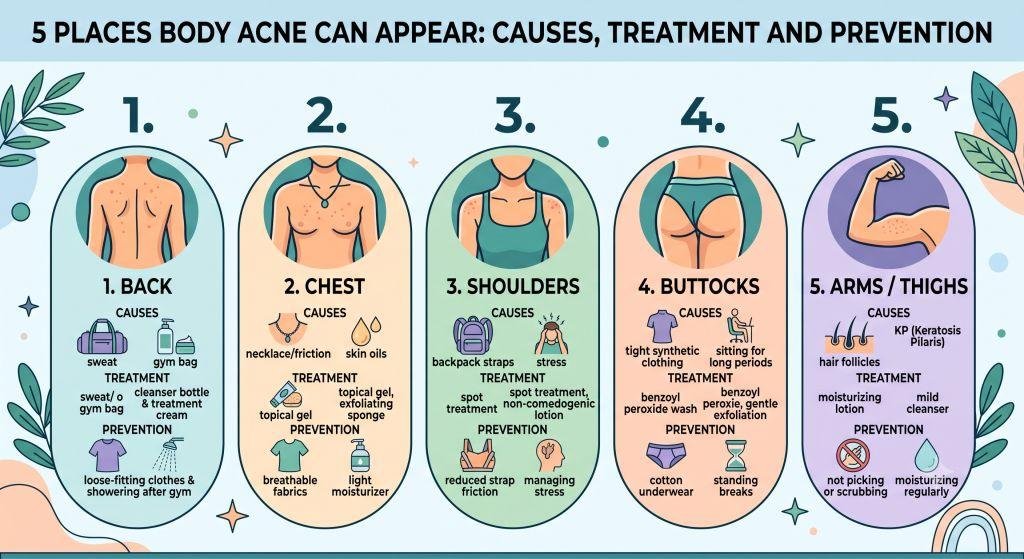
When people think about acne, they usually picture pimples on the face. But acne can develop on other parts of the body, too. The most common areas include the chest, back, shoulders, neck and, in some cases, the buttocks or upper arms. Acne forms when hair follicles become clogged with oil and dead skin cells, followed by inflammation.
For adults over 50, new or persistent body breakouts deserve a little extra attention. Acne is possible at any age, but a sudden change in your skin can sometimes be related to medications, skin products, friction, hormonal changes or another skin condition that looks like acne.
Another important point: not every bump that looks like body acne is actually acne. This is especially true on the buttocks, where folliculitis, keratosis pilaris and boils are often mistaken for pimples.
This guide explains the five common places body acne can appear, what may trigger breakouts in each area, how to care for acne-prone skin, and when it makes sense to see a dermatologist.
Quick Answer: Where Does Body Acne Usually Appear?
The five areas commonly associated with body acne are:
- Chest
- Upper back
- Shoulders
- Neck
- Buttocks and upper-body areas such as the upper arms
The exact location can provide clues about what is contributing to the breakout. Sweat, friction, tight clothing, backpacks, athletic equipment, oily products and certain medications can all play a role.
However, the appearance and location alone cannot always tell you whether you have acne, folliculitis, an ingrown hair or another skin condition.
What Is Body Acne?
Body acne is acne that develops somewhere other than—or in addition to—the face. Like facial acne, it begins inside hair follicles, which are tiny openings in the skin.
Four processes commonly contribute to acne:
- The skin produces excess oil, called sebum.
- Oil and dead skin cells clog the follicle.
- Bacteria living on the skin can contribute to inflammation.
- The immune response creates redness, swelling and pimples.
Body acne is particularly common on areas with many oil-producing glands, including the chest, upper back and shoulders.
It may appear as blackheads, whiteheads, red bumps, pus-filled pimples or, in more severe cases, painful nodules and cysts.
Body acne is not caused simply by being “dirty.” In fact, aggressively scrubbing acne-prone skin can irritate it and make breakouts worse. Dermatologists generally recommend gentle cleansing rather than harsh scrubbing.
The 5 Common Places Body Acne Appears
1. Chest Acne
The chest is one of the most common locations for body acne.
Chest breakouts may appear as small red pimples, whiteheads, blackheads or deeper inflamed bumps. The chest contains numerous sebaceous glands, so oil production can contribute to clogged follicles.
Sweat can make the problem more noticeable, particularly when clothing traps moisture against the skin.
Common contributors include:
- Sweating during exercise
- Tight or non-breathable clothing
- Oily lotions or body products
- Friction from clothing
- Delayed showering after heavy sweating
- Certain medications
If you regularly exercise, changing out of sweaty clothing and showering afterward can help reduce the combination of sweat, oil and friction that may aggravate breakouts.
2. Upper Back Acne
Back acne, sometimes casually called “bacne,” is one of the most recognizable forms of body acne.
It may occur across the upper back, shoulders and sometimes farther down the torso. Back acne can include whiteheads, blackheads, red pimples and painful deeper lesions.
The back can be especially challenging because it is difficult to see and reach.
Friction is an important consideration. Backpacks, tight shirts, sports equipment and sweaty clothing can rub against the skin and contribute to breakouts.
If you have trouble reaching your back, a long-handled applicator can make it easier to apply a topical product evenly.
For mild to moderate back acne, dermatologists may recommend over-the-counter ingredients such as benzoyl peroxide or adapalene, depending on the person’s situation.
3. Shoulder Acne
Shoulder acne often overlaps with acne on the upper back and chest.
One reason shoulders can be troublesome is friction. A backpack strap, purse strap, tight shirt or athletic equipment may repeatedly rub against the same area.
Sweat trapped underneath clothing can add another source of irritation.
If your breakouts appear primarily where a strap or piece of equipment touches your skin, consider whether reducing that friction makes a difference.
Practical steps include:
- Wearing comfortable, breathable clothing
- Washing workout clothes after each use
- Changing out of sweaty clothes promptly
- Cleaning equipment that touches the skin
- Avoiding unnecessary rubbing or scratching
- Choosing non-comedogenic skin products
Non-comedogenic means a product is formulated to be less likely to clog pores.
4. Neck Acne
The neck can develop acne, particularly along areas exposed to hair products, skin-care products, sweat or friction.
Hair oils, conditioners and styling products can sometimes come into contact with the neck. Collars, scarves and other clothing can also create repeated friction.
Neck bumps can be confusing because several different conditions can resemble acne.
For example, an itchy or uniform rash may not behave like ordinary acne. Shaving can also produce ingrown hairs or folliculitis, which may look like pimples.
If the bumps keep returning despite reasonable acne care, it is worth having them evaluated rather than repeatedly adding stronger products.
5. Buttocks and Upper Arms: When “Body Acne” May Be Something Else
People commonly describe bumps on the buttocks as “butt acne,” but they are often not acne at all.
Cleveland Clinic notes that folliculitis, keratosis pilaris and boils are common explanations for acne-like bumps in this area.
Folliculitis means inflammation around a hair follicle. It can produce small red or pus-filled bumps.
Keratosis pilaris produces small, rough bumps and is commonly associated with the upper arms and thighs.
This distinction matters because the treatment for these conditions may differ from standard acne treatment.
If the bumps are painful, repeatedly infected, intensely itchy or leaving scars, ask a healthcare professional for an accurate diagnosis.
How the Five Areas Compare
| Area | Common contributors | What to watch for |
|---|---|---|
| Chest | Sweat, oil, clothing, skin products | Repeated inflamed pimples |
| Upper back | Sweat, friction, backpacks, sports equipment | Deep or painful lesions |
| Shoulders | Straps, friction, sweat | Breakouts matching equipment or clothing |
| Neck | Hair products, collars, shaving, sweat | Ingrown hairs or unusual rash |
| Buttocks/upper arms | Friction, folliculitis, keratosis pilaris | Bumps that may not actually be acne |
The location can provide useful clues, but it is not enough to diagnose the condition by itself.
What Causes Body Acne?
Excess Oil and Clogged Hair Follicles
Oil is a normal and useful part of healthy skin. Problems can arise when excess oil combines with dead skin cells and blocks hair follicles.
That is the basic process behind many acne breakouts.
Sweat and Trapped Moisture
Sweat itself is not necessarily the cause of acne. The problem is often what happens afterward.
Sweat trapped beneath clothing, combined with friction and oil, can create an environment that aggravates acne-prone skin.
Friction and Pressure
Repeated rubbing is a common problem for body acne.
Backpacks, sports equipment, tight clothing and straps can all irritate acne-prone areas. This type of breakout is sometimes referred to as acne mechanica.
Skin and Hair Products
Heavy or oily products can contribute to clogged pores in some people.
Look for labels such as:
- Oil-free
- Non-comedogenic
- Won’t clog pores
This can be especially helpful when choosing moisturizers, sunscreens and other products for acne-prone skin.
Medications
Some medications can trigger or worsen acne-like eruptions.
Corticosteroids are one example. Certain hormones and other medications have also been associated with drug-induced acne.
If your breakout began soon after starting a medication, do not stop the medication on your own. Ask the prescribing clinician whether the medicine could be contributing.
Hormonal Changes
Hormones can influence oil production and acne.
Although acne is more common during adolescence, adults can develop acne as well. Adult acne may persist or appear later in life.
Signs It May Not Be Acne
One of the most useful things you can do is avoid assuming that every red bump is a pimple.
Consider another diagnosis when:
- The bumps are extremely itchy.
- They all look nearly identical.
- They appeared suddenly after a new medication.
- They are concentrated around individual hairs.
- They repeatedly become boils.
- They occur mainly on the buttocks and resemble rough, uniform bumps.
- The skin is very painful, warm or increasingly swollen.
- There is drainage or another sign of infection.
Folliculitis, keratosis pilaris and other skin disorders can resemble acne. A dermatologist can distinguish among them by examining the skin and considering your symptoms and medical history.
How to Treat Mild Body Acne
Treatment depends on the type and severity of the acne.
Start With Gentle Cleansing
Wash acne-prone skin gently rather than aggressively scrubbing it.
Avoid rough loofahs, stiff brushes, abrasive scrubs and harsh antibacterial products if they irritate your skin. Dermatologists specifically caution that excessive irritation can worsen acne.
Consider Benzoyl Peroxide
Benzoyl peroxide is an established acne treatment that reduces acne-associated bacteria and is commonly used for body acne.
For back acne, the American Academy of Dermatology recommends benzoyl peroxide washes as one over-the-counter option for mild to moderate cases. Allowing a wash to remain on the skin briefly before rinsing can improve its effectiveness.
It can also bleach fabrics, so use care with towels, clothing and bedding.
Consider Adapalene
Adapalene is an over-the-counter topical retinoid that helps prevent clogged pores.
It may be useful for some people with acne, including back acne, but older or sensitive skin may become irritated more easily.
Start cautiously and follow the product directions.
Moisturize If Your Skin Becomes Dry
It may seem strange to moisturize acne-prone skin, but overly dry or irritated skin can become harder to manage.
The American Academy of Dermatology recommends oil-free, non-comedogenic moisturizers for people whose acne treatments cause dryness.
This can be particularly relevant for adults over 50 because aging skin generally becomes thinner and drier and may be more easily irritated.
Body Acne and Skin Care After 50
Skin care often needs to change with age.
A product that was easy to tolerate at 25 may cause excessive dryness or irritation at 55 or 65.
For adults over 50:
Choose Gentle Products
Look for fragrance-free and non-comedogenic products when possible.
Avoid Over-Scrubbing
Scrubbing harder does not mean cleaning better. It can damage the skin barrier and increase irritation.
Use Warm Rather Than Very Hot Water
Very hot showers can worsen dryness. The American Academy of Dermatology recommends warm water and gentle cleansing for mature skin.
Pay Attention to New Breakouts
A sudden outbreak of severe acne later in life deserves more attention than an occasional isolated pimple.
Mayo Clinic notes that sudden severe acne in an older adult can sometimes signal an underlying problem requiring medical evaluation.
Review Your Medications
If the breakout appeared after a medication change, mention it to your healthcare professional.
Do not discontinue prescription medication without medical guidance.
Common Mistakes That Can Make Breakouts Worse
Scrubbing Until the Skin Feels “Squeaky Clean”
That feeling may actually indicate excessive removal of the skin’s natural oils.
Picking or Popping Pimples
Squeezing can increase inflammation and raise the risk of scarring.
Staying in Sweaty Clothes
Change into clean, dry clothing after exercise or heavy sweating.
Using Too Many Acne Products
More products do not necessarily mean faster results.
The AAD recommends giving a reasonable treatment time and avoiding a constant cycle of adding new products, which can irritate the skin.
Ignoring Friction
If acne repeatedly occurs exactly where a backpack strap or piece of athletic equipment rubs, changing the source of friction may be as important as changing your cleanser.
Potential Benefits of a Consistent Routine
A simple, consistent routine can help in several ways.
Fewer Clogged Pores
Appropriate acne treatments can help prevent follicles from becoming blocked.
Less Inflammation
Ingredients such as benzoyl peroxide can reduce acne-associated bacteria and inflammation.
Better Skin Comfort
Gentle cleansing and appropriate moisturizing can reduce the dryness and irritation that sometimes accompany acne treatments.
Lower Risk of Scarring
Controlling significant inflammatory acne early may reduce the chance of long-lasting scars. Deep nodules and cysts deserve professional treatment because they have a higher risk of scarring.
Practical Daily Action List
For many adults with mild body acne, the following habits are reasonable starting points:
- Shower after heavy exercise or sweating.
- Change sweaty clothes promptly.
- Wash workout clothing after each use.
- Choose loose-fitting or sweat-wicking clothing.
- Avoid repeatedly rubbing acne-prone skin.
- Use gentle cleansers.
- Look for non-comedogenic skin products.
- Avoid picking pimples.
- Moisturize dry skin with an appropriate product.
- Give an acne treatment time to work.
- See a dermatologist if acne is painful, deep, widespread or persistent.
These habits are more sustainable than trying to completely strip oil from your skin.
Real-Life Examples
Example 1: The Active 55-Year-Old
Imagine a 55-year-old who develops small pimples across the upper back after starting a new exercise routine.
Instead of scrubbing the back aggressively, a better approach may be to shower soon after exercising, change out of sweaty clothing, wash workout clothes after use and consider an appropriate acne cleanser.
If painful nodules develop, professional evaluation is more appropriate than simply increasing over-the-counter products.
Example 2: New Breakouts After a Medication Change
A 62-year-old notices sudden acne-like bumps a few weeks after starting a new medication.
Rather than assuming it is ordinary acne, the person should tell the prescribing clinician. Some medications can cause acne or acne-like eruptions.
Example 3: Persistent Buttock Bumps
A 58-year-old has recurring red bumps on the buttocks that are sometimes tender.
Calling these “butt acne” may be misleading. Folliculitis or another condition may be responsible, so a healthcare professional can determine the appropriate treatment.
Common Myths
Myth: Body acne means you are not washing enough.
Fact: Acne is not simply a hygiene problem. Excess oil, clogged follicles, inflammation, hormones, friction and other factors can all contribute.
Myth: Scrubbing harder will clear body acne.
Fact: Harsh scrubbing can irritate acne-prone skin and make breakouts worse.
Myth: Acne only affects teenagers.
Fact: Acne can affect adults of all ages.
Myth: Every bump on the buttocks is acne.
Fact: Folliculitis, keratosis pilaris and boils are common causes of acne-like bumps in this area.
Myth: Drying your skin out completely is the best treatment.
Fact: Excessive dryness can increase irritation. Acne-friendly moisturizers can be useful, particularly when treatments cause dryness.
Myth: You should stop a medication if it causes acne.
Fact: Some medications can contribute to acne, but you should discuss the problem with your healthcare professional rather than stopping a prescribed medication yourself.
Myth: Natural products are automatically safer.
Fact: “Natural” does not guarantee that a product will be non-irritating or non-comedogenic. Mature skin may be especially sensitive to fragrances and irritating ingredients.
Who Should Be More Careful?
Adults Over 50
New, persistent or severe acne should not automatically be treated as ordinary teenage-style acne. A healthcare professional may want to consider medications, hormonal factors and other possible causes.
People With Sensitive or Very Dry Skin
Benzoyl peroxide, retinoids and other acne treatments can cause dryness or irritation. Start cautiously and follow label directions.
People Taking Multiple Medications
If acne-like bumps begin after a medication change, ask your healthcare provider whether a drug reaction could be involved.
People With Deep or Painful Lesions
Large, painful nodules or cysts can scar and may require prescription treatment.
People With Signs of Infection
Increasing warmth, swelling, severe pain, drainage or fever warrants medical attention rather than repeated home treatment.
How to Get Started
You do not need a complicated 10-step routine.
Step 1: Identify the Location
Note whether your breakouts are mainly on the chest, back, shoulders, neck, buttocks or another area.
Step 2: Look for a Trigger
Think about recent changes such as:
- A new medication
- New skin-care products
- New laundry products
- Increased exercise
- A backpack or sports equipment
- Tighter clothing
- More sweating
Step 3: Simplify Your Skin Care
Use a gentle cleanser and avoid harsh scrubbing.
Step 4: Choose One Evidence-Based Treatment
For mild acne, an over-the-counter product containing benzoyl peroxide or adapalene may be an option for some adults. Follow the product directions and give it time rather than changing products every few days.
Step 5: Protect Your Skin Barrier
If treatment causes excessive dryness, use an oil-free, non-comedogenic moisturizer.
Step 6: Know When to Get Help
If acne is deep, painful, widespread, scarring or not improving, make an appointment with a dermatologist.
Frequently Asked Questions
1. What are the five common places body acne appears?
The most common areas discussed are the chest, upper back, shoulders, neck and areas such as the buttocks or upper arms. However, bumps in the last category are often caused by conditions other than acne.
2. Why do I suddenly have body acne?
Possible contributors include sweating, friction, skin products, hormonal changes and medications. A sudden severe outbreak in an older adult deserves medical evaluation.
3. Is body acne common in adults over 50?
It can occur, although acne is more common in younger people. New acne later in life should be assessed in context, particularly if it is sudden or severe.
4. Is back acne the same as facial acne?
The underlying acne process is similar, but treatment can be more challenging because the skin on the back is harder to reach and may experience more friction and sweating.
5. Can sweat cause body acne?
Sweat itself is not necessarily the sole cause, but trapped sweat, friction and clothing can aggravate acne-prone skin. Showering and changing clothes after heavy sweating can help.
6. Should I scrub body acne?
No. Gentle cleansing is generally preferable to aggressive scrubbing because irritation can make acne worse.
7. Can benzoyl peroxide help body acne?
Yes. Benzoyl peroxide is an evidence-based acne treatment and is commonly used for mild to moderate body acne, including back acne.
8. Can body acne leave scars?
Yes. Deep inflammatory acne, especially nodules and cysts, can leave permanent scars. Early treatment can help reduce the risk of lasting skin damage.
9. Why do I have pimples on my buttocks?
They may not actually be pimples. Folliculitis, keratosis pilaris and boils are common causes of bumps in this area.
10. Can clothing make body acne worse?
Yes. Tight clothing and equipment that repeatedly rub against the skin can contribute to or worsen breakouts.
11. Should I moisturize if I have body acne?
You can. If acne treatment makes your skin dry, an oil-free, non-comedogenic moisturizer can help reduce dryness without unnecessarily clogging pores.
12. How long does body acne take to improve?
It usually does not disappear overnight. Acne treatments often require consistent use for several weeks, and deeper acne can take considerably longer. If the condition is worsening or leaving scars, seek professional care rather than simply waiting.
13. Can medications cause body acne?
Yes. Several medications have been associated with acne or acne-like eruptions, including corticosteroids and certain hormonal or other drugs.
14. When should I see a dermatologist for body acne?
See a dermatologist if you have deep or painful pimples, significant scarring, widespread breakouts, recurrent acne, severe inflammation or acne that does not improve with appropriate over-the-counter care.
15. Is body acne a sign of poor health?
Not necessarily. Acne is a skin condition with multiple contributing factors and is not simply a reflection of cleanliness or overall health. However, sudden severe acne—particularly later in life—can sometimes warrant evaluation for an underlying cause.
Final Takeaway
Body acne can appear in several places, but the chest, upper back, shoulders, neck and buttocks/upper arms are important areas to recognize. The cause is not always the same from one location to another.
Sweat, friction, clogged follicles, skin products and certain medications can contribute to breakouts. At the same time, some bumps—especially on the buttocks—may be folliculitis or another condition rather than true acne.
For adults over 50, the best approach is usually simple: use gentle skin care, avoid unnecessary friction, change out of sweaty clothing, choose non-comedogenic products and avoid picking at lesions. If acne is sudden, severe, painful, persistent or leaving scars, professional evaluation is worthwhile.
Understanding where body acne appears is useful, but understanding why those particular areas are breaking out is what can lead to better treatment.
Medical Disclaimer
This article is for general educational and informational purposes only. It is not a substitute for individualized medical advice, diagnosis or treatment. If you have a new, severe, painful or persistent skin condition—or if you are taking medications and notice significant changes in your skin—speak with a qualified healthcare professional or dermatologist.
Also Read:
Written by:
Kanhaiya Solanki is a dedicated online researcher, content writer, and blogger passionate about publishing high-quality, research-based articles. His goal is to provide accurate, easy-to-understand, and practical information on health, technology, senior care, and lifestyle topics for readers worldwide.